

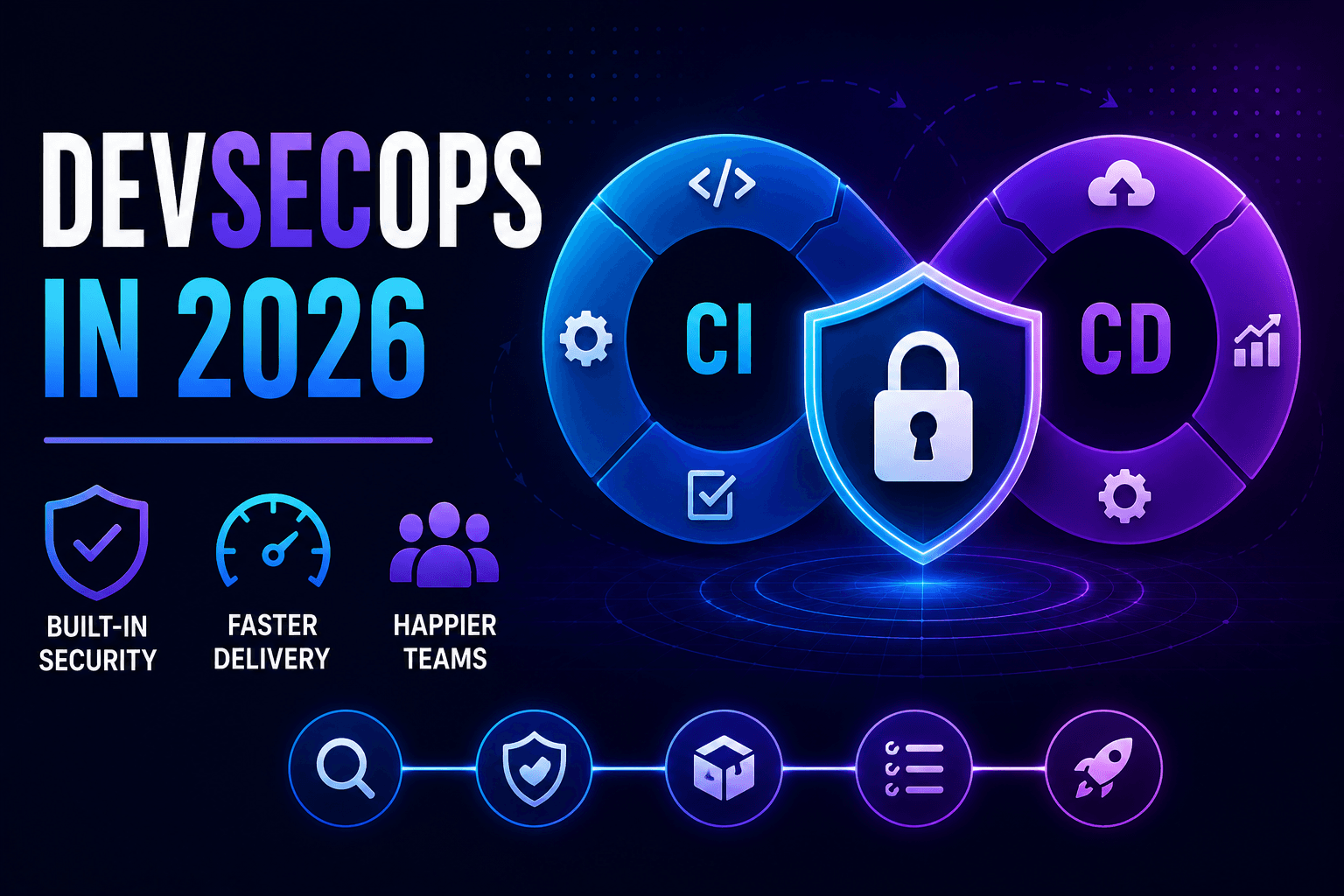
Security used to be the last step before shipping. A separate team would review the code, flag issues, and often send everything back for fixes. Sound familiar?
That model is broken. And in 2026, it is costing companies far more than just time.
The good news? Building security into your pipeline does not have to slow your team down. When done right, it actually speeds things up by catching problems when they are cheapest and easiest to fix
Why Is the Old Security Model Failing Teams Today?

Development teams are shipping faster than ever. Many organizations adopt DevSecOps consulting services to integrate security into development workflows without slowing release velocity. But most security processes have not kept up.
Here is what that gap looks like in practice:
- Code gets written and merged quickly, but security reviews happen days or weeks later
- Vulnerabilities found late in the cycle are 6x more expensive to fix than those caught at the code stage
- AI-assisted coding tools (Copilot, Cursor, etc.) are producing more code with more dependencies, but with less human scrutiny per line
- Compliance requirements like SOC 2, ISO 27001, and new AI-specific regulations are tightening, not loosening
As organizations adopt AI development tools, many are also exploring AI-powered cloud infrastructure management to improve operational efficiency. The problem is not that security is hard. The problem is that it is being applied at the wrong stage.
The result: Security becomes a bottleneck. Developers resent it. Releases get delayed. And critical issues still slip through.
What Does "Shift Left" Actually Mean?
You have probably heard the phrase "shift left security." It simply means: catch security issues earlier in your development process, not at the end.
Here is how security should map across a modern CI/CD pipeline:
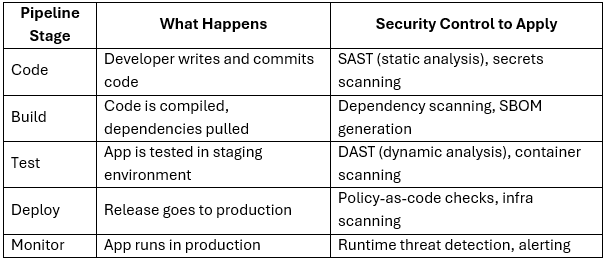
Most teams only apply security at the deploy or monitor stage. Shifting left means moving controls to the code and build stage, where issues are smaller, faster to fix, and do not block a release at the last minute.
DevSecOps Best Practices to Improve Security Without Slowing Developers?
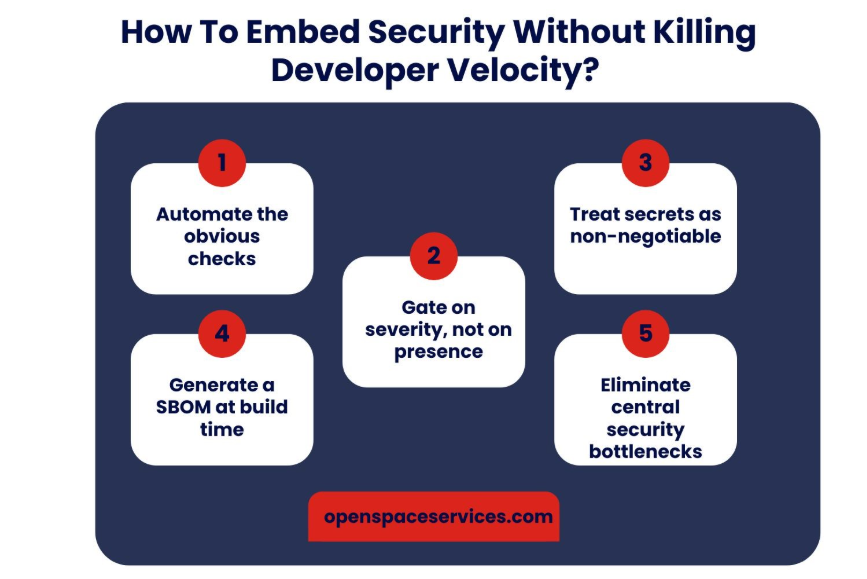
This is the question most brands actually care about. Here are five DevOps security best practices:
1. Automate the obvious checks
Tools like Snyk, Semgrep, and Trivy can be integrated directly into pull requests. A developer gets security feedback at the same time as linting feedback, in the same interface they already use. No extra steps, no separate portals.
2. Gate on severity, not on presence
Blocking a release every time any vulnerability is found will burn developer trust fast. Instead, use policy-as-code tools like Open Policy Agent (OPA) to define which severity levels block a pipeline.
- Critical and high? Block.
- Medium and low? Flag and log but let the build proceed.
3. Treat secrets as non-negotiable
Hardcoded API keys, passwords, and tokens in code remain one of the most common causes of breaches. Tools like GitGuardian or native GitHub secret scanning should be commit-level hooks, not optional add-ons.
4. Generate a Software Bill of Materials (SBOM) at build time
An SBOM is a list of every component, library, and dependency in your software. Regulators and enterprise customers are increasingly asking for them. Automating SBOM generation at build time means you always have one ready, and you are not scrambling to produce it manually when someone asks.
5. Stop routing everything through a central security team
A single AppSec team reviewing every security issue across 10 product squads is a guaranteed bottleneck. Embed a "security champion" in each squad instead. This is a developer with some security training who can handle first-line triage and context, and escalate only what genuinely needs expert input.
What Should Your 2026 DevSecOps Toolchain Look Like?
You do not need every tool on the market. In DevSecOps 2026, you need the right tools for your maturity level.
Tier 1: Start here (non-negotiable)
- Secrets scanning
- Dependency vulnerability scanning
- Container image scanning
Tier 2: As you scale
- DAST in staging environments (OWASP ZAP, Burp Suite)
- Policy-as-code enforcement (OPA, Rego)
- Supply chain integrity checks (SLSA framework)
Tier 3: Emerging in 2026
- AI-assisted code review specifically for security anti-patterns
- LLM prompt injection scanning for teams building AI-native features
NOTE: More tools does not mean more security. Tool sprawl creates noise, alert fatigue, and gaps between systems that no one owns. Consolidation and signal-to-noise ratio matter more than coverage breadth.
A Real-World Example: What This Looks Like in Practice
Consider a SaaS company with a 15-person engineering team shipping weekly. Previously, security reviews happened before each release, led by one senior developer who wore the "security hat" alongside their regular work.
After restructuring their pipeline:
- Snyk was added to their GitHub PR workflow, catching vulnerable npm packages before merge
- A secrets scanner was added as a pre-commit hook, immediately flagging a hardcoded staging key that had been sitting in a config file for three months
- Severity-based gating meant only critical issues blocked releases, reducing security-related release delays by roughly 70%
- One developer per squad went through a two-day security training and became the first point of contact for triage
The security function did not get smaller. It got distributed, automated, and faster.
Is Security Culture More Important Than Security Tooling?
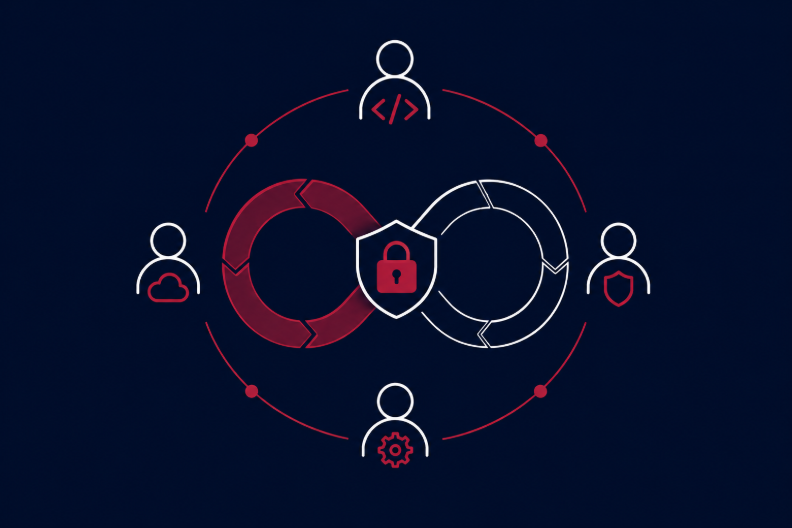
Honestly, yes. Tools only work if people use them properly and take ownership of what they flag.
A few things that make a real difference:
Security champions model
One trained developer per squad who handles first-line triage, promotes secure coding habits, and escalates only what needs specialist input. Rotate the role quarterly so the knowledge spreads.
Blameless security post-mortems
When a vulnerability is found or a breach occurs, treat it like an infrastructure outage. Ask: what system or process allowed this to happen? Not: who made the mistake? People will hide problems if they fear blame.
Developer experience is a security metric
If your security tooling is slow, noisy, or hard to act on, developers will find ways around it. Measure friction, not just coverage. A tool with 60% adoption beats a tool with 100% theoretical coverage and 20% actual use.
Track the right numbers:
- Mean time to remediate (MTTR) for vulnerabilities
- Percentage of issues caught pre-production vs in production
- Number of security-related release blockers per sprint
Where Should you Start if you are Building this from Scratch?
Do not try to do everything at once. Here is a practical three-phase approach:
Phase 1: Lay the foundation (Weeks 1 to 4)
- Add secrets scanning to all repositories
- Integrate a dependency scanner into your CI pipeline
- Define a severity policy so developers know what blocks and what does not
Phase 2: Expand coverage (Months 2 to 3)
- Add SAST to pull request workflows
- Start generating SBOMs at build time
- Identify and train one security champion per squad
Phase 3: Mature and measure (Month 4 onwards)
- Introduce DAST in your staging environment
- Build dashboards tracking MTTR and pre-production catch rate
- Run your first blameless security post-mortem
Security at Speed Is a Maturity Milestone, not a Trade-Off
Many engineering teams use DevOps best practices for growing teams to balance release velocity, cloud efficiency, and security governance.
The tension between security and developer velocity is real, but it is a symptom of poor integration, not an unavoidable reality.
Teams that treat security as a separate function will keep fighting that tension. Teams that build it into their daily workflow, automate the repetitive checks, and distribute ownership across squads will find that security supports speed rather than blocking it.
The goal is not a perfectly secure pipeline overnight. The goal is a pipeline that gets measurably more secure with every sprint, without making your developers' lives harder.
Ready to Build Security into Your Pipeline?
At OpenSpace Services, we help engineering teams embed security into their CI/CD pipelines without disrupting the way they work. Our end-to-end DevOps services help organizations build scalable, secure, and automated delivery pipelines. As AWS-certified DevSecOps specialists, we have hands-on experience designing and implementing pipelines that are fast, compliant, and secure by default.
Whether you are starting from scratch or maturing an existing setup, our team brings the expertise to:
- Audit your current CI/CD pipeline and identify security gaps
- Design and implement the right toolchain for your stack and team size
- Set up automated security controls across every stage of your pipeline
- Train your developers and establish a security champions program
- Ensure your pipeline meets compliance requirements like SOC 2 and ISO 270
No generic frameworks. No one-size-fits-all templates. Just practical DevSecOps built around your team. Contact us today!