
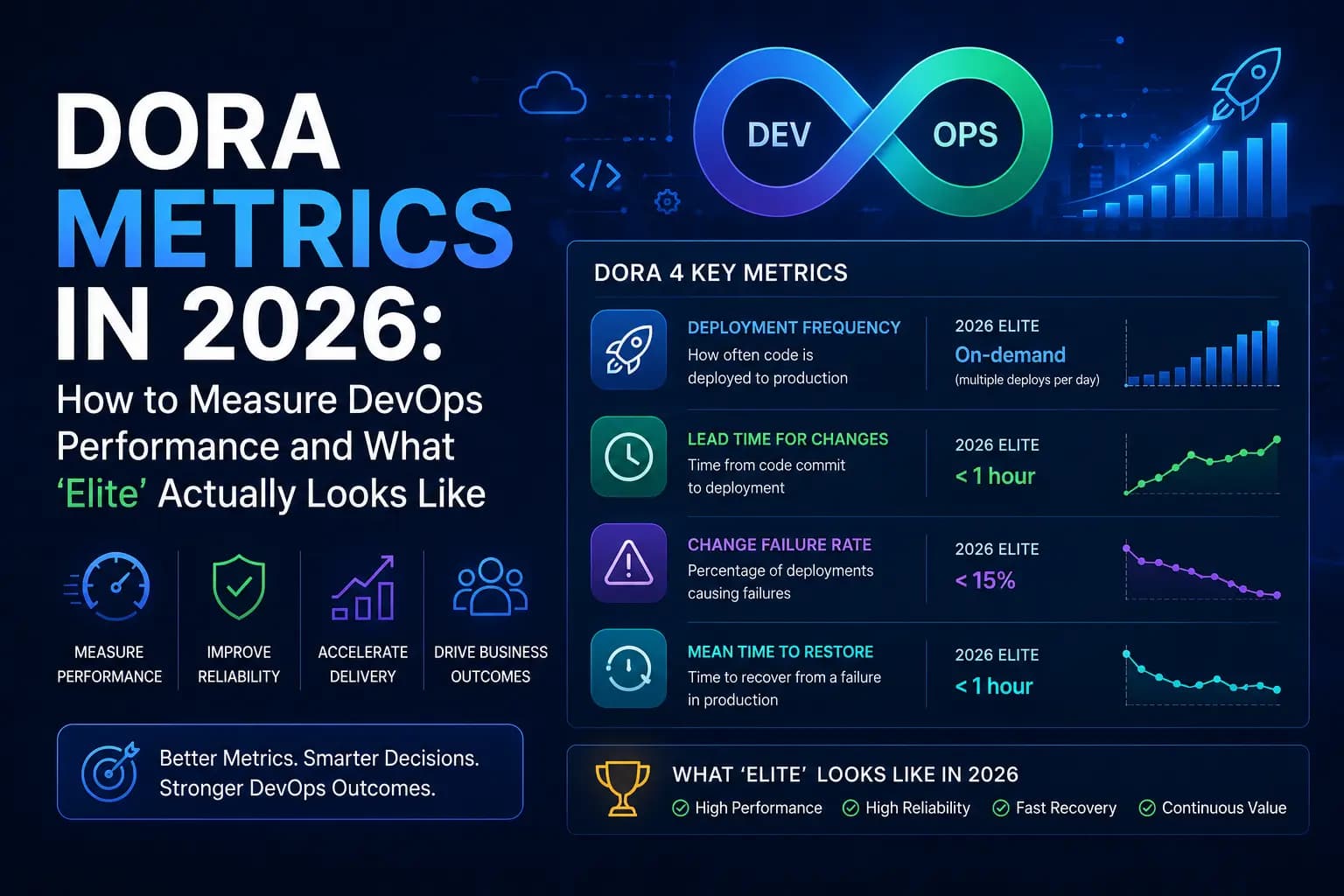
In 2026, the real DevOps question is no longer, “Are we shipping faster?” It is, “Can we prove that faster shipping is also reliable, measurable, and worth the investment?”
That is where DORA metrics 2026 become essential. They help CTOs and engineering managers measure how often teams deploy, how quickly code reaches production, how many releases fail, how fast teams recover, and how much effort goes into rework.
With AI-assisted development increasing code velocity, leaders also need to understand how AI is reshaping DevOps and cloud infrastructure before scaling automation too quickly. Speed alone is no longer enough. This is especially important when DevOps automation is expected to improve deployment speed, cloud efficiency, and security together.
In this blog, we’ll break down what DORA metrics mean in 2026, how to measure each one, what “elite” DevOps performance looks like, which tools can track them, and how to use these numbers in board-level DevOps maturity and budget conversations.
Key Takeaways
- DevOps Research and Assessment i.e., DORA metrics (Deployment Frequency, Lead Time, Change Failure Rate, MTTR/FDRT) are the industry-standard for measuring DevOps performance.
- In 2026, only 16.2% of organizations achieve the elite benchmark of on-demand deployment frequency. (DORA 2025 Research)
- The 2025 DORA report shifted from 4 static tiers to richer percentile distributions; “elite” is now the top 15%.
- Elite DORA performance correlates with 2x likelihood of meeting organizational goals, 50% higher market cap growth, and 2.5x faster time to market.
- AI adoption improves deployment throughput but can increase delivery instability — DORA measurement is more important, not less, in the AI era.
What Are DORA Metrics and Why Do They Matter in 2026?
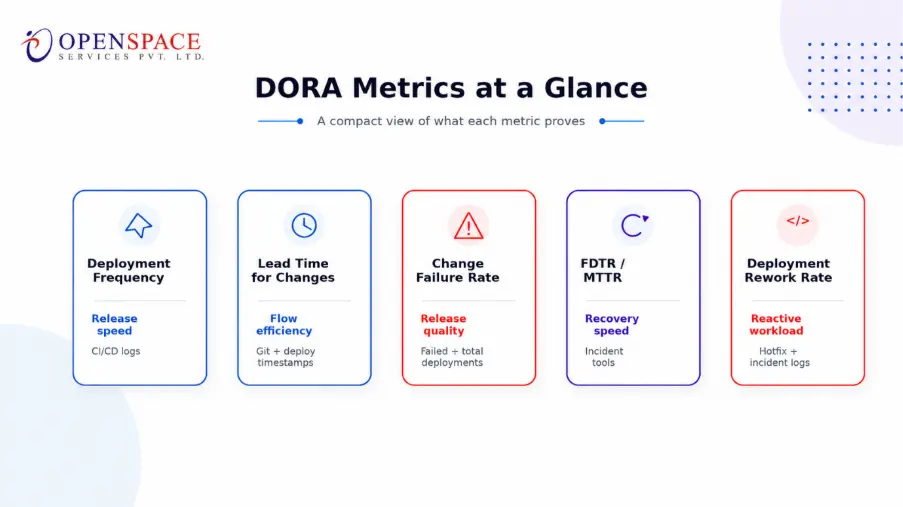
DORA metrics are the industry’s most widely used framework for measuring DevOps performance. DORA was historically known for four core metrics:
- Deployment Frequency: How often you release code to production
- Lead Time for Changes: How quickly code moves from commit to production
- Change Failure Rate: How often deployments cause issues
- Mean Time to Recovery (MTTR): How quickly teams recover from failures
For teams still relying on manual releases, understanding how a CI/CD pipeline works is the first step toward improving deployment frequency.
More recently, many organizations have also started tracking Deployment rework rate Percentage of deployments triggered by production incidents. This metric provides additional visibility into engineering effort spent on rework rather than innovation.
Created by the DevOps Research and Assessment (DORA) team and now backed by Google Cloud research, these 5 metrics helps engineering leaders measure both speed and reliability.
Why do they matter? Because high-performing teams don’t choose between moving fast and maintaining stability; they achieve both. DORA research consistently shows that organizations with strong software delivery practices release faster, recover from incidents quicker, and deliver better business outcomes.
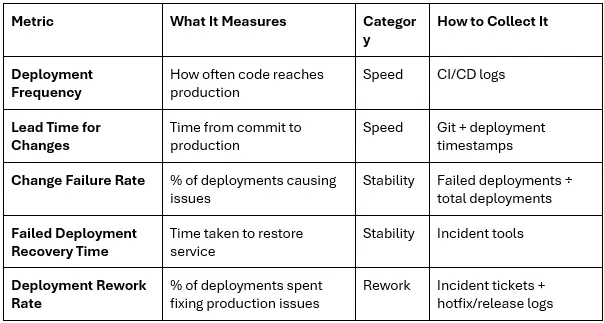
How Do You Measure Each DORA Metric Correctly?
Also read: What is a CI/CD Pipeline? A Simple Guide for CTOs Who Are Tired of Slow Releases (2026)
What Does Elite DevOps Performance Look Like In 2026?
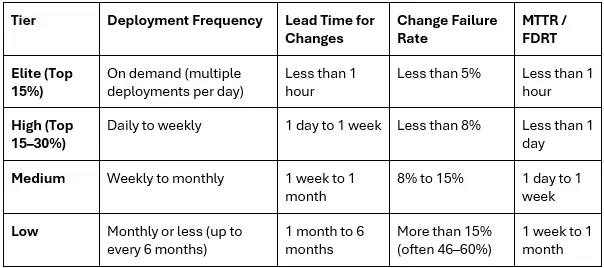
Elite DevOps performance in 2026 means frequent, low-risk deployments, fast lead times, fast recovery, and low rework. The best teams do not choose between speed and stability. They improve both together.
Elite teams don’t just deploy more frequently, they also maintain low failure rates and recover from incidents rapidly, demonstrating both speed and operational stability.
How Do You Actually Improve Each DORA Metric? A Practical Playbook
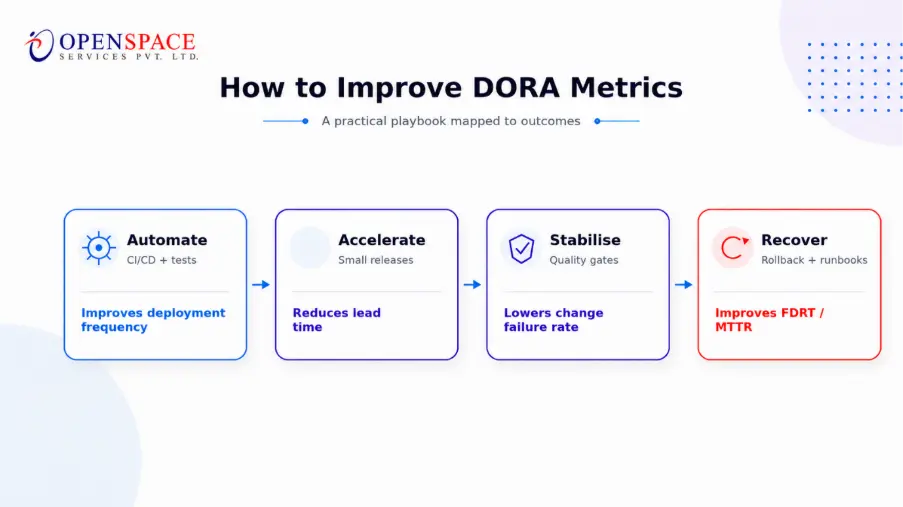
1. Deployment Frequency
- Invest in a mature CI/CD pipeline; automate build, test, and deploy stages end-to-end
- Break large releases into smaller, independently deployable changes
- Use feature flags to decouple deployment from release
- Reduce manual approval gates; replace with automated quality checks
2. Lead Time for Changes
- Establish trunk-based development — long-lived branches kill lead time
- Speed up code review with automated linting, static analysis, and review assignment policies
- Parallelize test suites; target under 10-minute pipeline runs
- Eliminate external QA handoff delays with shift-left testing
3. Change Failure Rate
- Implement automated regression testing and contract testing for microservices
- Adopt blue/green or canary deployments to limit blast radius
- Build observability (metrics, logs, traces) before you ship
- Integrate security scanning into the pipeline (DevSecOps)
4. MTTR / FDRT
- Invest in monitoring and alerting. You can’t fix what you can’t see fast
- Build automated rollback or one-click rollback capabilities
- Run blameless post-mortems to drive systemic improvements, not firefighting
- Document runbooks and keep them current; automate common incident responses
The DORA Maturity Ladder by OpenSpace Services
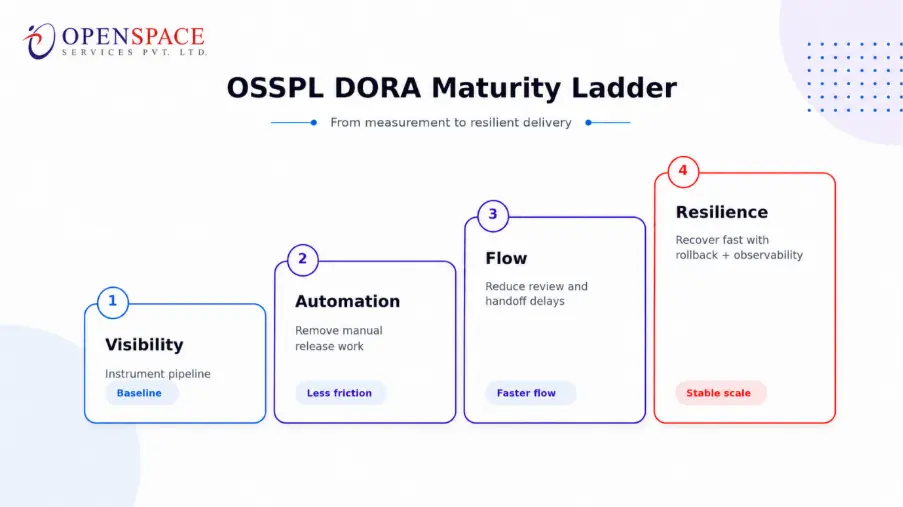
Based on our DevOps consulting experience, we've seen most organizations move through four distinct stages on their journey from Low to Elite DORA performance.
1. Build Visibility First
Start by measuring your current performance. Instrument your CI/CD pipeline, deployment process, and incident management tools to track all DORA metrics.
You can't improve what you don't measure. At this stage, many teams discover they're performing at a Medium or Low level and that's completely normal. The goal is to establish a clear baseline.
2. Automate the Delivery Pipeline
The next step is reducing manual work across the software delivery lifecycle.
Focus on:
- Automating testing
- Automating deployments
- Automating infrastructure provisioning
- Reducing approval bottlenecks
For many teams, this stage alone significantly improves deployment frequency and release confidence.
3. Reduce Delivery Bottlenecks
Once automation is in place, the focus shifts to speeding up the flow of changes.
Common practices include:
- Feature flags
- Trunk-based development
- Smaller release batches
- Service decomposition where appropriate
This is often where lead time drops from weeks to days or even hours.
4. Engineer for Resilience
Elite teams don’t just prevent failures; they recover from them quickly.
This stage focuses on:
- Observability and monitoring
- Automated rollback mechanisms
- Incident response readiness
- Reliability testing
- A blameless engineering culture
Achieving an FDRT of less than one hour is the outcome of systems, processes, and culture working together.
Which Tools Actually Measure DORA Metrics? A 2026 Comparison
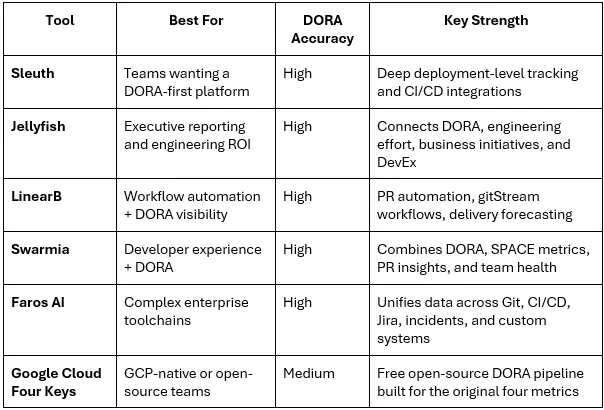
Measuring DORA metrics accurately depends on clean deployment, commit, incident, and workflow data. Here’s how leading DORA and engineering intelligence platforms compare in 2026:
Why Do DORA Metrics Matter for DevOps Budget Conversations?
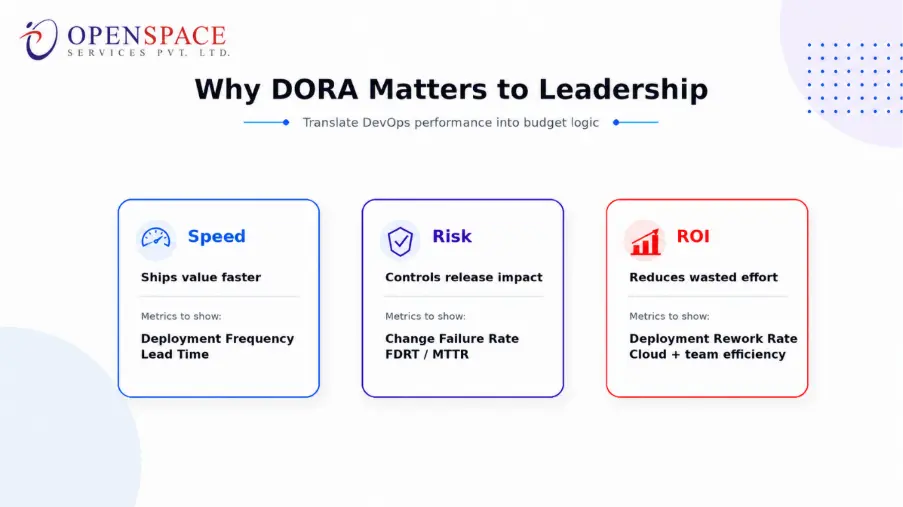
DORA metrics help CTOs and engineering managers turn DevOps investments into measurable business outcomes. Instead of saying "we need better DevOps," you can show how improving delivery performance impacts speed, reliability, and business results.
Key findings from DORA research include:
- 2x more likely to meet or exceed organizational goals
- 2.5x faster time-to-market for elite DevOps teams
- Only 19% of teams achieved Elite status in 2024, while 25% remained in the Low-performance tier
For leadership discussions, focus on the improvement journey. Show your current DORA tier, estimate the impact of moving to the next tier, and quantify gains such as faster releases, fewer incidents, and lower operational costs.
DORA metrics are also becoming a key way to measure the impact of AI-assisted development. As AI speeds up software delivery, DORA helps determine whether teams are actually improving outcomes or simply generating more code.
Final Thoughts
DORA metrics are not just engineering KPIs. In 2026, they are board-level evidence of delivery maturity.
If your team deploys slowly, waits days for approvals, struggles with production defects, or cannot explain DevOps ROI clearly, DORA gives you the baseline. But measurement alone will not fix delivery. You need the right CI/CD automation, cloud infrastructure, monitoring, security integration, and governance model.
OpenSpace Services Pvt Ltd (OSSPL) helps teams move from fragmented workflows to unified, automated, secure DevOps environments.
Where does your team sit on the DORA scale? Get a Free DevOps Maturity Assessment with OpenSpace Services.