
Quick Answer
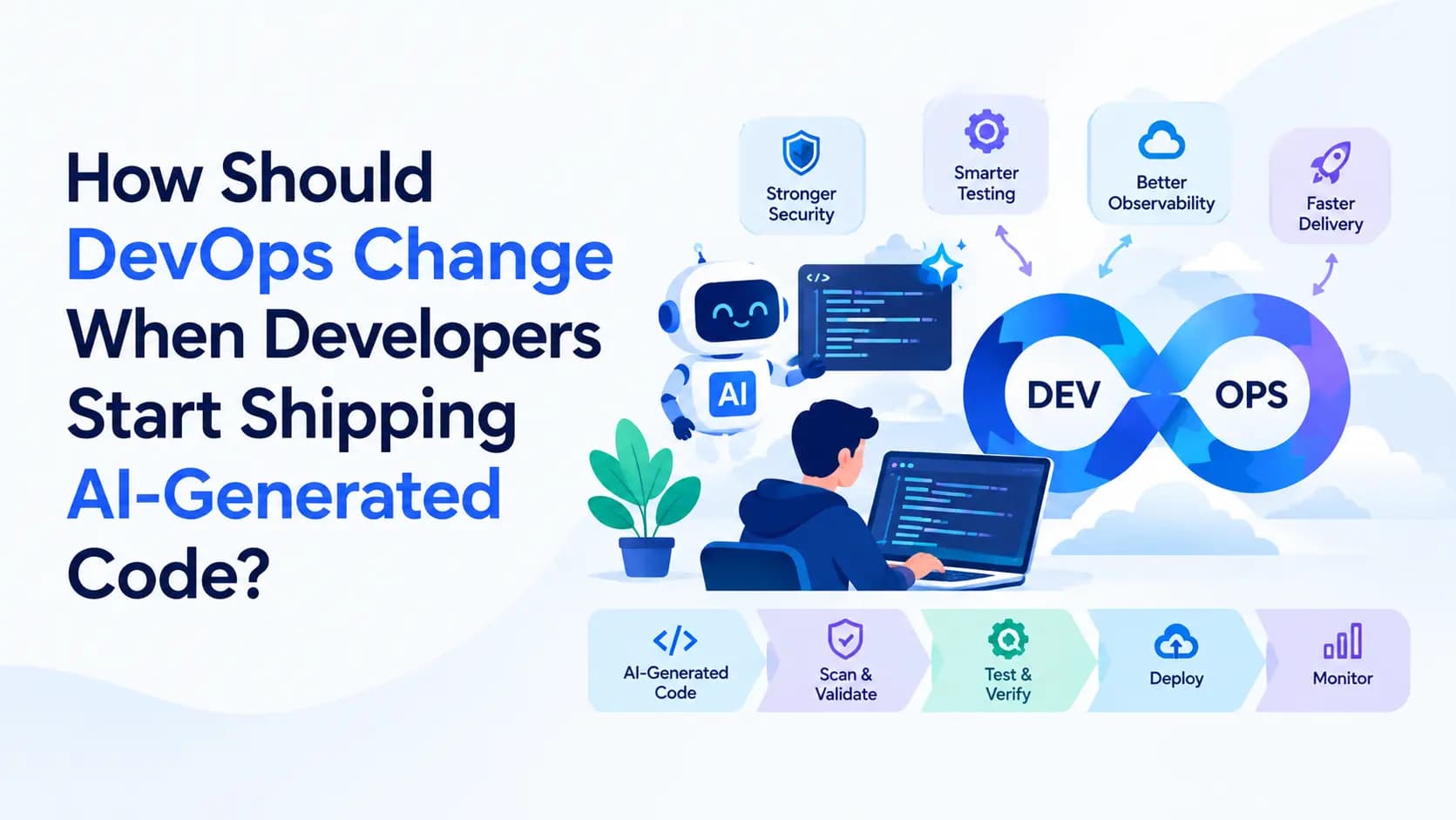
As AI coding tools increase the volume and speed of software changes, organisations investing in DevOps Development Services can build automated CI/CD pipelines, security controls, and observability practices that safely support AI-assisted engineering. Engineering teams need faster automated testing, risk-based quality gates, stronger software supply-chain controls, scalable CI infrastructure, and production observability that can detect the impact of more frequent changes. The goal is not to create a separate pipeline for AI-generated code, but to build a delivery system that can safely absorb higher development velocity regardless of who, or what, writes the code.
AI May Be Moving the Engineering Bottleneck
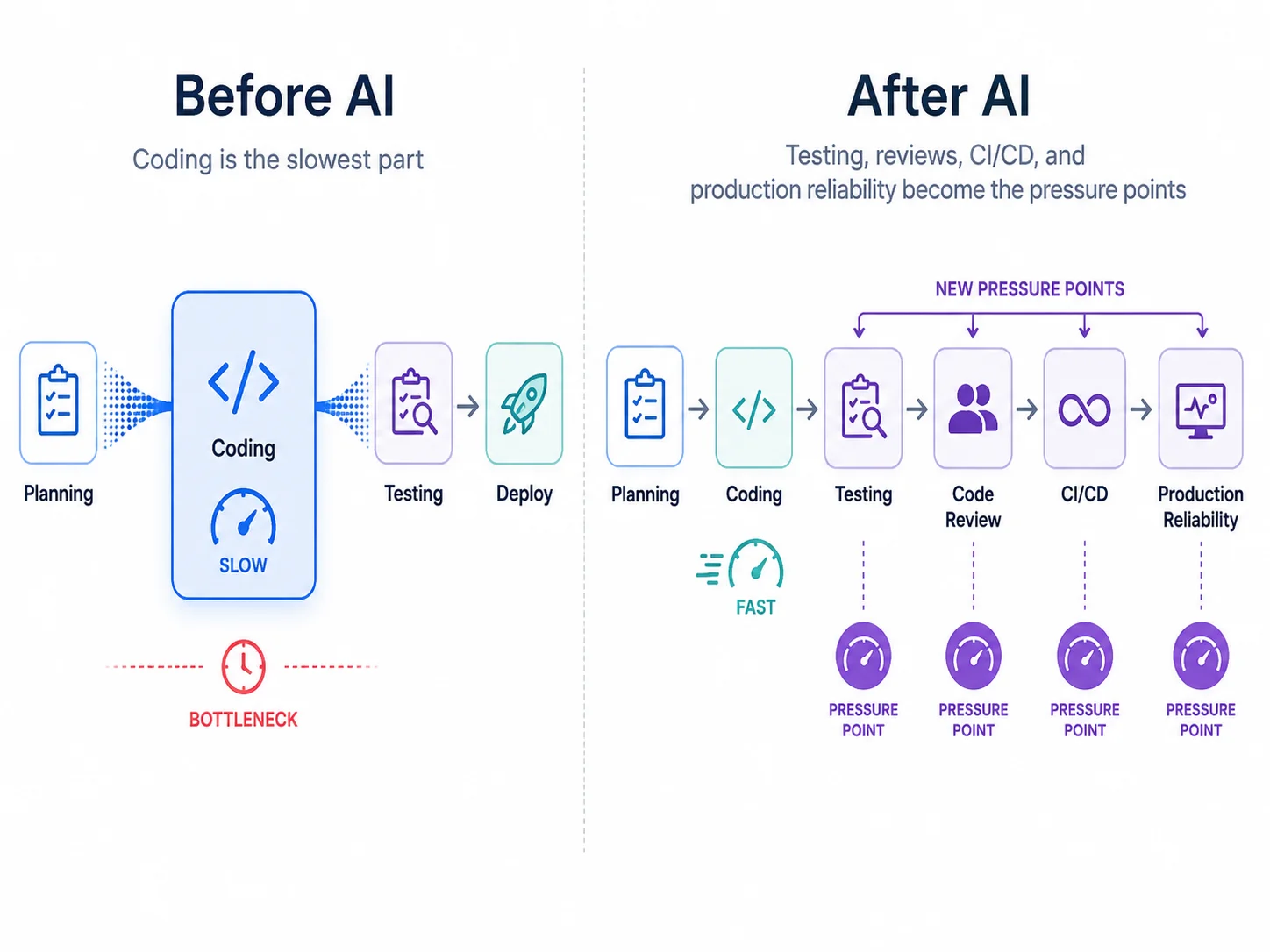
For years, DevOps has focused on removing friction between writing code and getting it into production. AI coding assistants and autonomous coding agents are now changing the first part of that equation.
Developers can generate functions, tests, documentation, infrastructure configurations and even complete pull requests faster. Businesses adopting AI-assisted engineering should also evaluate Software & Application Development Services that integrate AI, DevOps, and cloud-native development into a unified delivery process.
Google Cloud's 2025 DORA research, based on responses from nearly 5,000 technology professionals, found that AI adoption was positively associated with software delivery throughput and product performance. However, it continued to have a negative relationship with delivery stability. DORA's conclusion is particularly important for DevOps leaders - AI tends to amplify the engineering system that already exists. Strong automated testing, version control and fast feedback loops help teams absorb additional development velocity; weak systems can become more unstable as change volume increases.
This suggests a different question for engineering leaders. Instead of asking only, "How much faster can our developers code with AI?", they should also ask, "Can everything between commit and production keep up?"
1. Optimise the Pipeline for Verification, Not Just Velocity
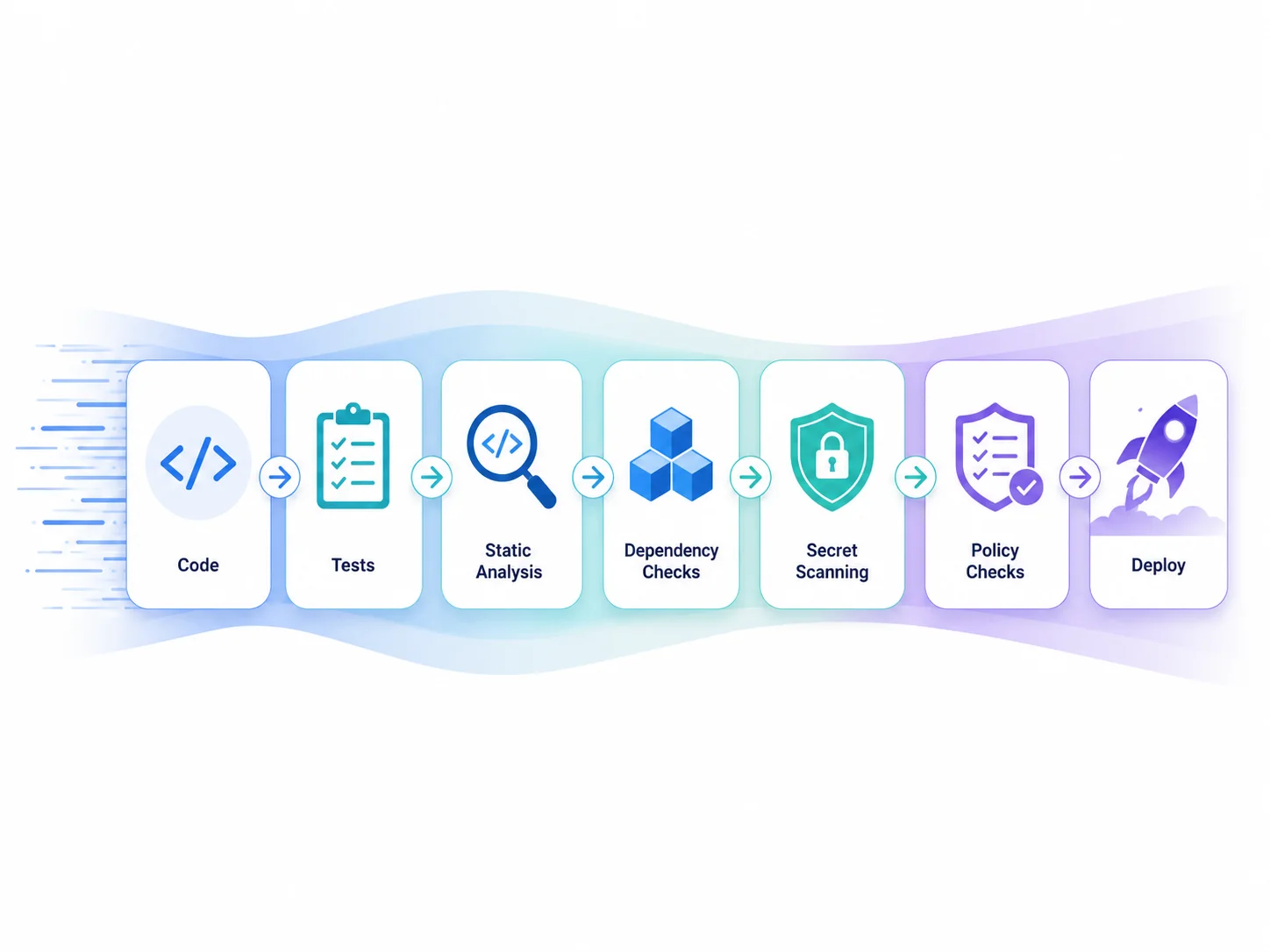
When producing code becomes cheaper, verifying code becomes more valuable.
An AI-generated function may compile successfully, but organisations should combine automated testing with Cloud Infrastructure Managed Services to strengthen infrastructure security, monitoring, and production reliability. GitHub itself advises developers tovalidate AI-generated code for functionality, intent, quality, dependencies and AI-specific pitfalls rather than assuming generated code is production-ready.
This changes what a mature CI/CD pipeline needs to accomplish.
Unit and integration tests remain important, but teams should also consider automated static analysis, dependency checks, secret scanning, security testing and policy checks before changes reach production. The objective is not to distrust AI-generated code specifically. Human-written code can contain exactly the same problems.
The difference is scale. If AI increases the amount of code an organisation can produce, manual verification can become the new constraint.
The DevOps response should therefore be verification that scales with generation.
2. Don't Create an “AI Code” Pipeline
It may be tempting to create one set of controls for human-written code and a stricter set for AI-generated contributions. In most organisations, that will become difficult to maintain.
Developers increasingly work with AI rather than handing complete tasks either to a human or an agent. A single pull request might contain manually written architecture, AI-generated boilerplate, agent-generated tests and human revisions.
Trying to establish exactly which line came from whom is less useful than establishing whether the resulting change meets production standards.
A better principle is simple - The same production contract should apply to all code.
Does it pass the tests? Does it meet security policies? Does it introduce an unacceptable dependency? Does it violate architectural rules? Can it be safely deployed and rolled back?
Interestingly, GitHub is already moving in this direction with its coding agent. Code produced by the agent is automatically checked using CodeQL, dependency analysis and secret scanning, and the agent attempts to address identified issues before finalising its pull request.
The lesson for DevOps teams is not that AI needs an entirely new delivery process. It is that quality controls increasingly need to become machine-enforceable.
3. Your CI Infrastructure May Need to Scale Before Production Does
There is another consequence that receives less attention: more generated changes can mean more pull requests, test runs, security scans and builds.
That makes CI infrastructure a capacity-planning problem.
If developers can create changes faster but every pull request waits 25 minutes for an available runner and another 30 minutes for tests, the productivity gain disappears into the pipeline.
Engineering teams should therefore start watching metrics such as queue time, build duration, flaky-test rates, test parallelisation, runner utilisation and feedback time. Tests may need to be intelligently segmented so a small change does not unnecessarily trigger hours of unrelated validation.
The principle is straightforward - when code creation accelerates, feedback loops must accelerate with it.
4. AI Agents Are Beginning to Touch DevOps Itself
AI-generated application code is only part of the change. Coding agents are also beginning to modify the machinery used to build and deploy software.
A 2026 empirical study examined 8,031 agent-authored pull requests across 1,605 GitHub repositories where agents modified YAML configurations. CI/CD files represented 3.25% of agent changes, and 96.77% of the CI/CD modifications targeted GitHub Actions. The researchers found broadly comparable build-success rates between agent changes involving CI/CD and those that did not.
This is significant because a mistake in application code may affect one feature, while a mistake in a deployment workflow can affect how the organisation builds or releases software.
Teams therefore need to think about blast radius, not simply code authorship.
An AI-assisted change to documentation may require normal automated validation. A change to authentication logic deserves greater scrutiny. A change to production IAM permissions, deployment workflows or infrastructure definitions may warrant mandatory human approval.
As agents gain more autonomy, permissions should reflect the potential impact of what they can change.
5. Software Provenance Becomes More Important
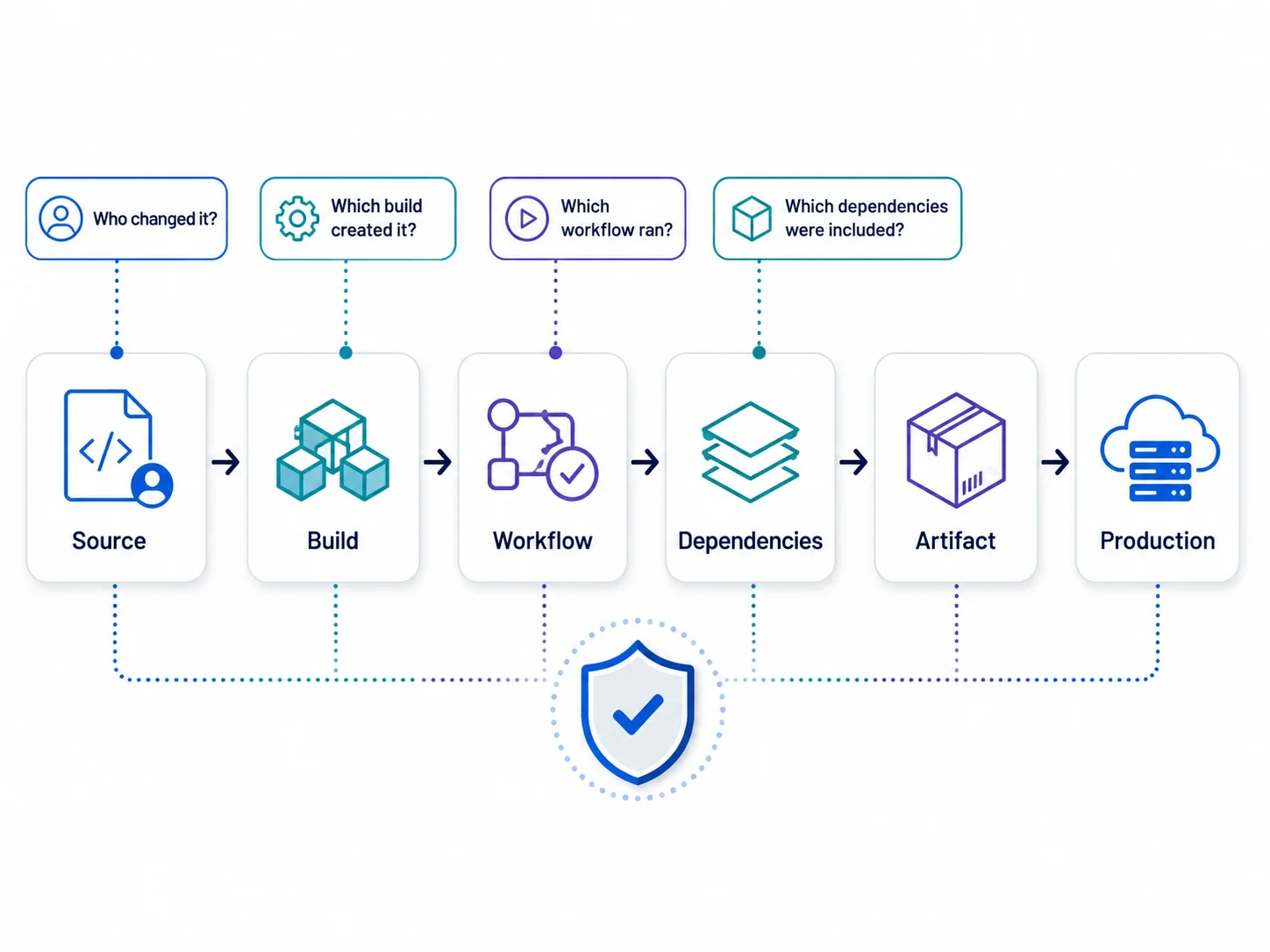
When humans and multiple AI agents contribute to software, organisations may increasingly need stronger answers to basic questions: What source produced this artifact? Which build created it? Which workflow ran? Which dependencies were included?
This is where software supply-chain practices become more relevant.
SLSA defines build provenance as verifiable information describing where, when and how a software artifact was produced. Its purpose includes allowing consumers to verify that an artifact was built according to expectations and trace it back through the software supply chain.
For most organisations, this does not mean immediately implementing the highest possible supply-chain maturity level. It means recognising that as software creation becomes increasingly automated, traceability should become stronger rather than weaker.
6. Observability Becomes the Final Verification Layer
When the volume and frequency of changes increase, organisations also need to become better at detecting what happens after deployment.
That makes observability particularly important in AI-accelerated engineering environments. Teams need visibility into whether a release changes error rates, latency, resource consumption, customer journeys or system behaviour.
Deployment markers should make it easy to correlate production changes with emerging problems. Progressive delivery techniques can limit exposure when higher-risk changes are introduced, while reliable rollback mechanisms reduce the cost of discovering a problem after release.
In other words, the pipeline should not end at deployment successful.
It should answer a more important question - Did this change behave as expected in production?
What Should Engineering Leaders Change First?
Organisations do not need to redesign their entire DevOps environment simply because developers start using AI.
Start by measuring where additional development velocity is creating pressure. If pull requests wait too long for tests, improve CI capacity and test efficiency. If reviewers are overwhelmed, automate predictable quality and security checks. If production incidents increase as deployment frequency rises, strengthen progressive delivery, observability and rollback. If agents can modify infrastructure or pipelines, revisit permissions and approval policies.
This is also consistent with DORA's broader finding - AI does not compensate for weak engineering fundamentals. It magnifies them.
How OpenSpace Services Can Help
At OpenSpace Services, we see AI-assisted development as more than a change to how developers write code. It changes the demands placed on CI/CD, security controls, cloud infrastructure and production operations.
For engineering teams adopting AI coding tools and agents, we help assess whether existing DevOps environments can support higher change velocity without sacrificing reliability. This can include strengthening CI/CD automation, Infrastructure as Code, DevSecOps controls, cloud environments, observability and production reliability practices.
The objective is not simply to help teams generate software faster. It is to ensure the engineering system around that software is capable of verifying, deploying and operating it safely at the same pace.
Final Thoughts
AI coding tools may make software easier to produce, but production software still has to be tested, secured, deployed, observed and maintained.
That makes the next phase of AI-assisted development as much a DevOps challenge as a developer-productivity opportunity.
Engineering organisations that simply add AI to existing workflows may find that bottlenecks migrate from coding to reviews, testing, CI infrastructure or production operations. Teams that strengthen those systems can use AI differently: not merely to produce more code, but to increase delivery capacity without allowing reliability to deteriorate.