

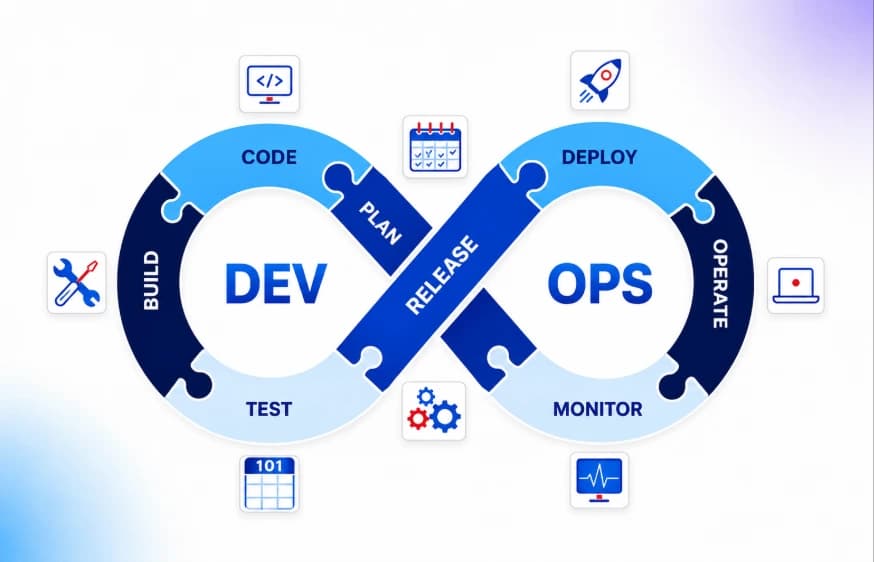
The Short Answer
Your company may need DevOps services if software releases are becoming slower, deployments are increasingly risky, cloud costs are rising, or engineering teams are spending more time maintaining systems than delivering new features.
DevOps services help organizations streamline software delivery by improving collaboration between development and operations teams, automating deployments, optimizing infrastructure, and reducing operational bottlenecks.
If you're unsure whether DevOps is the right investment for your business, this assessment will help you identify the signs.
What Are DevOps Services?
DevOps services are professional consulting, implementation, automation, and optimization services designed to improve how software is developed, deployed, monitored, and maintained.
A DevOps services provider typically helps organizations:
- Build and optimize CI/CD pipelines
- Automate infrastructure management
- Improve cloud operations
- Implement Infrastructure as Code (IaC)
- Strengthen monitoring and observability
- Integrate security into development workflows
- Reduce deployment risks
The ultimate goal is to help businesses release software faster, more reliably, and at lower operational cost.
Why Are More Businesses Investing in DevOps?
Modern businesses are expected to deliver software updates quickly while maintaining reliability and security.
As products grow, teams expand, and cloud environments become more complex, traditional software delivery processes often struggle to keep up.
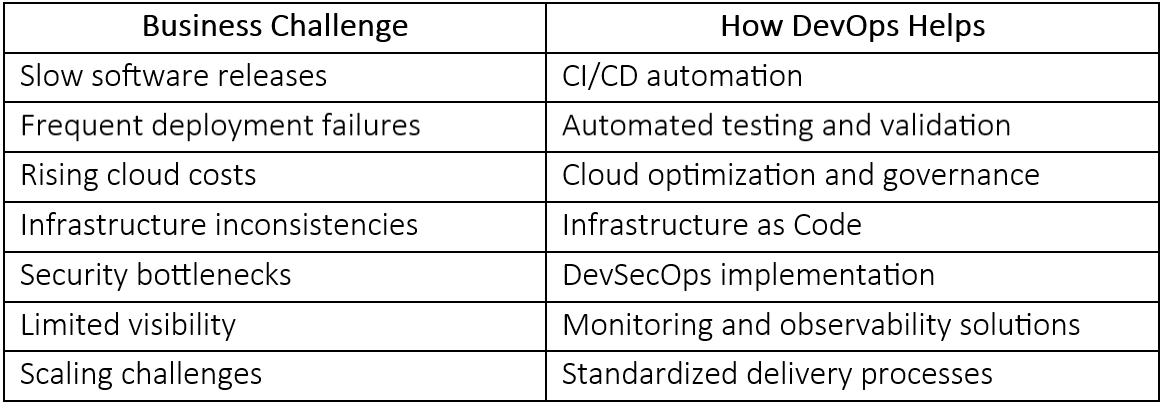
DevOps helps organizations solve challenges such as:
- Slow release cycles
- Frequent deployment failures
- Infrastructure inconsistencies
- High cloud spending
- Security bottlenecks
- Limited operational visibility
DevOps Readiness Assessment
Answer each question with Yes or No.
Software Delivery
1. Do software releases often get delayed?
2. Do deployments require significant manual effort?
3. Do teams avoid releasing changes because of deployment risks?
4. Are production issues common after releases?
Team Collaboration
5. Do development and operations teams work in separate silos?
6. Do teams spend time assigning blame when issues occur?
7. Are deployment responsibilities unclear?
Infrastructure Management
8. Is infrastructure still configured manually?
9. Do development, testing, and production environments behave differently?
10. Does provisioning infrastructure take days instead of minutes?
Cloud Operations
11. Have your cloud costs increased without clear justification?
12. Is cloud resource utilization difficult to track?
13. Are teams unsure whether infrastructure is optimized?
Monitoring & Incident Response
14. Do customers report issues before your teams detect them?
15. Is root cause analysis often slow and difficult?
16. Are application performance problems hard to diagnose?
Security & Compliance
17. Does security review happen only at the end of development?
18. Do compliance requirements slow down releases?
19. Are security checks mostly manual?
Business Agility
20. Do competitors seem to release new features faster than you?
Understanding Your Score
0-5 Yes Answers
Your organization already demonstrates strong DevOps maturity.
There may be opportunities to optimize specific areas, but major transformation may not be necessary.
6-10 Yes Answers
Your software delivery process likely contains operational bottlenecks that are slowing growth.
Targeted DevOps improvements could significantly improve efficiency.
11-15 Yes Answers
Your organization is likely experiencing substantial delivery friction that affects release speed, reliability, and engineering productivity.
A DevOps assessment is strongly recommended.
16-20 Yes Answers
Your current delivery processes may be limiting business growth and increasing operational risk.
A structured DevOps transformation could deliver significant value.
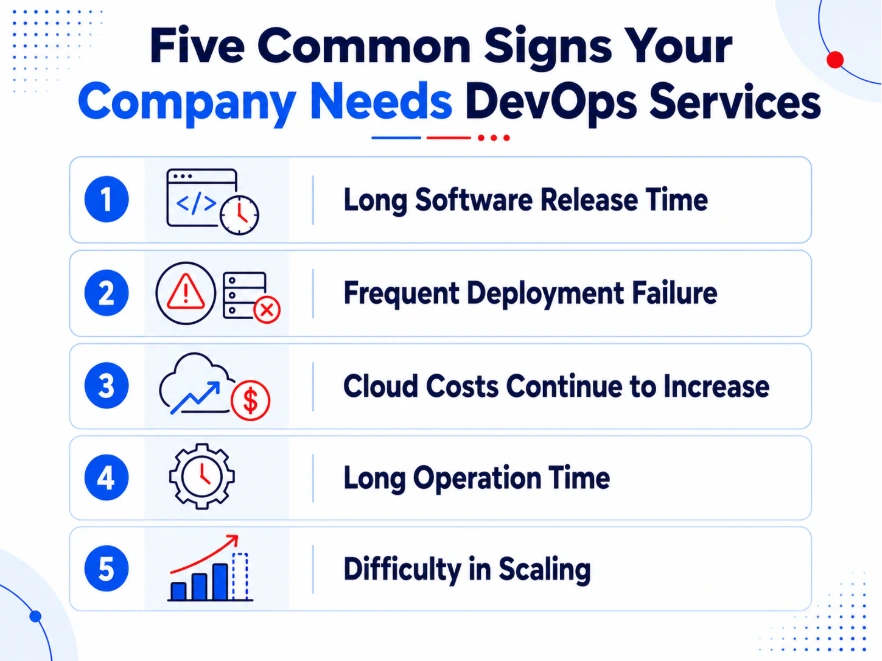
Five Common Signs Your Company Needs DevOps Services
1. Software Releases Are Taking Too Long
If a feature takes weeks to move from development to production, the problem is often process-related rather than technical.
DevOps introduces automation and streamlined workflows that reduce release delays.
2. Deployment Failures Are Becoming Common
Frequent deployment issues typically indicate gaps in testing, automation, environment consistency, or release management.
DevOps practices help reduce risk through continuous integration and continuous delivery.
3. Cloud Costs Continue to Increase
Cloud adoption does not automatically result in efficiency.
Without proper governance and automation, infrastructure costs often rise faster than expected.
DevOps teams help optimize cloud environments using AI-powered cloud infrastructure optimization.
4. Engineering Teams Spend Too Much Time on Operations
Developers create the most value when building products-not manually managing infrastructure or troubleshooting deployments.
DevOps reduces operational overhead through AI-driven DevOps workflow automation.
5. Scaling Becomes Increasingly Difficult
Growth introduces complexity.
What worked for a team of 10 engineers often breaks down at 50 engineers.
DevOps creates repeatable processes that support sustainable scaling.
What Problems Can DevOps Services Solve?
Should You Build an Internal DevOps Team or Partner with Experts?
The answer depends on your current maturity level.
An Internal DevOps Team May Be Appropriate If:
- You have ongoing large-scale infrastructure requirements.
- You already have mature engineering operations.
- You need dedicated long-term operational ownership.
A DevOps Services Partner May Be More Effective If:
- You need expertise quickly.
- Your team lacks DevOps experience.
- You are modernizing legacy systems.
- You want to accelerate cloud transformation.
- You need objective assessment and implementation support.
For many organizations, partnering with experienced DevOps specialists provides faster results while avoiding the cost and complexity of building a team from scratch.
What Happens During a DevOps Assessment?
A DevOps assessment is a structured evaluation of your software delivery lifecycle.
The assessment typically reviews:
- Current deployment processes
- Infrastructure architecture
- Cloud environments
- Security practices
- Monitoring capabilities
- Team workflows
- Automation opportunities
The goal is to identify bottlenecks, risks, and improvement opportunities that directly impact software delivery performance.
How OpenSpace Services Helps Organizations Improve DevOps Maturity
At OpenSpace Services, we help businesses modernize software delivery through end-to-end DevOps consulting and implementation services.
Our team works closely with organizations to:
- Assess DevOps readiness
- Design scalable delivery pipelines
- Implement CI/CD workflows
- Enable Infrastructure as Code
- Optimize cloud environments using DevOps cloud optimization services.
- Improve observability and monitoring
- Integrate security into development processes
Whether you're beginning your DevOps journey or optimizing an existing environment, our focus is on helping you deliver software faster, more reliably, and with greater operational efficiency.
Your Next Step
If your assessment score was 6 or higher, there is a strong possibility that delivery bottlenecks are impacting your team's productivity, software quality, or business agility.
The challenge is that many of these issues remain hidden until they start affecting customers, revenue, or growth.
Book a DevOps Readiness Assessment with OpenSpace Services
Our experts can help you identify:
- Delivery bottlenecks
- Automation opportunities
- Cloud optimization gaps
- Infrastructure risks
- Security and compliance challenges
You'll receive a clear view of your current DevOps maturity and practical recommendations for improvement.
Because faster software delivery isn't just an engineering objective.
It's a competitive advantage.
Contact Openspace Services to learn more about our services.