
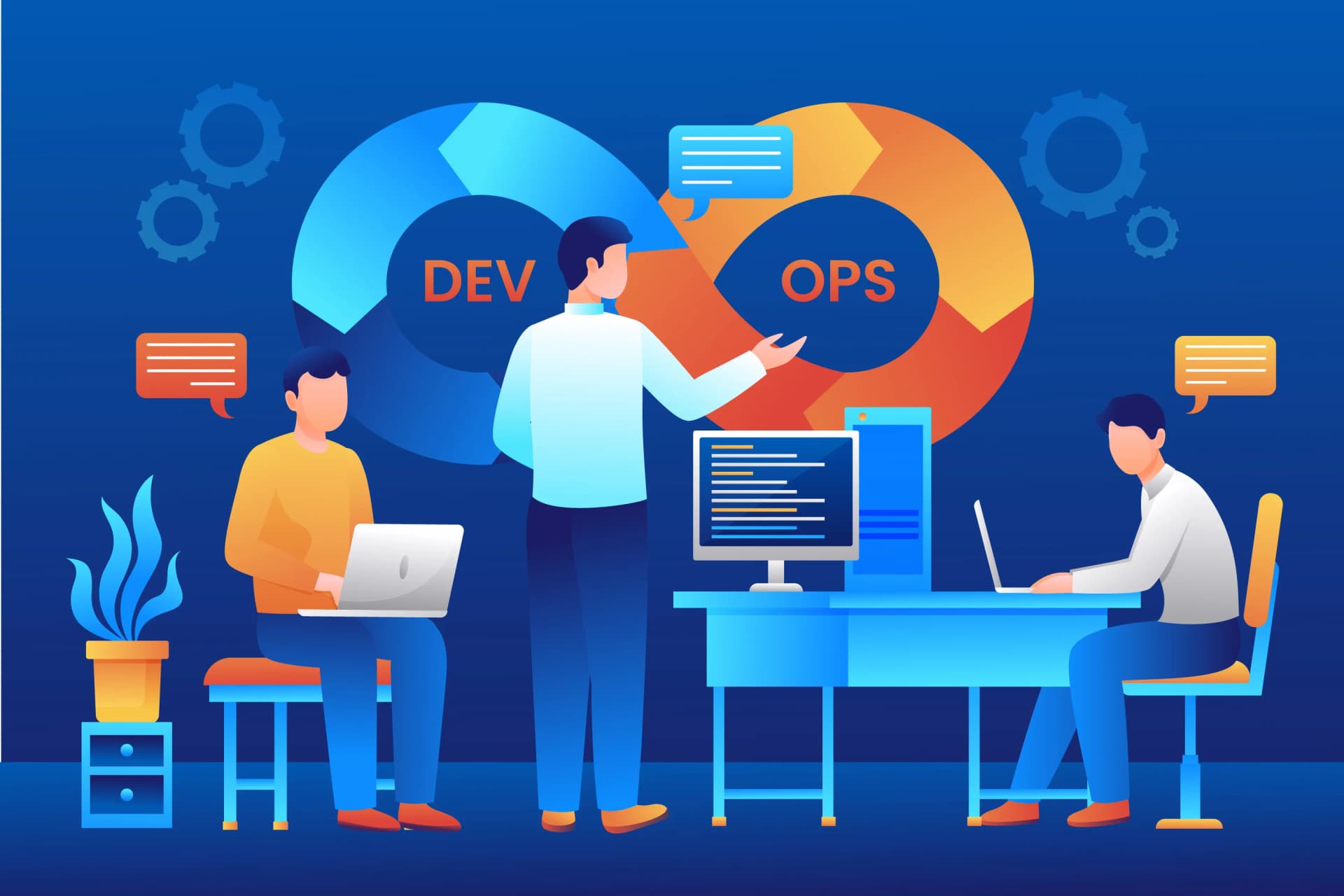
A few years ago, DevOps at most US companies meant one person. Usually a sysadmin who also wrote deployment scripts and got paged at 2 a.m. Today, the same job covers CI/CD pipelines, cloud infrastructure, security scanning, compliance evidence and round-the-clock monitoring. Very few teams can hire for all of that.
That is why so many leaders now look at DevOps outsourcing services. Search "DevOps outsource" and you will find hundreds of providers promising faster releases. But the real question is not "should we outsource?" It is "which parts, to whom, and how do we stay in control?"
In this guide, I share the framework we use with clients to answer exactly that, including when a hybrid model beats both extremes.
What DevOps Outsourcing and DevOps as a Service Mean?
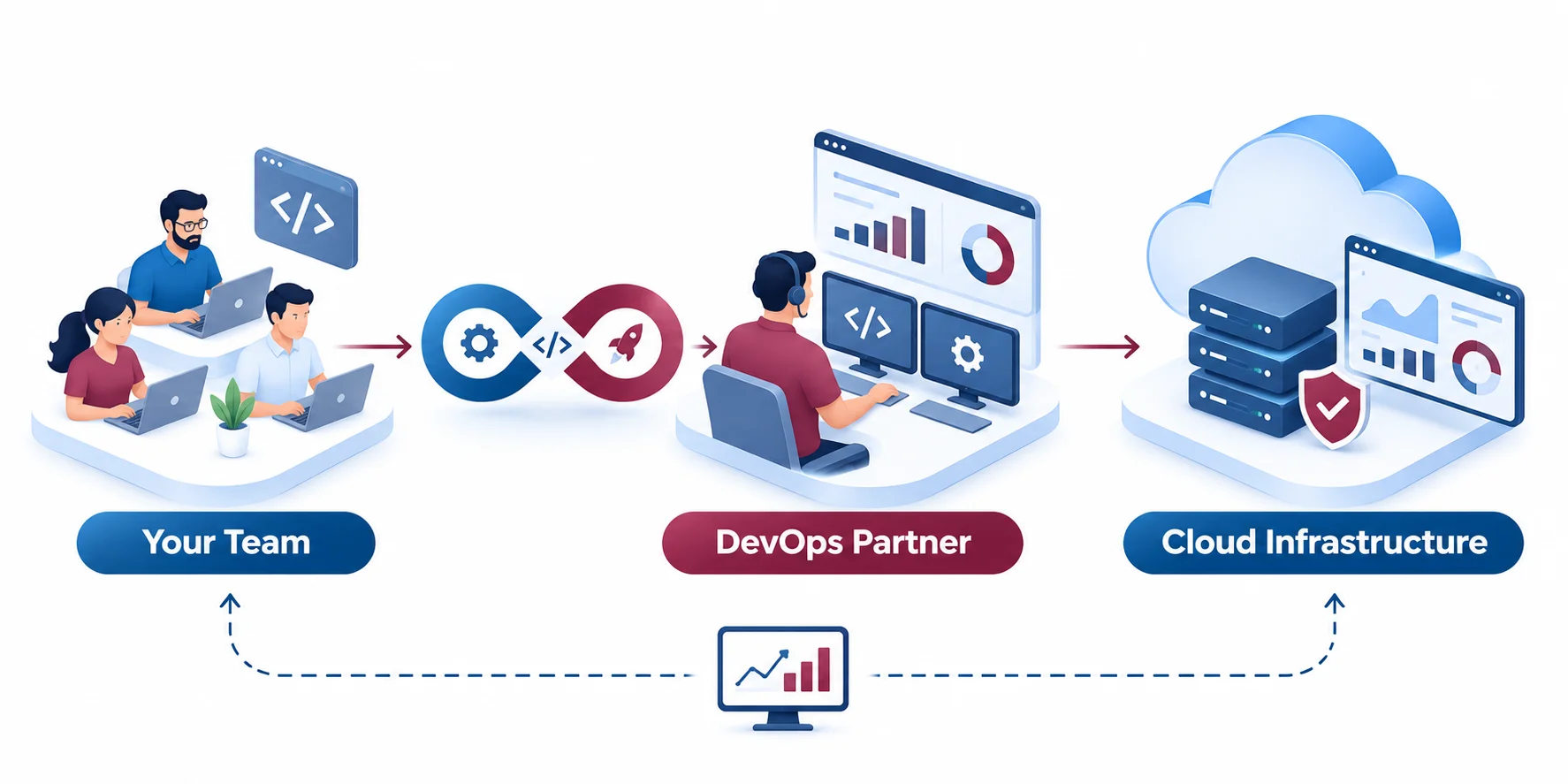
DevOps outsourcing means handing some or all of your DevOps work to an outside team.
DevOps as a Service (DaaS) is one form of it: the provider runs your pipelines and cloud operations every day, under agreed service levels. You will also hear this called DevOps managed services.
DaaS often gets confused with two other models:
| Model | What you get | Best for |
|---|---|---|
| DevOps as a Service | An outside team that runs and improves your DevOps daily, with SLAs | Ongoing operations and 24/7 coverage |
| DevOps consulting | Experts who assess, design and build, then hand over | One-off projects such as a migration or a new pipeline |
| Staff augmentation | Individual engineers who join your team and take your direction | Filling a skills gap when you already have DevOps leadership |
The simple way to remember it: A DaaS provider owns outcomes, a consultant owns a project, and an augmented engineer owns tasks.
What You Can Outsource, and What Should Stay In-House
Pipelines and Release Management
Setting up CI/CD, adding automated tests and security scans to every build, managing releases and making rollbacks safe and quick.
Cloud Operations, Monitoring and On-Call
Infrastructure as code, patching, backups, scaling, alerting and 24/7 incident response.
Security and Compliance Support
Server hardening, secrets management, vulnerability scanning and collecting audit evidence for frameworks such as SOC 2, HIPAA and PCI DSS.
What to Keep In-House
- Architecture and tooling decisions
- Product priorities and release timing
- Final approval on high-risk production changes
- Ownership of your cloud accounts and code repositories
You can hand off the work. You should not hand off the accountability.
In-House vs Outsourced DevOps
The in-house vs outsourced DevOps debate usually forgets the third option. Here is how all three compare on the factors that matter most.
| Factor | In-house | Outsourced | Hybrid |
|---|---|---|---|
| Control | Full | Shared through contract and SLAs | You decide, the provider runs operations |
| Time to start | Months of hiring and ramp-up | Weeks | Weeks |
| Skill depth | Limited to who you hire | A broad bench of specialists | Your core team plus specialists |
| 24/7 coverage | Hard with a small team | Usually included | Provider covers nights and weekends |
| Knowledge retention | Strong, until people leave | At risk without documentation | Strong, if handover is built in |
| Best for | Large, mature platform teams | Small teams with no DevOps lead | Most growing companies |
The Decision Framework: Six Questions to Choose Your Model
Most guides end with "it depends." Here is what it actually depends on. Answer each question and note which column your answer falls into.
| Question | Points to in-house | Points to outsourced | Points to hybrid |
|---|---|---|---|
| 1. How often do you release? | Many times a day; releases are core to the product | Weekly or less | Daily, with a few critical services |
| 2. How heavy is your compliance load? | Very heavy, with your own security team | Light | Moderate to heavy, needing outside expertise |
| 3. Do you need 24/7 coverage? | You already run a full on-call rotation | Yes, and you have no rotation | Yes, but only for some systems |
| 4. Do you have a DevOps or platform lead? | Yes, with a team | No | Yes, one or two people |
| 5. How unique is your infrastructure? | Highly custom, needs deep internal knowledge | Standard cloud setup | Mostly standard, with a few custom parts |
| 6. How long do you need the help? | Permanently, at large scale | Ongoing but modest | Ongoing and growing |
If four or more answers land in one column, that is a clear signal. A split usually means hybrid.
If you are an early-stage company, our guide to DevOps services for startups and scale-ups explains how this choice changes from seed to Series B.
Making Hybrid Work: Who Owns What
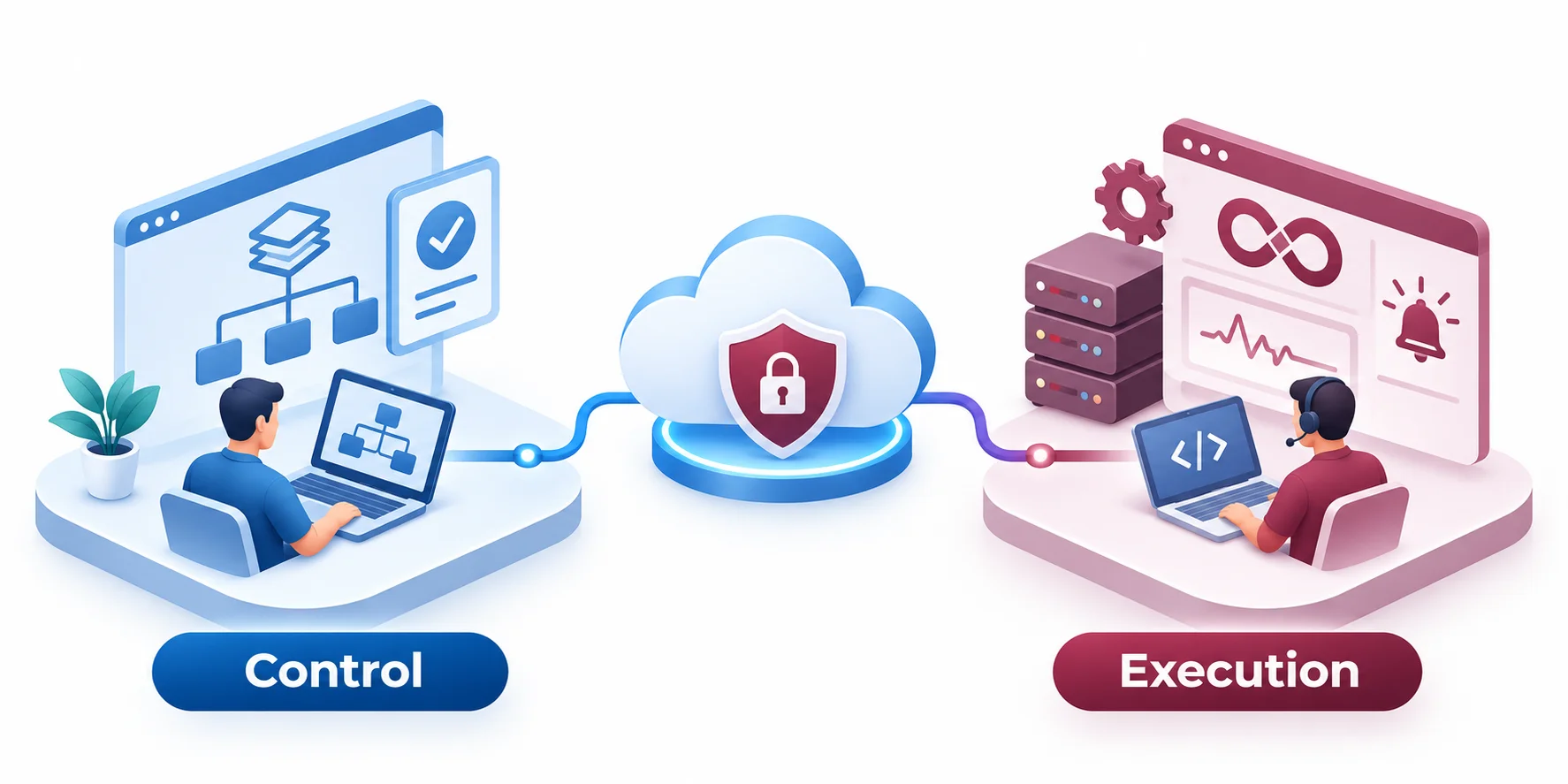
Hybrid fails when nobody knows who decides. Agree on this table before the provider's first day.
| Activity | Your team | Provider |
|---|---|---|
| Architecture and tooling | Decides | Recommends |
| Pipeline build and upkeep | Reviews | Does the work |
| Production deployments | Approves high-risk changes | Runs them |
| Monitoring and alerting | Sets priorities | Runs it |
| On-call first response | Is kept informed | Responds |
| Major incident command | Leads | Supports and fixes |
| Access to cloud and code | Owns and grants | Uses only what is granted |
| Post-incident reviews | Joins and signs off | Writes and drives the actions |
Security, Access and Compliance When Outsiders Touch Production
The biggest risk in outsourcing is not bad code. It is loose access. These controls should be in place from day one:
- Least privilege: Each engineer gets only the access they need, through named accounts. Never shared logins.
- SSO and MFA on every vendor account.
- Secrets in a vault, never in code, tickets or chat.
- Audit logs for every production change, stored in your accounts.
- Same-day offboarding when someone leaves the provider's team.
Rules to Know (Verify with Your Legal Counsel)
- HIPAA: If the provider can reach protected health information, you need a business associate agreement. The provider is also directly liable for safeguarding that data (HHS). This matters for Boston's many healthcare and life sciences companies.
- Massachusetts 201 CMR 17.00: Applies to any business holding personal information about Massachusetts residents, wherever it is based. It requires you to make sure your service providers can protect that data (Mass.gov).
- Illinois BIPA: Sets strict rules on how fingerprints, face scans and voiceprints are stored, shared and destroyed (Illinois General Assembly). If your provider can reach that data, include them in your BIPA controls.
- SOC 2 and PCI DSS: Ask for the provider's own SOC 2 report or PCI attestation, not just a promise.
Pricing Models and What Drives Cost
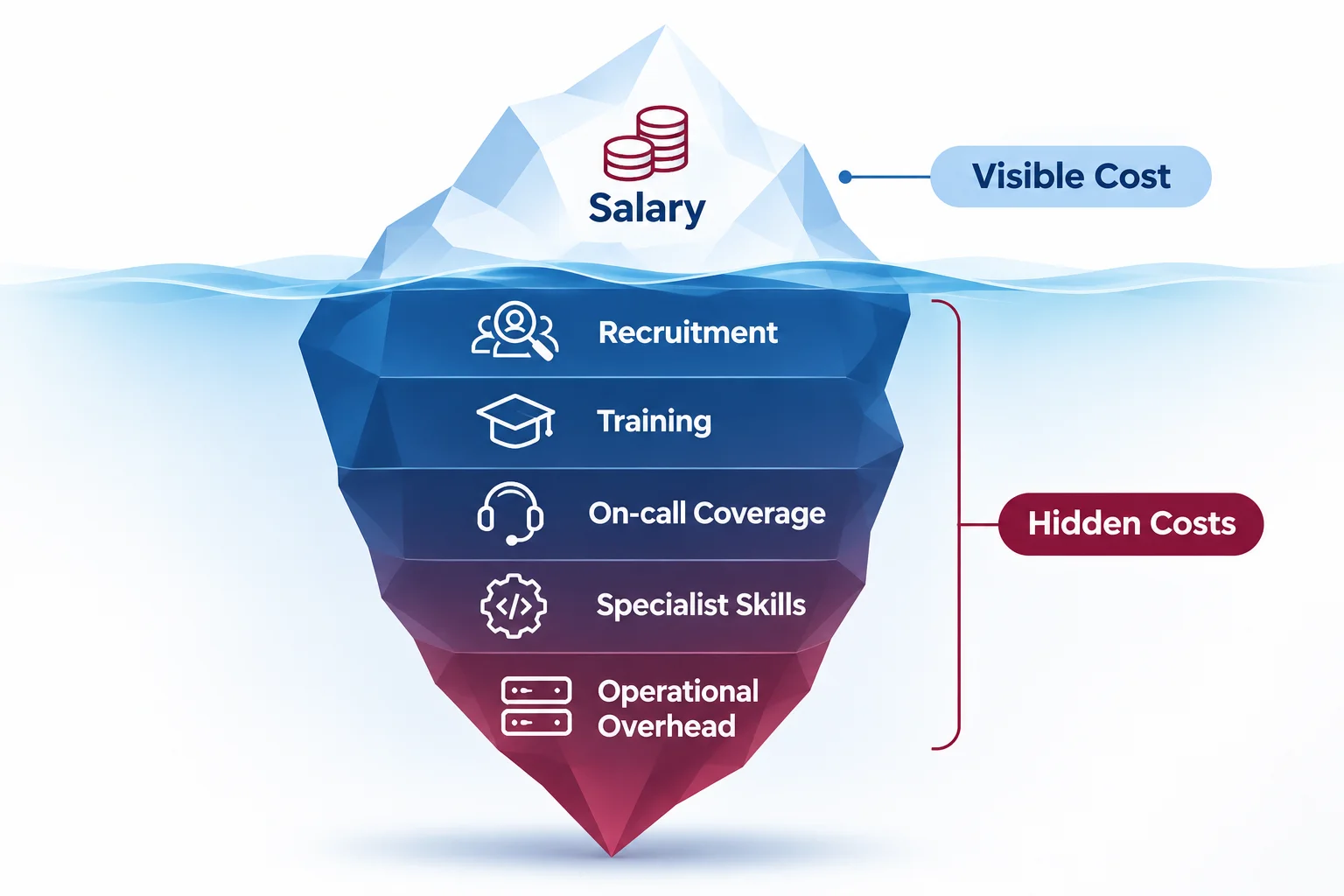
Most providers use one of three models:
| Model | How it works | Works best for |
|---|---|---|
| Monthly retainer | A fixed fee for agreed scope and coverage | Ongoing DaaS |
| Time and materials | You pay for the hours used | Variable or exploratory work |
| Fixed-price project | An agreed price for a defined deliverable | Migrations and pipeline builds |
What moves the cost up or down:
- Number of environments, services and clouds
- Complexity, such as Kubernetes or multi-cloud setups
- Compliance requirements and audit support
- Response times promised in the SLA
- Seniority of the engineers assigned
How to Evaluate DevOps Providers
When you compare a DevOps outsourcing company, look past the tool logos on its website. Check for:
- Hands-on experience with your cloud and your stack, not just similar ones.
- Clear SLAs: Response times by severity, an escalation path and a list of what is excluded.
- Proven security practice, ideally with its own SOC 2 or ISO 27001 certification.
- Named engineers and low turnover, so you are not training a new person every quarter.
- Documentation as a deliverable, not an afterthought.
- Willingness to start with a pilot, such as one pipeline or one environment.
Above all, agree on how success is measured. Tickets closed say little. DORA's software delivery metrics, such as deployment frequency, lead time for changes, change failure rate and recovery time, give you and the provider one shared scorecard (DORA).
"The best DevOps partnerships feel less like outsourcing and more like adding a team that happens to sit somewhere else. Our rule is simple: You should always be able to see what we are doing, measure how well it is working, and walk away with everything if you choose to. That transparency is what earns us the right to keep the work."
Niket Shah, Founder, OpenSpace Services
Onboarding: What the First 90 Days Look Like
Most slow starts are caused on the client side, not the provider's. Before day one, have these ready:
- One named owner on your team
- A list of the systems and access the provider needs
- Architecture notes, even rough ones
- Known pain points and recent incidents
- Your compliance requirements
Then expect three phases:
- Days 1 to 30, discover and fix the obvious: access set up, a full audit, monitoring gaps closed and a written summary of risks.
- Days 31 to 60, stabilise: pipelines standardised, key environments moved to infrastructure as code, runbooks written and on-call live.
- Days 61 to 90, measure and improve: a DORA baseline, the first round of improvements and the first quarterly review.
For a longer view of what comes after, see our DevOps transformation roadmap from assessment to automation.
Conclusion
There is no single right answer to in-house, outsourced or hybrid. There is a right answer for your release pace, compliance load and team today, and it will likely change as you grow. Use the six questions, agree on who owns what, lock down access and protect your exit.
If you would like a second opinion, our team at OpenSpace Services provides DevOps outsourcing services for US businesses, from full DevOps as a Service to hybrid support for in-house teams. Talk to our DevOps team about the model that fits you.