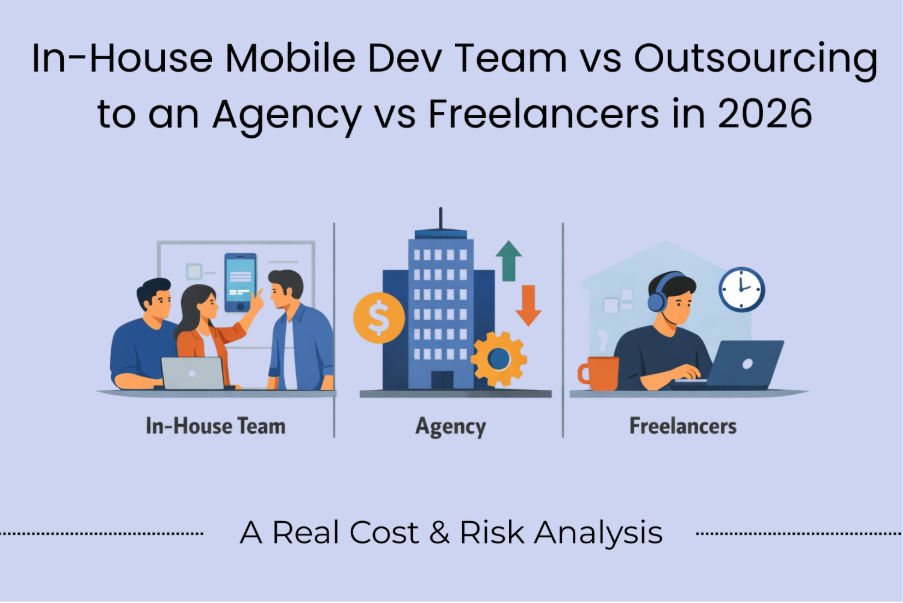
You’ve validated your app idea. Maybe you’ve even secured early funding. Now comes the decision that quietly determines whether you scale… or stall:
Who actually builds your product?
- Do you hire an in-house team?
- Do you outsource to an agency?
- Or do you piece it together with freelancers?
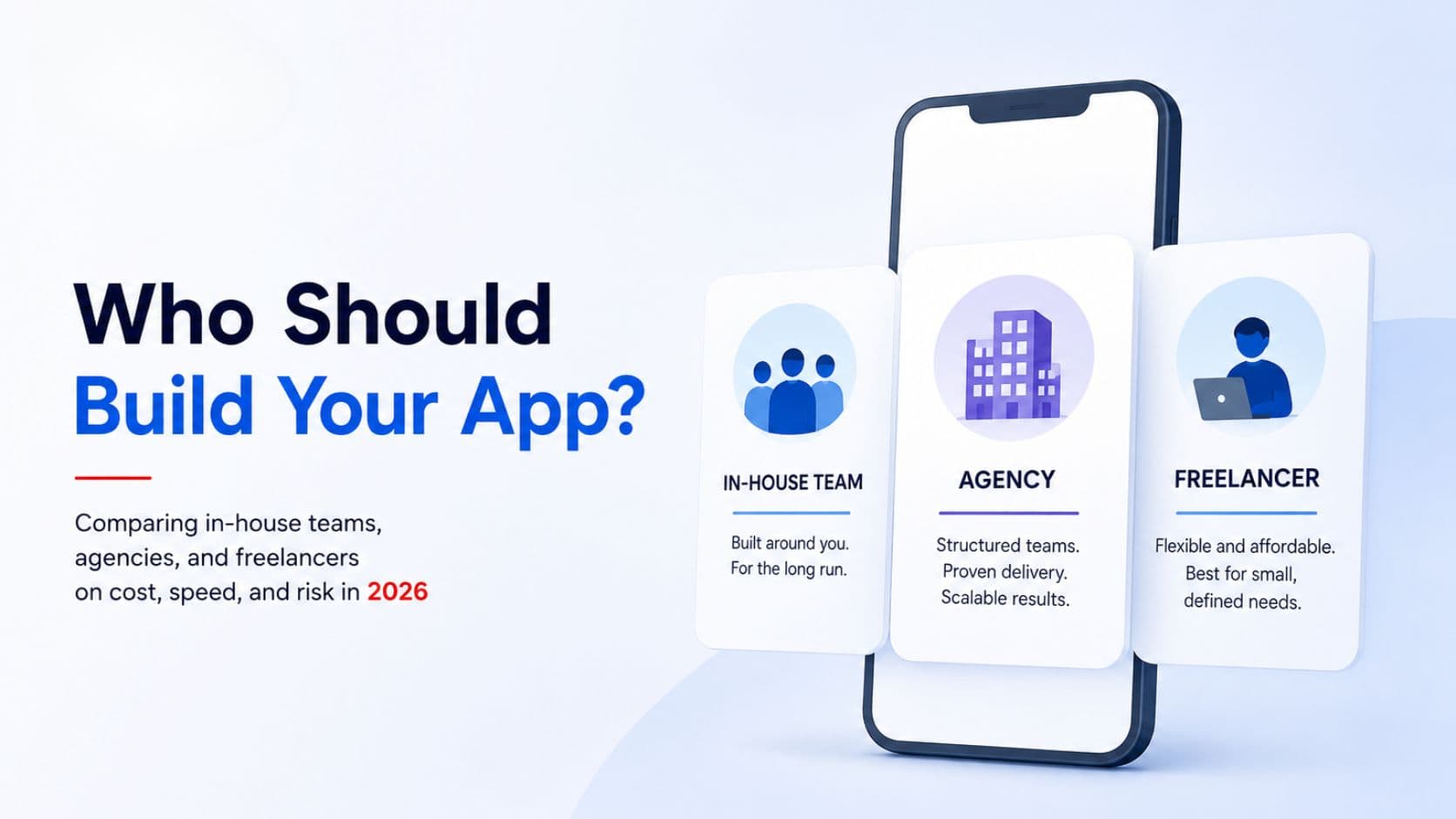
In 2026, choosing between in-house teams, freelancers, or a mobile app development agency is both a capital allocation and product risk management decision.
At Openspace Services (OSSPL), we’ve worked with multiple US startups facing this exact crossroads. And the reality is simple:
There is no universally “best” option; only the best-fit model based on your stage, budget, and risk tolerance. The right decision often depends on when custom mobile app development makes sense for your business model, scalability goals, and operational requirements.
Who actually builds your mobile app development project can directly impact your scalability, cost, and speed to market.
In this guide, we break it down clearly, practically, and with real cost structures, so you can make a confident decision.
Key Takeaways
- A fully loaded in-house mobile developer in the USA costs $160K–$230K/year, making mobile app development cost 2026 a key consideration for growing businesses.
- A mobile app agency project in the US costs $40,000–$300,000+ depending on complexity, which is why many companies prefer mobile app development outsourcing for flexibility and faster execution.
- A US-based freelance mobile developer bills $50–$150/hour but you become the project manager
- Hidden costs like recruitment, ramp-up, attrition, and management overhead routinely add 40–60% on top of any in-house hire's base salary
- Freelancers fail most often on complex, long-term builds because of accountability and single-point-of-failure risk
- The right choice depends on three factors: how often you build, how technical your team is, and how long the app will live
- At Openspace Services, we combine structured delivery with startup-speed responsiveness
In-House vs Agency vs Freelancers: Which Model Makes Sense in 2026?
Most early-stage and growth-stage startups should not be building in-house mobile teams yet. The economics rarely work out, and the organizational lift is larger than it looks on a hiring plan.
That doesn't mean agencies are always right either. And freelancers can be the smartest move in the right situation.
The table below gives you the full picture on in-house vs freelancer vs agency mobile app before we go deeper into each model.
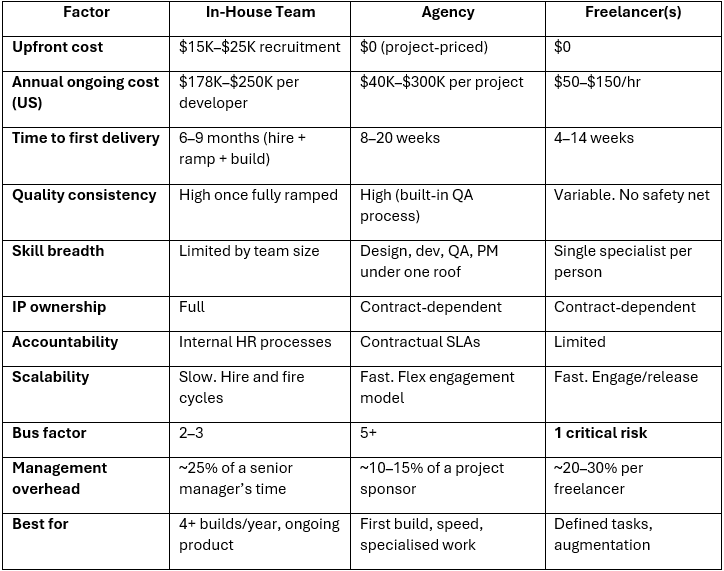
Bus factor is the number of people who need to be unavailable for your project to stop. A solo freelancer has a bus factor of 1. If they disappear (due to emergencies, etc), so does your timeline.
Also Read: Mobile App Development Cost in 2026 – The Honest Breakdown
What are the Hidden Costs of In-House Mobile Development in 2026?
The single biggest mistake founders make when evaluating in-house hiring is treating the salary as the cost. It isn’t. The salary is the baseline.
The average mobile app developer salary in the US is $110,482/year as of 2026, per ZipRecruiter. Here's what the full picture actually looks like:
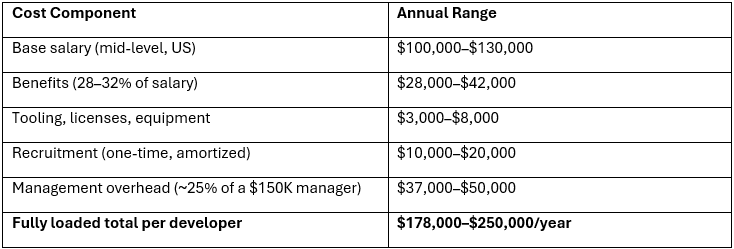
Sources: ZipRecruiter (2026), SHRM recruitment cost benchmarks
And that's before accounting for ramp-up time. A new developer typically takes 3–6 months before contributing at full capacity. You’re paying full cost for partial output during that window.
Then there's the attrition problem. Replacing a developer costs 50–100% of their annual salary when you factor in recruitment, notice period overlap, knowledge loss, and getting the next hire up to speed. Every resignation resets the clock.
There’s also idle capacity. Your in-house team costs the same in a slow quarter as a productive one. Agencies and freelancers don’t.
A two-person mobile team also can’t simultaneously cover iOS, Android, backend, UI/UX, and QA. Something always gets compromised. You either hire more people with compounding every cost above or you ship a product with gaps.
In short, in-house cost is not linear. It compounds.
When Freelancers for App Development Work vs When They Fail?
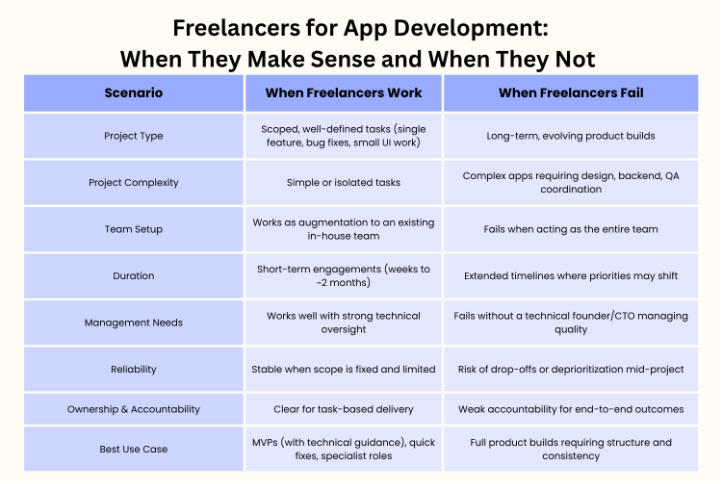
Freelancers get a bad reputation they don’t always deserve. The problem isn’t freelancers; it's misusing them.
Where freelancers are genuinely the right call:
They work well for scoped, defined tasks: building a single feature, fixing a specific bug, migrating a database, or designing three screens for a new onboarding flow.
They also work well as specialist augmentation when you already have an in-house team but need a React Native expert for eight weeks.
For early-stage founders with technical co-founders who can review code and manage scope, freelancers can get an MVP off the ground at a fraction of the cost.
Where they consistently fail:
Long-term product builds. Once an engagement stretches past a few months, the probability of your freelancer deprioritizing your project or disappearing into a better-paying one, climbs sharply. There’s no one else on the “team” who can pick the task up.
Complex projects requiring coordinated effort across design, development, QA, and backend integration. A freelancer can do only one of those well. Meaning all four is your job now.
And non-technical founders. If you can’t review a pull request or spot a poorly architected codebase, you have no mechanism to catch problems until they’re expensive to fix.
The math on a failed freelance engagement:
A $25,000 freelance build that requires a full rebuild three months later because the architecture can’t scale doesn’t cost you $25,000. It costs you $25,000 in sunk spend, another $60,000–$120,000 to rebuild properly with a more accountable partner, and 4-6 months of lost market time.
Industry data puts most custom app projects between $40,000 and $400,000+ once scope is honestly defined. The cheap initial quote rarely reflects the true scope.
The average US freelance mobile developer charges approximately $61/hour, while platform rates on Upwork skew closer to $27 due to international talent. The hourly rate is almost never the problem. The problem is scope creep on hourly billing, no QA layer, and no one accountable when timelines slip.
So, when it comes down to it, would you bring in a freelancer, or are you weighing the decision to hire mobile developer vs agency?
If you’re finding yourself leaning toward an agency model for more structured execution and lower risk, keep reading.
What to Demand from an Agency while Outsourcing Mobile App Development?
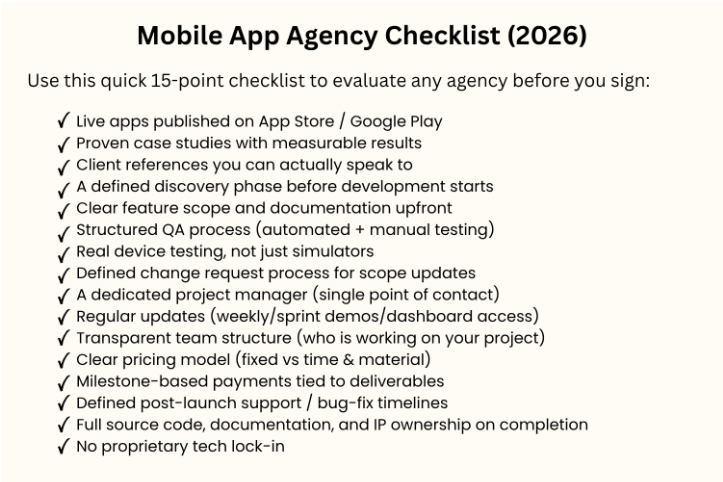
If you’re exploring mobile app development outsourcing in 2026, don’t just compare pricing; evaluate capability. Businesses comparing vendors should also review this framework on how to evaluate a custom mobile app development partner before committing to long-term development engagements. Here’s the exact checklist you can use:
1. Proof of delivery:
- Live apps in the App Store and Google Play from a reliable mobile app development agency — not mockups, not staging links
- Case studies with measurable outcomes: retention, crash rates, launch timelines, user ratings
- Direct references from clients
2. Process and structure:
- A defined discovery phase before any code is written, especially when working with professional mobile app development services
- A documented QA process with automated tests, manual testing, real device coverage
- A clear change management process: what happens when you need to adjust scope mid-build?
3. Team and visibility:
- A dedicated project manager, ensuring transparency typically expected from quality custom mobile app development services
- Sprint reviews, weekly updates, or live project dashboards
- Developer-to-Project Manager ratio on your specific project
4. Commercial terms:
- Fixed-price or T&M. And do you understand which one you’re agreeing to and why?
- Payment milestones tied to deliverables, not calendar dates
- Post-launch warranty period with defined response times for bugs
5. Handover:
- Full source code, documentation, and credentials on project completion
- No proprietary internal tools that create lock-in after the engagement ends
Here’s a detailed breakdown on How to Choose the Right Mobile App Development Agency for Your Business.
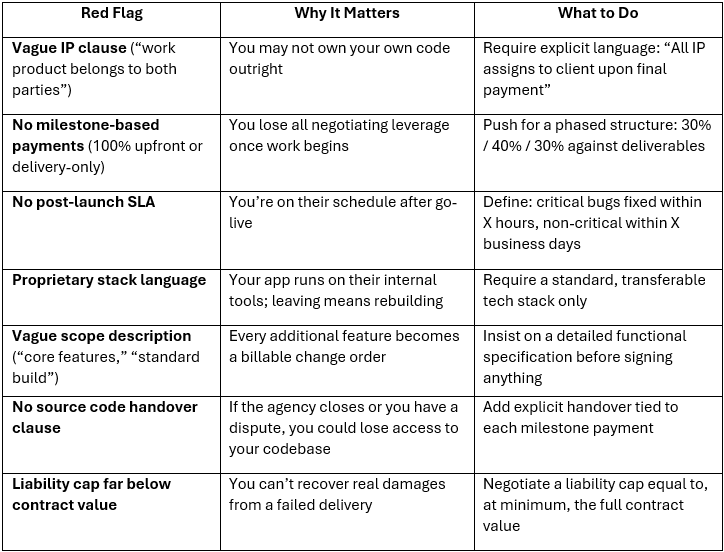
Red Flags in Mobile App Development Agency Contracts to Watch For?
The pitch meeting will almost always go well. The contract is where things get complicated.
Real Results: What a Good Delivery at Openspace Services Look like?
We’ve built across healthcare, edtech, sports management, and IoT. The pattern is consistent:
Successful projects don’t fail on coding; they fail on clarity, structure, and execution discipline.
Case 1: Born Smart (EdTech App)
Problem: Parents needed age-specific, usable content and not just information.
Requirements: Multilingual support, subscriptions, analytics.
Our Approach:
- Discovery before development
- Early architecture alignment
- QA integrated into sprints
Outcome:
- 50,000+ downloads
- 4.3+ App Store rating
- Continuous improvement via analytics
Case 2: Athletiq by PlayMo (Sports Management Platform)
Problem: Disconnected manual systems across academies.
Requirements: Attendance, payments, performance tracking, analytics.
Our Approach:
- Unified platform design
- Multi-user workflows (coaches, parents, trainees)
- Scalable backend
Outcome:
- 4.8-star rating
- Enabled academies to scale without extra admin overhead
And what actually made these work?
- Discovery before development
- Clear architecture from day one
- QA built into the process not added later
- Continuous feedback loops post-launch
Why We Work the Way We Do
The agency market has a real problem: most agencies are either too slow and bureaucratic to be useful for startups, or too small and fragile to be reliable for anything long-term.
We’ve built OpenSpace Services to operate differently, and the difference is structural, not just positioning.
- We run fixed-IP engagements. Full intellectual property transfers to you on final payment. No ambiguity, no joint ownership, no lock-in. Your product is yours.
- We use milestone-based delivery. Projects are scoped and priced as defined deliverables, not open-ended hourly billing. You know what you're getting, and when, before work begins.
- We're genuinely specialists. Our mobile work spans iOS, Android, React Native, and Flutter. Specialization means faster architectural decisions, better-patterned code, and developers who’ve already solved your category of problem on a prior engagement.
- We stay past launch. Every engagement includes a post-launch warranty period and a proper structured handover. You’re never left with a working app and no one who understands it.
Final Thoughts
Choosing between in-house teams, freelancers, and agencies ultimately comes down to one thing: how reliably you can turn your idea into a working, scalable product without costly delays or rework. Each model has its place, but for most startups building or launching their first app, the balance of speed, structure, and accountability matters more than anything else.
If you’re looking for a partner that delivers with clarity, process, and real ownership; there’s a better way to build with Openspace Services (OSSPL).
See Why US Startups Choose OSSPL Over Freelancers and In-House Teams