


For years, you’ve optimised your website for humans: better UX, faster load times, cleaner navigation. But today, over half your website visitors may not be human at all.
According to the 2026 Thales Bad Bot Report, bots now account for 53% of all global web traffic. And buried inside that number is a fast-growing category that most digital leaders are not yet prepared for: agentic AI.
These are autonomous systems that don't just crawl your pages, they interact with them. They fill forms. They compare products. They initiate transactions. The question isn't whether AI agents will visit your website. They already are. The question is whether your website is built to receive them.
Key Takeaways
- Agentic AI traffic grew 7,851% in 2025. AI agents now navigate, transact, and interact with websites autonomously.
- 53% of all web traffic is now automated; human visitors are officially a minority on the internet.
- Websites that lack structured data, semantic HTML, and API access are effectively invisible to AI agents.
- The OSSPL AI-Agent Readiness Framework outlines four pillars to future-proof your digital presence.
- Pages with structured data appear 20–30% more often in AI-generated answers — immediate competitive upside.
What Is an AI Agent?
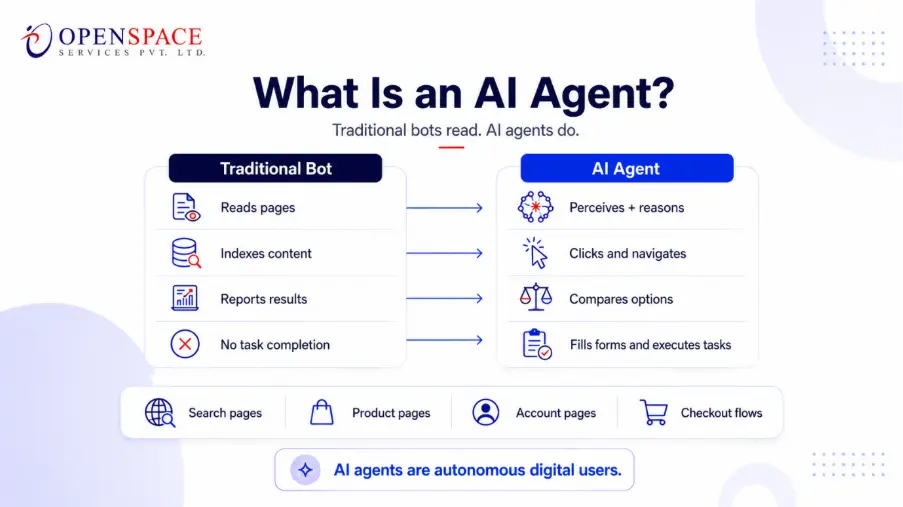
An AI agent is an autonomous software system that can perceive, reason, and act. Unlike a search crawler that reads and indexes pages, an AI agent interacts with them by clicking links, filling forms, comparing options, and executing tasks without human input. For CIOs and digital transformation leaders, this means a new class of “user” is arriving on your platforms, one your current stack was never designed to serve.
Think of it this way: traditional bots were readers. AI agents are doers. Tools like Perplexity Comet, OpenAI’s ChatGPT Atlas, and enterprise workflow automation built on frameworks like Claude and GPT-4o can now browse product pages, extract pricing, submit enquiry forms, and synthesise competitive intelligence; all in seconds, all without a human touching the keyboard.
In 2025, 77% of agentic AI activity occurred on product and search pages, with another 8.8% on account pages and 2.3% on checkout flows; the exact pages your marketing and product teams spend the most time optimising for human conversion. HUMAN Securities, 2026
Many experts refer to this shift as the Agentic Web. An internet where AI agents actively browse, evaluate, and complete tasks on behalf of users rather than simply retrieving information.
How Do AI Agents Interact with Your Website?
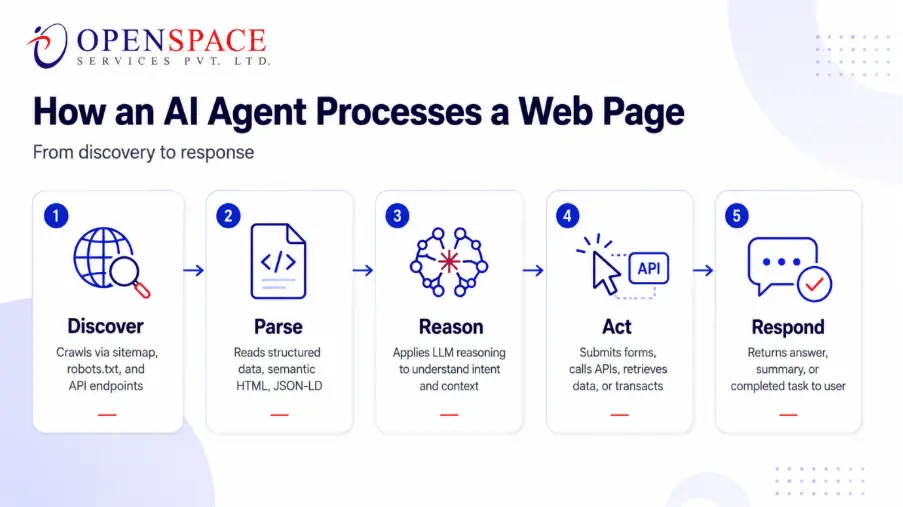
AI agents interact with websites by reading page content, following links, extracting structured information, interpreting navigation, checking authority signals, using APIs and sometimes completing actions such as form submissions or comparisons.
In practice, this creates a different behaviour pattern from human browsing. A human may scroll, pause, click visuals and read selectively. An AI agent may scan several pages quickly, compress the decision journey and look for machine-readable clarity. It will prefer pages where services, pricing logic, FAQs, capabilities, location, proof points and next actions are easy to parse.
This is why AI search optimisation, structured data SEO, technical SEO, accessibility and API readiness are now connected disciplines.
What Makes a Website AI-Agent-Friendly?
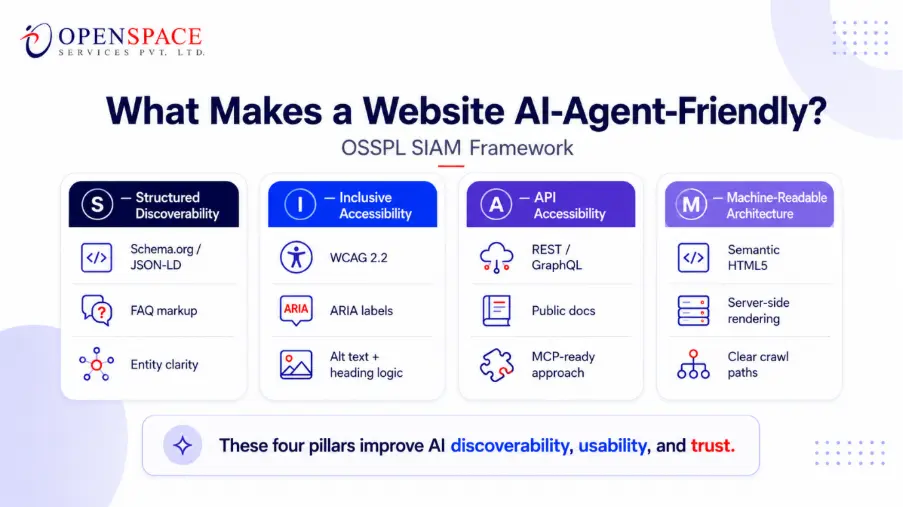
Based on OpenSpace Services’ experience building and modernising digital platforms for clients across the USA, Europe, and the Middle East, we’ve distilled website AI-readiness into four interdependent pillars. We call it the OSSPL’s SIAM Framework for checking AI-Agent Friendliness.
1. S–Structured Discoverability
AI agents need clear information to understand what your business does. And they can do so when your website is well-optimised with Schema.org / JSON-LD, FAQPage markup, Entity definition, AI Overviews optimisation, and Knowledge Graph alignment. Pages with valid structured data appear 20–30% more often in AI-generated summaries.
2. I–Inclusive Accessibility
A website that is easy for people to use is also easier for AI to understand. This makes WCAG 2.2 compliance, ARIA labels, alt text, logical heading hierarchy hyper crucial. Accessible websites are inherently more machine-readable; two goals, one investment.
3. A–API Accessibility
Many AI agents interact with websites through APIs rather than web pages.
AI-friendly websites should:
- Offer RESTful or GraphQL APIs
- Have publicly documented endpoints
- Offer rate-limit policies
- Be ready for MCP (Model Context Protocol) server compatibility
This makes it easier for AI tools to connect with and use your business data.
4. M–Machine-Readable Architecture
Semantic HTML5, clean server-side rendering, clear robots.txt directives, fast TTFB, and no critical content hidden behind JavaScript walls or infinite scroll traps. Such a machine-readable website helps AI agents quickly find, process, and trust your content.
These four pillars form the foundation of modern AI website optimisation. If your website is missing structured data, semantic HTML, accessible content, and documented APIs, it is unlikely to perform well in AI-driven discovery environments.
Businesses that strengthen these foundations improve both AI search visibility and traditional search performance.
Website AI-Readiness Checklist: Where Does Your Platform Stand?
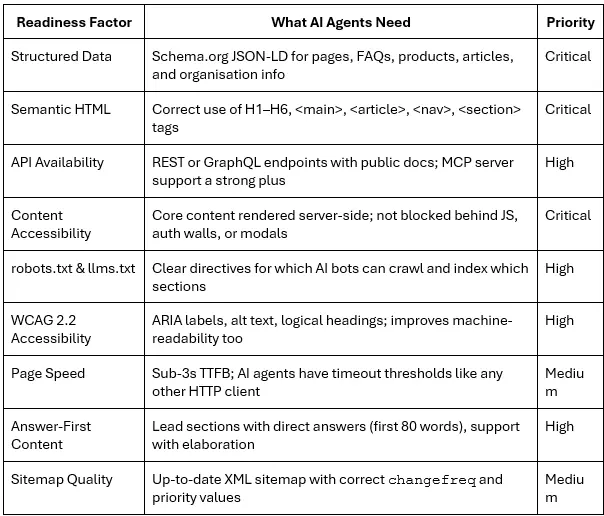
Each readiness factor contributes directly to your AI search visibility, influencing how often your content is surfaced, cited, or recommended by AI assistants.
How Does Structured Data for AI Search Improve Crawlability?
Structured content—particularly Schema.org JSON-LD—helps AI systems extract accurate answers quickly. It reduces ambiguity and increases the chance that your brand is cited, compared or shortlisted correctly.
For example, a normal paragraph saying “We build powerful digital platforms” is weak for AI interpretation. A structured section saying “OpenSpace Services builds scalable Strapi CMS websites, custom software applications, mobile apps, AI/ML solutions, DevOps systems and cloud infrastructure” gives AI systems clearer context.
Use:
- Question-based H2s and H3s
- 40 to 80-word answer blocks
- Tables for comparisons
- Bullets for checklists
- FAQ schema
- Service-specific landing pages
- Clear author and company information
This improves both SEO and AEO because the page becomes easier to quote, summarise and understand.
Do You Need APIs for AI Agents to Interact with Your Website?
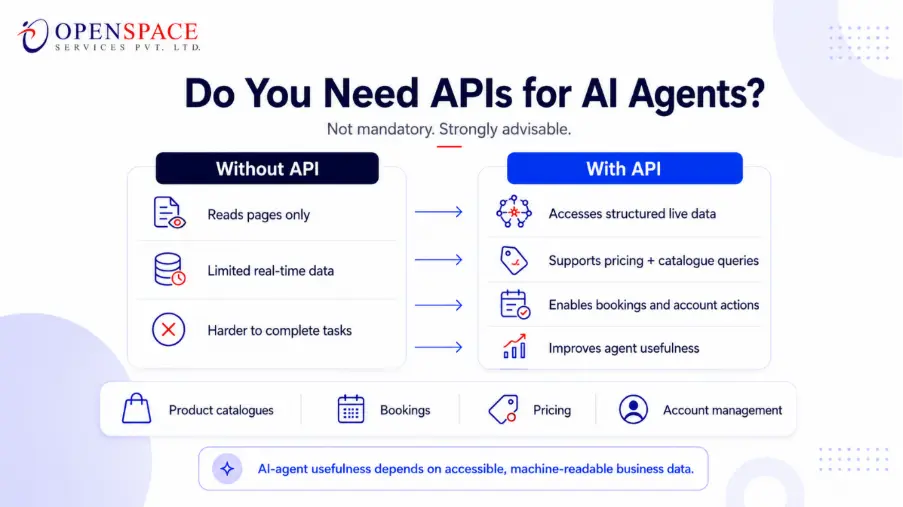
Not mandatory, but strongly advisable. A public or partner API allows AI agents to retrieve structured, real-time data directly. For websites handling product catalogues, bookings, pricing, or account management, an API layer is the difference between being accessible to AI agents and being useful to them.
The rise of agentic AI, systems that complete tasks like booking a service, comparing plans, or submitting a form, makes API accessibility a competitive advantage. If your competitor’s platform offers a documented API and yours doesn’t, an AI assistant helping a customer make a purchase decision will retrieve, present, and potentially transact on your competitor’s data, not yours.
For website and product owners, this is the product strategy question of 2026: Are we building for the AI-agent user? The organisations that answer yes first will define the default options presented to millions of AI-assisted users.
Final Thoughts
AI agents are becoming your next users. They may not admire your hero banner, but they will evaluate your content structure, technical clarity, accessibility, trust signals and action paths.
The mobile-friendly era taught businesses to design for new user behaviour. Now this era, with AI-agent-friendly era, will reward businesses that design for both people and intelligent systems.
If your website, CMS or digital platform is not yet structured for AI-led discovery, OpenSpace Services Pvt Ltd can help you modernise it with the right mix of AI/ML, website development, headless CMS, cloud, DevOps, data and custom software expertise.
Ready to make your website AI-agent-friendly?
Connect with OpenSpace Services and build a digital experience prepared for the way users search in 2026 and beyond.