
Did you know, your content management system might be the single biggest bottleneck to your company’s growth in 2026?
Think about the last time your marketing team had to wait weeks for a developer to publish a landing page. Or the last time your mobile app showed outdated content because it couldn’t sync fast enough with your website backend. Or the time your enterprise client walked away because your platform couldn’t deliver localized content at scale.
These are symptoms of a legacy architecture problem that traditional CMS platforms were simply never built to solve. Modern businesses now require headless CMS solutions capable of powering scalable, omnichannel digital experiences.
Modern consumers interact with brands across multiple touchpoints—websites, mobile apps, smart TVs, voice assistants, and even digital signage. Yet legacy, monolithic CMS solutions were built for a single channel: the website. They simply aren’t equipped for a multi-channel world.
If your business is scaling, expanding into new markets, or trying to deliver seamless digital experiences, it may be time to rethink your approach. This is where a headless CMS architecture becomes essential for businesses managing websites, mobile apps, and multiple digital touchpoints.
In this article, we’ll break down what a headless CMS is, how it differs from traditional systems, how it works, its key benefits, and how to choose the right solution and development partner for your business.
Let’s get started.
Key Takeaways
- Headless CMS separates backend and frontend, delivering content via APIs—this enables true flexibility and omnichannel delivery.
- Headless CMS vs traditional CMS: Traditional systems are rigid and web-focused, while headless is scalable, faster, and built for multi-platform experiences.
- Key headless CMS benefits include better performance, improved SEO, stronger security, and faster time-to-market for new channels.
- It’s ideal for growing businesses managing multiple digital touchpoints or facing CMS-related development bottlenecks.
- Adoption depends on readiness: Headless requires developer support but offers long-term scalability and efficiency when implemented correctly.
What is Headless CMS?
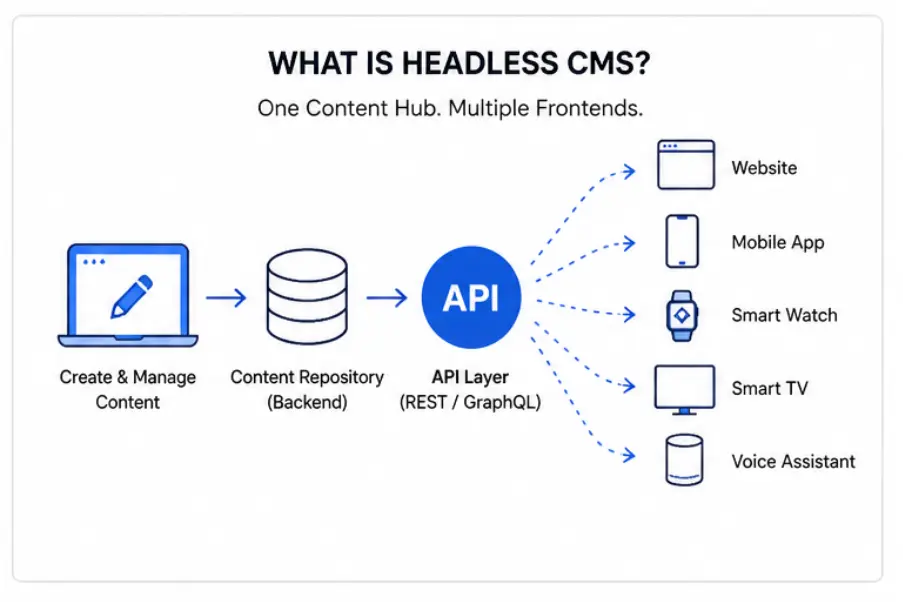
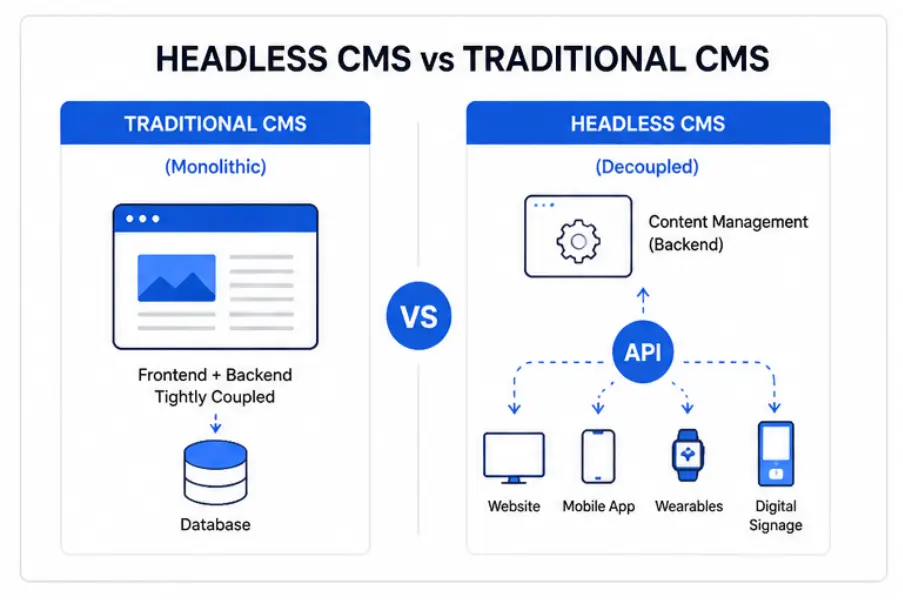
A Headless CMS is a backend-only content management system that stores and manages content in a structured repository and delivers it via APIs; with no built-in frontend or “head.”
Unlike traditional CMS platforms, it doesn’t dictate how or where content is displayed.
Developers can connect any frontend (a website, mobile app, smart TV interface, or IoT device) to the same content backend through REST or GraphQL APIs. This makes it the foundation of truly omnichannel digital experiences.
The word “headless” refers to the removal of the “head”; the presentation layer (HTML templates, themes, frontend rendering) from the content system. What remains is a pure content engine: powerful, flexible, and completely channel-agnostic. If you're exploring this architecture for the first time, this beginner’s guide to Strapi CMS explains how modern headless CMS platforms are structured and implemented.
What is the Difference? Headless CMS vs Traditional CMS
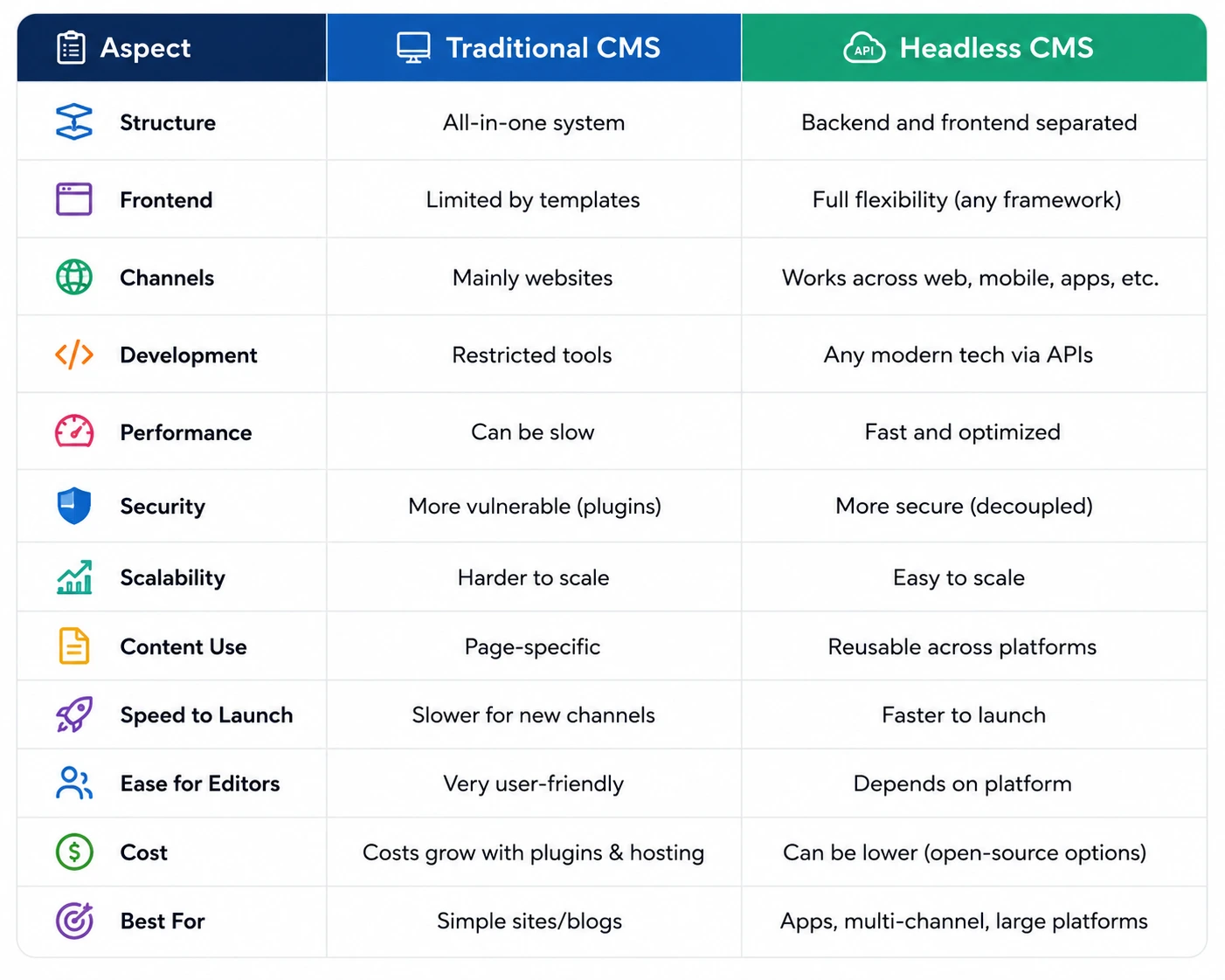
How Does Headless CMS Works in 2026?
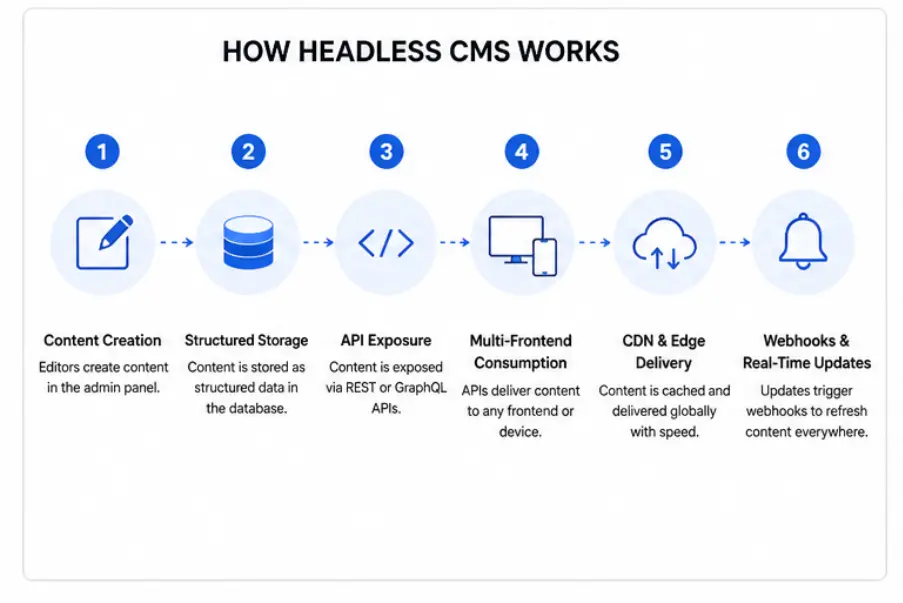
Here’s how content moves from creation to every screen your users interact with:
1. Content Creation: The Admin Panel
Editors and marketers create structured content (articles, product listings, landing page blocks, media assets) in the CMS admin interface. Strapi, for example, provides a clean, role-based editorial UI that non-technical users can operate independently with custom content types defined by developers once, used by editors forever.
2. Structured Storage: The Content Repository
Content is stored as structured data in a database (PostgreSQL, MongoDB, etc.) not as HTML. This means a “blog post” is stored as discrete fields: title, author, body, tags, SEO metadata, featured image; completely presentation-agnostic. The content knows nothing about how it will be displayed.
3. API Exposure: REST or GraphQL
The CMS exposes all content through a standardized API layer; either REST endpoints (/api/articles) or a GraphQL schema. In 2026, GraphQL is the dominant choice for complex content graphs, while REST remains preferred for simpler, mobile-first architectures. Strapi auto-generates both.
4. Multi-Frontend Consumption
Any frontend, including a Next.js website, a React Native mobile app, a Flutter app, a digital kiosk, an Alexa skill, or a smartwatch UI; queries the same API and renders the content according to its own design system. One content update reaches every channel simultaneously. No duplication. No gaps.
5. CDN & Edge Delivery
In 2026, most headless architectures pair with a CDN or edge network (Vercel Edge, Cloudflare Workers, AWS CloudFront) to serve pre-rendered or incrementally static regenerated pages at sub-100ms response times globally. Your users in Mumbai, Dubai, and New York get the same blazing speed.
6. Webhooks & Real-Time Updates
When a content editor publishes an update, the CMS triggers webhooks that notify all connected frontends to revalidate or rebuild affected pages. With Next.js ISR (Incremental Static Regeneration), this means live content updates reach production in seconds.
What are the Key Headless CMS Benefits for Businesses in 2026?
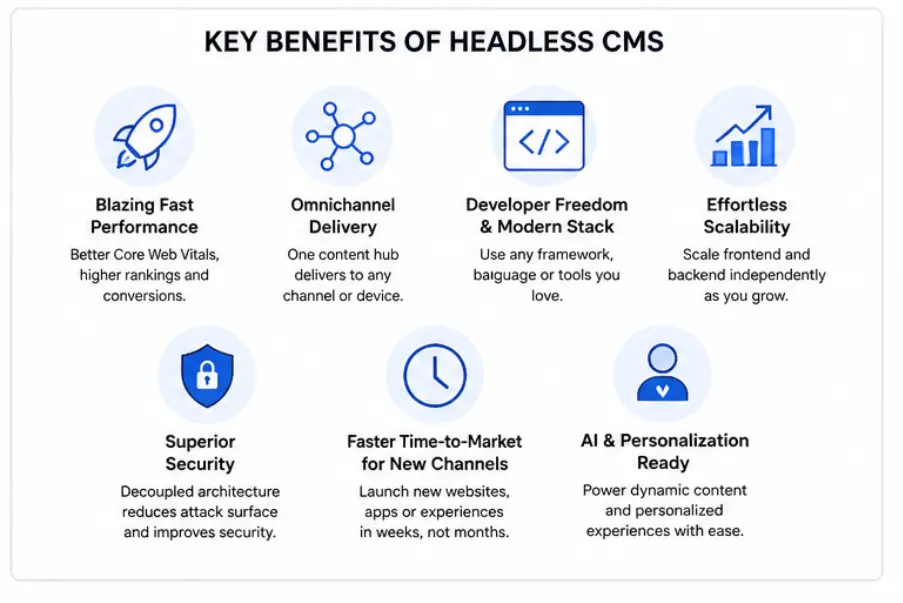
Every benefit below maps directly to measurable business outcomes that OSSPL's clients have experienced.
1. Dramatically Faster Page Performance
Headless sites served via CDN with SSG or ISR routinely achieve Core Web Vitals scores in the "Good" range. Faster pages mean higher Google rankings, lower bounce rates, and directly higher conversion rates.
2. True Omnichannel Delivery
One API. Infinite frontends. This is exactly why many enterprises are adopting Strapi CMS for modern web applications that require scalability, flexibility, and faster deployment cycles. Your content team publishes once, and it flows simultaneously to your website, mobile app, in-store kiosk, email system, and smart TV interface without any extra effort.
3. Developer Freedom & Modern Stack
Developers can build frontends in any framework — React, Vue, Svelte, Flutter — without being locked into a PHP/plugin ecosystem. This attracts better engineering talent and enables faster feature development.
4. Effortless Scalability
Because the frontend is static or edge-rendered and the backend is a standalone API service, each layer scales independently. Traffic spikes on your marketing site don't impact your CMS performance.
5. Superior Security Posture
The content database is never directly exposed to the public internet. There's no plugin ecosystem to exploit. For enterprises handling sensitive customer data, this architecture dramatically reduces the attack surface.
6. Reduced Time-to-Market for New Channels
Launching a new mobile app or regional website? With headless, your content infrastructure is already done. Your team now only needs to build the new frontend directly cutting down the launch timelines from months to weeks.
7. AI & Personalization Ready
In 2026, AI-powered personalization engines (Adobe Target, Optimizely, custom LLM layers) can query your headless CMS to serve dynamically personalized content based on user behaviour, location, and intent; something monolithic CMSes cannot support natively.
Who Is Headless CMS NOT Right For?
Headless CMS is surely transformative but it’s not the right solution for every business, every budget, or every team. Here's honest guidance:
Consider Traditional CMS Instead If...
- You’re a small business with a single website and no apps. WordPress or Squarespace will serve you better and cost far less. Headless adds engineering complexity without proportional ROI at this scale.
- Your team has no developers (or very limited technical capacity). Headless CMS requires at minimum a developer to set up and maintain the frontend. Without in-house or agency engineering support, you'll be stranded.
- You need a working website in under 2 weeks with no budget for development. A traditional CMS with a pre-built theme gets you live faster for zero or minimal cost. Headless requires a custom frontend build.
- Your content is entirely managed by non-technical users with zero developer involvement ever. Traditional WYSIWYG editing in WordPress still offers a simpler experience for teams that will never touch code.
- Your content model is extremely simple (5 pages, rarely updated). The infrastructure overhead of a full headless architecture is overkill for brochure sites.
The inflection point is typically when a business reaches two or more digital channels, a marketing team that publishes more than once a week, or an engineering team that’s spending significant hours on CMS maintenance instead of product development.
That’s when headless is the right solution.
What are the top Headless CMS Options? Brief Overview
The headless CMS landscape has matured significantly. Here are the leading platforms we work with and recommend, depending on your use case:
The most popular open-source headless CMS. Self-hosted, fully customizable, with auto-generated REST & GraphQL APIs. Ideal for enterprises needing control over data and infrastructure. OSSPL's primary recommendation for most clients. In fact, this shift is accelerating globally, especially among scaling SaaS and enterprise brands. Here's why US startups are choosing Strapi development over traditional CMS platforms in 2026.
2. Contentful (SaaS)
The enterprise SaaS standard. Excellent developer experience and a robust content modeling system. Best for global enterprises willing to pay premium SaaS pricing. Can become expensive at scale.
3. Sanity (SaaS)
Known for its real-time collaborative editing and highly flexible “Portable Text” content model. Excellent for media companies and agencies that need custom editorial experiences.
4. Hygraph (SaaS)
GraphQL-native from the ground up. Strong choice for teams that want a GraphQL-first architecture with federated content from multiple sources. Well-suited for complex content federation scenarios.
How to Choose a Headless CMS Development Partner
Choosing the right platform is only half the equation. The expertise of the partner who implements it determines whether your headless investment delivers real ROI or becomes a maintenance burden.
Here’s what to look for and the questions to ask before signing anything:
- Proven headless delivery track record: Ask for case studies with named clients, real metrics, and descriptions of the tech stack. Agencies that are "exploring" headless on your project are a liability.
- Deep API architecture expertise: Your partner should be fluent in REST, GraphQL, webhook design, and CDN strategies not just CMS configuration.
- Frontend-backend full-stack capability: Headless requires coordinated work on the CMS backend AND the frontend frameworks. Verify your partner owns both layers.
- Long-term managed services support: Headless architectures require ongoing maintenance: CMS upgrades, security patches, API versioning, and CDN optimization. Confirm post-launch support terms.
- Performance-first engineering culture: Ask what Core Web Vitals scores their last three headless projects achieved on launch day. Sub-2.5s LCP should be the baseline expectation.
- Transparent project management: Look for structured delivery methodology with clear milestone documentation, sprint reviews, and regular client communication — not just a Slack channel and vague timelines.
- Data residency and security awareness: For enterprises, your partner must understand data sovereignty requirements (especially relevant for Indian businesses under DPDP Act 2023 compliance).
What OpenSpace Services Delivers | Case Study: ANAROCK
OpenSpace Services (OSSPL) is a full-stack digital engineering firm specialising in headless CMS, Strapi development, and enterprise web platforms. We deliver scalable solutions across industries including real estate, aviation, and governance. This project demonstrates how a properly planned headless CMS architecture can improve SEO, scalability, and content operations simultaneously.
Here’s one example of what that looks like in the real world:
Real Case Study ANAROCK (Real Estate Platform)
A leading global real estate consultancy serving multiple business segments (residential, commercial, advisory, land).
The Challenge:
- Fragmented digital presence across segments
- Risk of siloed content, inconsistent branding, and high maintenance
- Need for a unified, scalable enterprise platform
The Solution:
OSSPL built a headless architecture using:
- Strapi (content backend)
- Next.js 14 (frontend)
- PostgreSQL (data layer)
- Amazon Web Services (infrastructure)
- Tailwind CSS (UI)
The Result:
A single content engine powering a unified, SEO-optimized, multi-segment platform, fully manageable by content teams without engineering dependency.
Key Achievements:
- Higher Engagement: Higher session time via seamless navigation
- Higher Rankings: Strong SEO gains from optimized architecture
- Higher Retention: Faster load times + improved UX increased repeat visits
- Stronger Brand Perception: Unified platform strengthened market positioning
Read the full case study here.
Our Strapi CMS development services are built around this exact delivery model not just implementation, but architecture strategy, performance engineering, and long-term managed support.
Final Thoughts
In 2026, the question isn’t whether to adopt a headless CMS; it’s when and how. With ~25.8% annual growth, the shift is driven by real business costs from legacy systems that can’t handle modern speed, scale, and complexity.
Headless CMS isn’t a cure-all. But if you operate across multiple channels, plan to scale, or your team spends excessive time on CMS maintenance and plugin conflicts, it signals a need for structural change.
The model is proven. Tools like Strapi are mature, enterprise-ready, and open-source. The key decision is choosing the right implementation partner that treats your digital infrastructure as a long-term investment, not a one-off build.
At OpenSpace Solutions Pvt Ltd, we’ve built and shipped headless CMS platforms across industries, let’s talk about what the right architecture looks like for your business.