

You asked three different development agencies what technology they would use to build your app.
One said Flutter. One said React Native. The third said you absolutely need a native build in Swift and Kotlin.
All three sounded confident. All three gave you different quotes. And none of them spent more than five minutes asking about your business.
This is one of the most common frustrations business owners face when exploring custom mobile app development services — unclear technology choices, confusing terminology, and recommendations that are not aligned with business goals.
This guide cuts through all of that. By the end of this guide, you will know exactly what each major technology does, what questions to ask before committing, and how to spot when an agency is steering you in the wrong direction.
Quick Definition: What Is a Mobile App Stack?
A mobile app stack is the combination of programming languages, frameworks, and tools used to build your mobile application.
Your choice of stack directly impacts how efficiently your mobile development service is executed, including cost, scalability, and long-term maintenance.
The Mobile Development Landscape in 2026: What Has Actually Changed
Mobile app development has shifted significantly over the past few years. The debate used to be simple: do you build a native app (one built specifically for iOS or Android) or do you go cross-platform (one codebase that works on both)?
That debate is largely over. Here is what has changed in 2026:
Cross-platform frameworks have matured. Flutter and React Native now deliver performance that is, for most business apps, indistinguishable from native to real users.
A new contender has emerged. Kotlin Multiplatform (KMP) has grown from 7% adoption in 2024 to 23% in 2025, used in production by companies like Netflix, Cash App, and Google Workspace.
AI-assisted development has shortened timelines. Developers across all stacks are shipping faster, which changes the cost and timeline calculations for every option.
The market is about strategic fit, not framework superiority. In 2026, the question is not which technology is best in a lab. It is which technology best matches your specific situation.
The technology is no longer the limiting factor. It has become a part of your decision making.
Today, modern mobile apps services are no longer limited by technology but by how well the chosen stack aligns with business strategy.
The 6 Questions That Should Drive Your Stack Decision
The right stack for your app depends on your specific business context. These six questions will give you the clarity you need before any agency conversation.
1. Are You Building for One Platform or Both?
This is the first and most important question.
- If your app is iOS-only, native Swift is worth serious consideration.
- If it is Android-only, Kotlin is the natural choice.
But if you need both platforms, cross-platform frameworks like Flutter or React Native immediately become the more practical option.
Most businesses building a consumer-facing or B2B app today need both iOS and Android. In that case, starting with a cross-platform framework saves significant time and cost from day one.
2. What Is Your Budget and Timeline?
Choosing the right approach is critical when investing in app building services, as it determines both initial cost and long-term scalability.
Cross-platform development can reduce your build cost compared to maintaining two separate native codebases. That is because one development team can build and update a single codebase instead of two.
Native development means two teams, two codebases, two sets of updates, and two sets of testing. It delivers the highest performance ceiling, but it comes with a premium that not every business needs to pay.
3. How Important Is UI and UX to Your Product?
If your app's visual identity is central to your brand and you need pixel-perfect, heavily animated interfaces, Flutter is the strongest choice in the cross-platform space. Its custom rendering engine gives designers and developers a high degree of control.
If a native look and feel matters more to your users (for example, they expect your app to feel like a standard iOS or Android app rather than a custom-designed experience), React Native or a native build may serve you better.
4. What Does Your Post-Launch Roadmap Look Like?
Many businesses underestimate how much of their total app cost comes after launch. If you plan to release frequent updates, add new features regularly, or run A/B tests on the interface, a single cross-platform codebase will save you significant time and money over the long term.
If your app is a stable, relatively fixed product that will not change often, the single-codebase advantage is less pronounced.
5. Who Will Maintain the App After Launch?
This question is rarely asked early enough. If you plan to bring development in-house eventually, consider which stack is easier to hire for. React Native benefits from a very large JavaScript talent pool. Flutter's community is growing fast. Swift and Kotlin developers are available but more specialised.
If an agency will maintain the app on your behalf, make sure you understand the implications for your long-term relationship with that agency. You should always own your code and be able to move it elsewhere.
6. How Complex Is Your App?
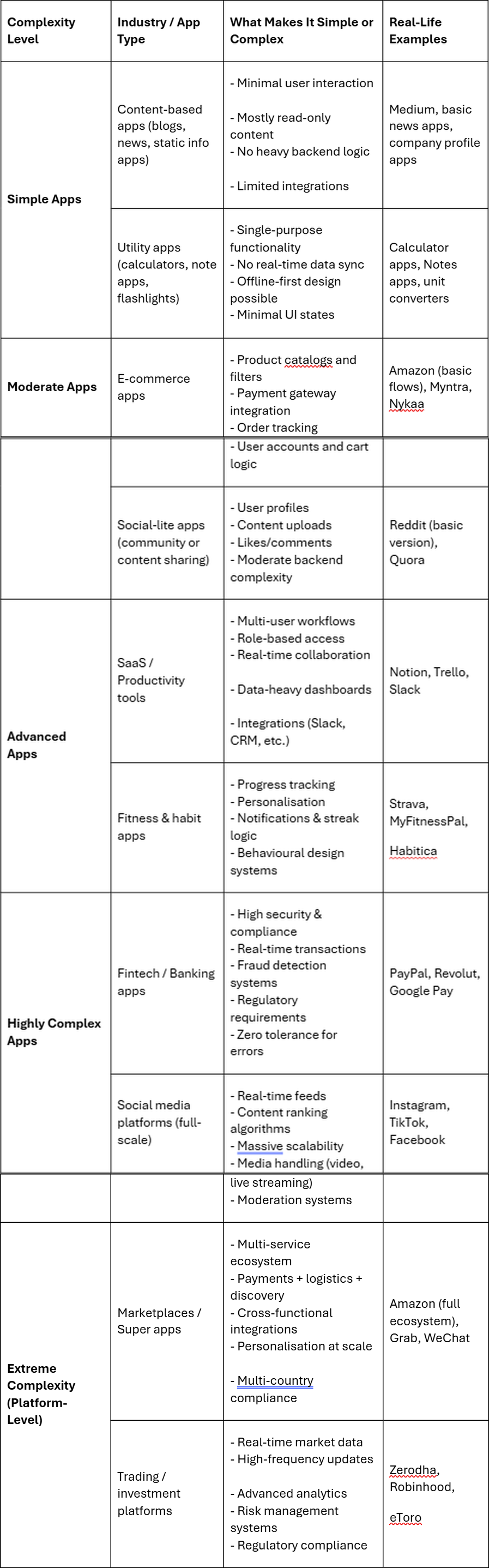
For the vast majority of business apps, including e-commerce platforms, booking tools, dashboards, fintech products, and delivery apps, cross-platform frameworks now handle everything well. The performance gap with native is negligible to real users.
Native development still holds a genuine edge in specific scenarios: apps that rely heavily on advanced camera functionality, augmented reality, health sensor integration, or deep hardware access. If your app requires features like these from day one, native may be worth the investment.
Stack-by-Stack Breakdown: What It Means for Your Business
Flutter
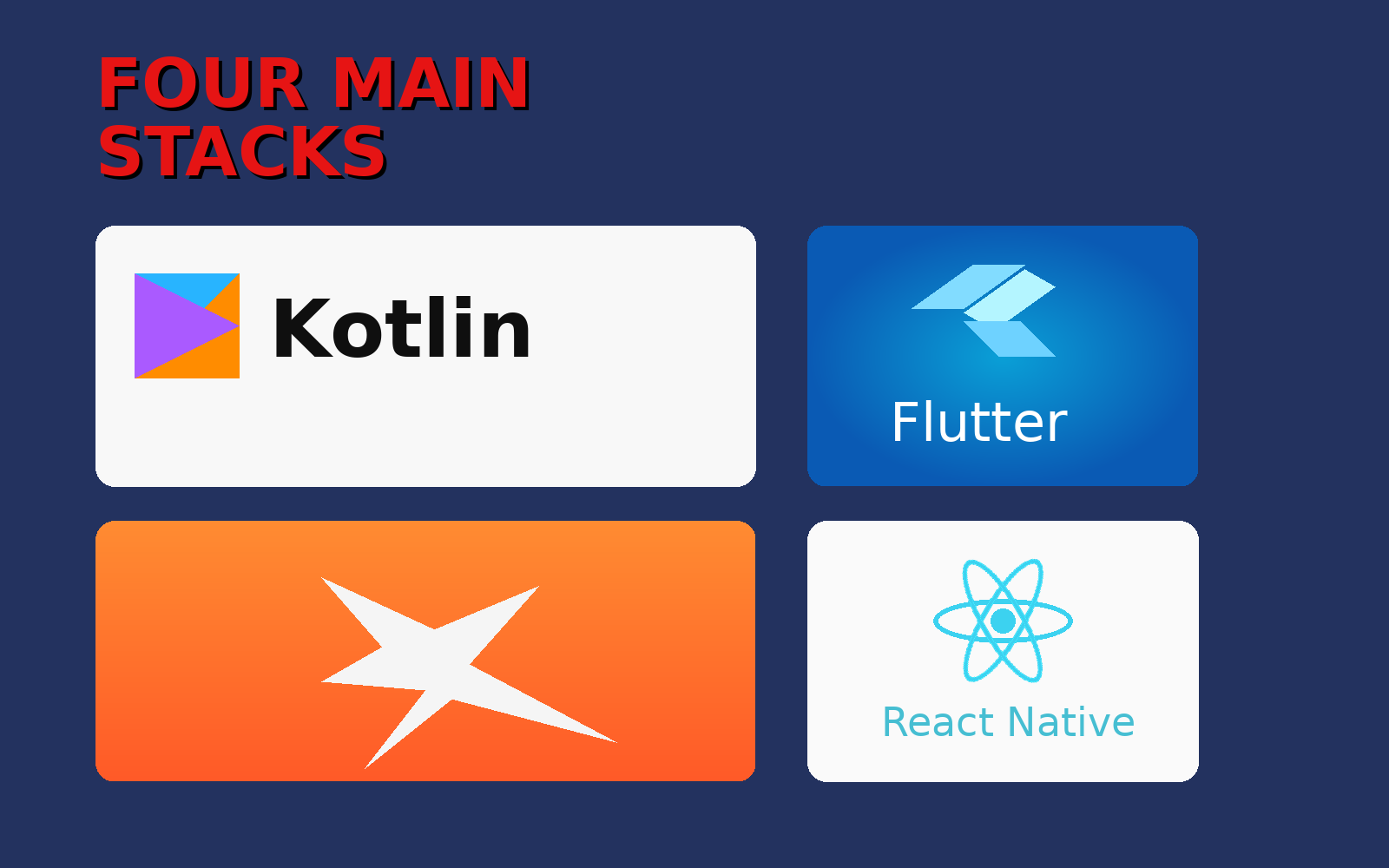
Flutter is currently the most popular cross-platform framework in 2026, and for good reason. Flutter leads cross-platform frameworks with 46% developer adoption in 2026, up from 30% in 2019, powering over 500,000 apps on Google Play and 30% of new free iOS apps Its single codebase approach works across iOS, Android, web, and desktop.
Real-world examples: eBay Motors, Google Pay, Alibaba, and ByteDance all use Flutter in production.
Best suited for: Startups wanting to move fast, SMEs building their first app, businesses that need both platforms at a reasonable cost, and products where UI quality is a priority.
One honest limitation: Dart is not as widely known as JavaScript, so the talent pool, while growing, is smaller than React Native's. The Dart learning curve can also slow down teams coming from a web development background.
React Native
React Native is the battle-tested workhorse of cross-platform mobile development. Its biggest practical advantage is the talent pool. Because it is built on JavaScript and shares patterns with React (the most widely used web framework), there are more React Native developers available than for any other mobile framework.
Real-world examples: Facebook, Microsoft Office, Shopify, and Xbox Game Pass are all built with React Native.
Best suited for: Teams with existing JavaScript or web development experience, businesses that need to move to mobile quickly, and organisations that want the widest possible hiring options.
One honest limitation: React Native relies on native UI components, which can occasionally lead to subtle differences in how the app looks and behaves across iOS and Android. Complex UI animations can also require more effort to perfect.
Swift (Native iOS)
If you are building an app exclusively for the Apple ecosystem and you are willing to invest in the highest quality iOS experience, Swift is the gold standard. It is Apple's own language, which means new iOS features, APIs, and hardware capabilities are available to Swift developers on launch day.
Real-world examples: Airbnb's iOS app and Lyft's iOS app are built with Swift, as are most flagship iOS products from major consumer brands.
Best suited for: Apps targeting iPhone or iPad users exclusively, products in the health, fitness, or wearables space that need deep Apple ecosystem integration, and businesses for whom iOS is the primary or only target platform.
Kotlin (Native Android)
Kotlin is the modern standard for Android development, and the language Google officially recommends for building Android apps. If your target audience is predominantly Android users (which is the majority of the global smartphone market, particularly in markets like India, Southeast Asia, and Africa), Kotlin gives you full access to the platform's capabilities.
Real-world examples: Most major Android apps, including many Google products themselves, are built with Kotlin.
Best suited for: Android-first products, apps requiring deep integration with Android hardware, and businesses serving markets where Android dominates device usage.
One honest limitation: Like Swift, Kotlin only builds for Android. A combined iOS and Android strategy requires a separate codebase, a separate team, and a higher ongoing investment.
One honest limitation: Swift only builds for Apple platforms. If you need Android too, you are looking at a second development effort entirely, which significantly increases cost and complexity.
Native options dominate app stores: Swift builds 82% of App Store apps, while Kotlin powers 79% of Google Play apps and is used by over 60% of professional Android developers.
Also Read: Mobile App Development Cost in 2026 - The Honest Breakdown No Agency Wants You to See
Short Summary
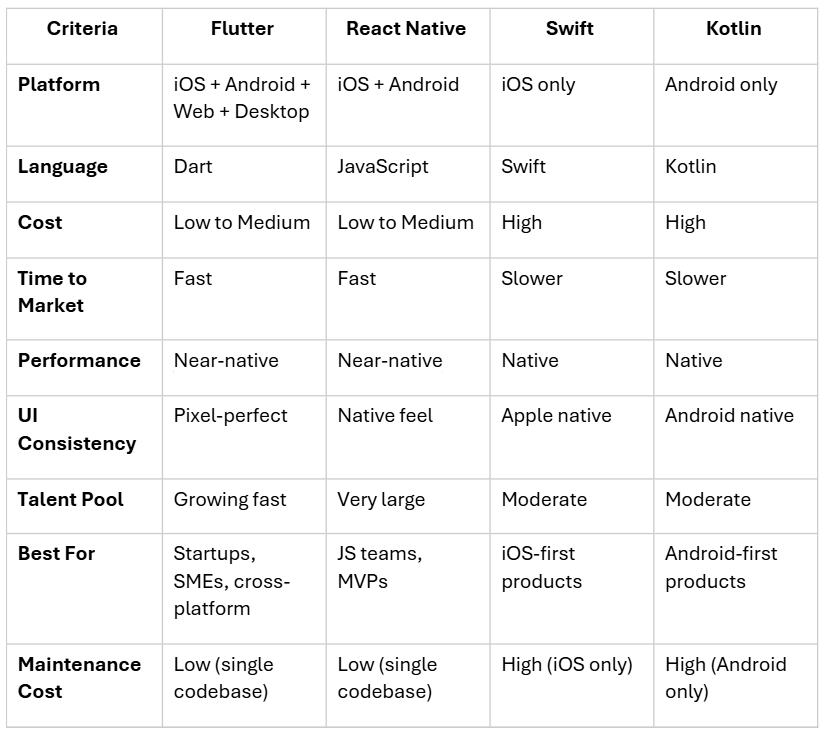
Warning Signs to Notice When an Agency Recommends a Stack
A strong development partner will guide you to the right technology for your business. A less scrupulous one will guide you toward the technology they already know how to build. Here is how to tell the difference.
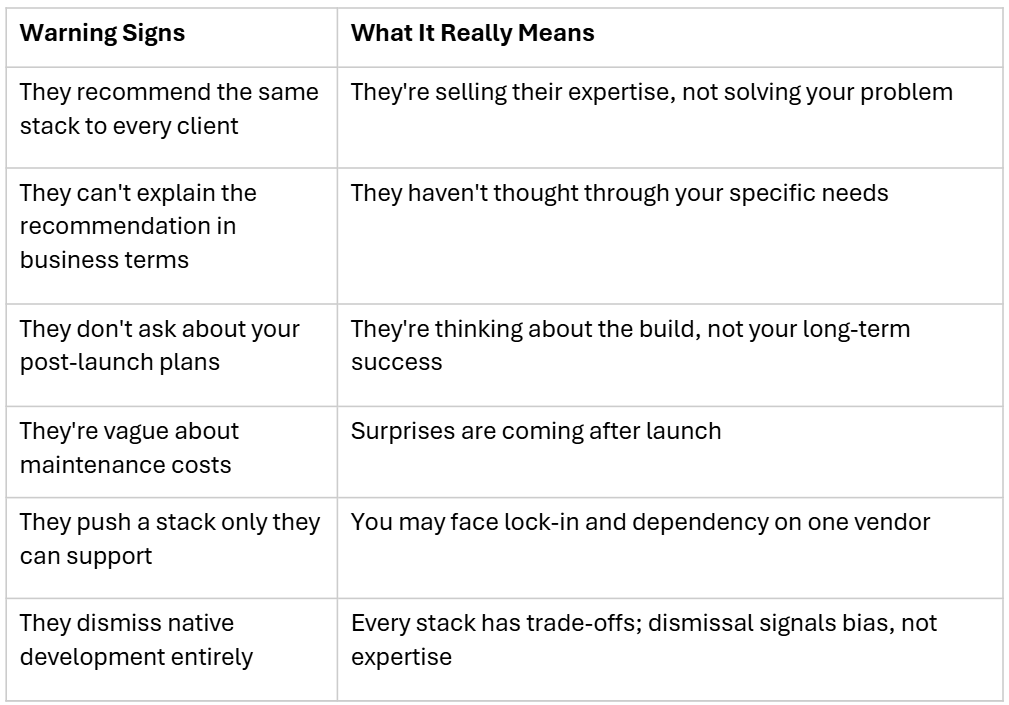
A genuinely good development partner will walk you through the trade-offs of each option, ask about your budget, your timeline, your roadmap, and your team, and give you a recommendation that makes sense for your specific situation, not theirs.
How We Approach Stack Selection at Openspace Services (OSS)
At OSS, our custom mobile app development services are designed around your business goals, not just technology preferences.
Whether you need end-to-end mobile apps services or support with scaling an existing product, our approach remains strategy-first.
Before we recommend any stack, we work through a structured discovery process that covers your
Target audience
- Platform priorities
- Budget and timeline
- Post-launch roadmap
- Long-term maintenance plans.
Only then do we recommend a technology, and we are always transparent about why.
Our team work across Flutter, React Native, Swift, and Kotlin. We do not have a preferred stack or a vendor relationship that skews our recommendations. Our only interest is helping you build the right product at the right cost, in the right timeframe.
We have helped businesses across sectors, from early-stage startups to established enterprises, make exactly this decision. In our experience, the businesses that get the most out of their mobile investment are not the ones who chose the most sophisticated technology. They are the ones who chose the technology that matched their specific context.
Conclusion
Choosing a mobile app stack is not a technology decision. It is a business decision that happens to involve technology.
The right answer depends on where you want to reach your users, how much you want to spend, how fast you need to move, and what your product needs to do.
Flutter and React Native are excellent choices for most business apps in 2026, offering near-native performance at a significantly lower cost than dual native development. Swift and Kotlin remain the right choice when you are building exclusively for one platform and need maximum performance or deep platform integration.
What matters most is that you go into the conversation with your development partner armed with the right questions. Ask them to justify their recommendation. Ask about the long-term maintenance implications. Ask about your ownership of the code. And if they cannot answer those questions in plain language, keep looking.
Ready to Make the Right Call?
At Openspace Services, we help businesses choose the right mobile app stack before writing a single line of code. If you are planning a mobile app and want an honest, business-first recommendation, we would love to have a conversation. Get in touch with our team today and let us help you build something that works.