Quick answer
AI/ML development services in the USA cover everything from finding the right use case to running a model in production. A good partner starts with your workflow, not the technology. They test on your real data, connect the AI to your systems, and keep a person in the loop where accuracy matters. Most of the early value sits in back-office work.
Most businesses don't need "an AI strategy" to get started. They need one slow, repetitive process fixed. Think of the invoices someone retypes every morning, or the forms a team checks by hand.
That's where AI earns its keep first. This guide shows what to expect from a partner, from the first call to a system running every day.
What do AI/ML Development Services Include?
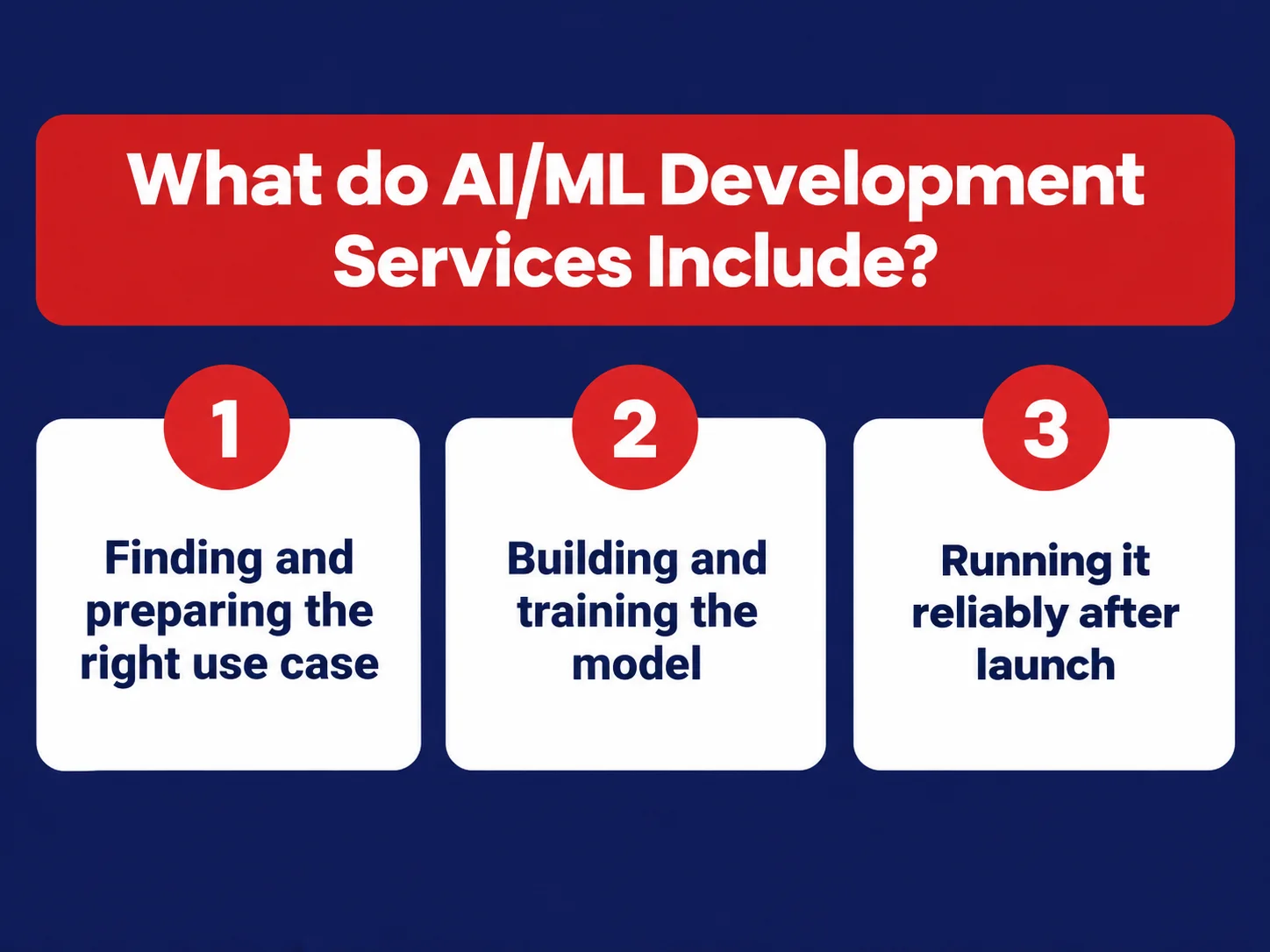
AI/ML development services cover three stages:
- Finding and preparing the right use case
- Building and training the model
- Running it reliably after launch.
The last stage is the one most buyers underestimate. It's also where the value shows up.
How Does Use-Case Discovery and Data Readiness Work?
Discovery starts with how work happens today. The partner maps the process step by step, then finds where AI can save the most time.
Next comes a data check. Do you have enough examples, such as past documents, records or emails? Are they stored somewhere the model can reach?
For document-heavy workflows, this discovery phase can reveal opportunities to automate extraction, classification, verification, and routing. Our guide to AI workflow automation explains how document data can be converted into structured information that existing business systems can use.
How are Models Built and Trained?
Many projects today don't need a model built from scratch. A partner often starts with an existing model, such as Gemini or an open model like Qwen, and adapts it to your data. That's faster and cheaper.
The right approach depends on the task, available data, accuracy requirements, cost, and integration constraints. Some workflows benefit from an existing foundation model, while others need conventional machine learning for forecasting, classification, or anomaly detection. Explore our guide to generative AI applications to understand where generative models fit into business software.
Traditional ML development services still matter for prediction tasks. Think demand forecasting, fraud scoring or spotting unusual readings. Those models train on your own historical data.
What Happens After Launch?
A model in production needs care. That work is often called MLOps.
- Monitoring:Tracking accuracy on live data
- Retraining:Updating the model as your data changes
- Exception review:Sending low-confidence cases to a person
- Integration:Keeping the AI connected to your other systems
Which Business Problems is AI Best at Solving Today?
AI works best on high-volume, rules-based work with plenty of examples. Document handling, data extraction, verification and routing are strong starting points. These back-office tasks are often the quickest to show a clear return.
Research backs this up. MIT's NANDA initiative published The GenAI Divide: State of AI in Business 2025, based on 150 leader interviews, 350 employee surveys and 300 public AI deployments. It found more than half of generative AI budgets go to sales and marketing tools. Yet the biggest returns came from back-office automation.
This matches what we see in our own custom AI and ML services work:
- Telecom KYC:Our system for a telecom provider's eSIM onboarding cut manual document checks by about 70 to 80%
- Healthcare reports:diagnostic PDFs from many labs become structured data in under a minute
- Parking:Our ANPR system for Secure Parking reads plates in under 100 milliseconds, with 98 to 99% accuracy
Document-heavy operations are a practical starting point because the work often follows repeatable steps. Intelligent document processing can extract information from invoices, forms, reports, and other files, then pass the structured data to existing systems for review or further processing. See our guide to intelligent document processing for a real-world example.
How do you Pick your First AI Use Case?
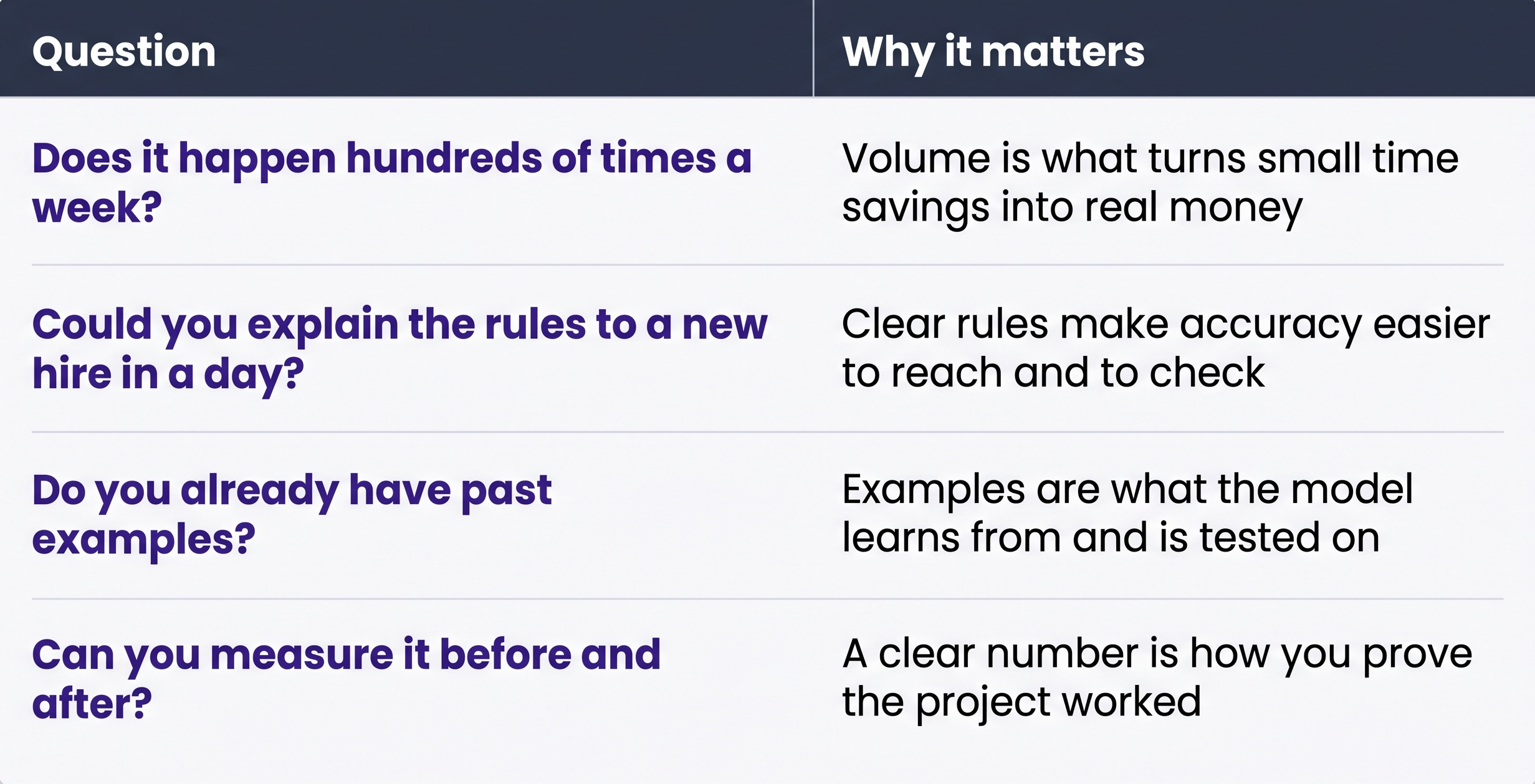
Pick a process that runs often, follows clear rules, has past examples, and can be measured. If a task scores yes on all four, it's a strong first project. If it scores yes on two or fewer, start somewhere else.
What Does an AI Engagement Look Like, from Pilot to Production?
A typical engagement moves through five stages: discovery, data check, pilot, production and ongoing improvement. Each stage ends with a clear decision. You either move forward, adjust, or stop before spending more.
- Discovery:Map the current workflow and agree on one success measure
- Data check:Confirm you have enough usable examples
- Pilot:Test the model on your real data, with your team reviewing results
- Production:Connect it to your systems, with exception review and monitoring
- Improve:Retrain on new data and add the next use case
The workflow itself often changes along the way. McKinsey's State of AI 2025 survey found AI high performers are nearly three times as likely to fundamentally redesign their workflows. Good AI ML solutions fit into a better process, not the old one.
Should you Build, Buy or Partner?
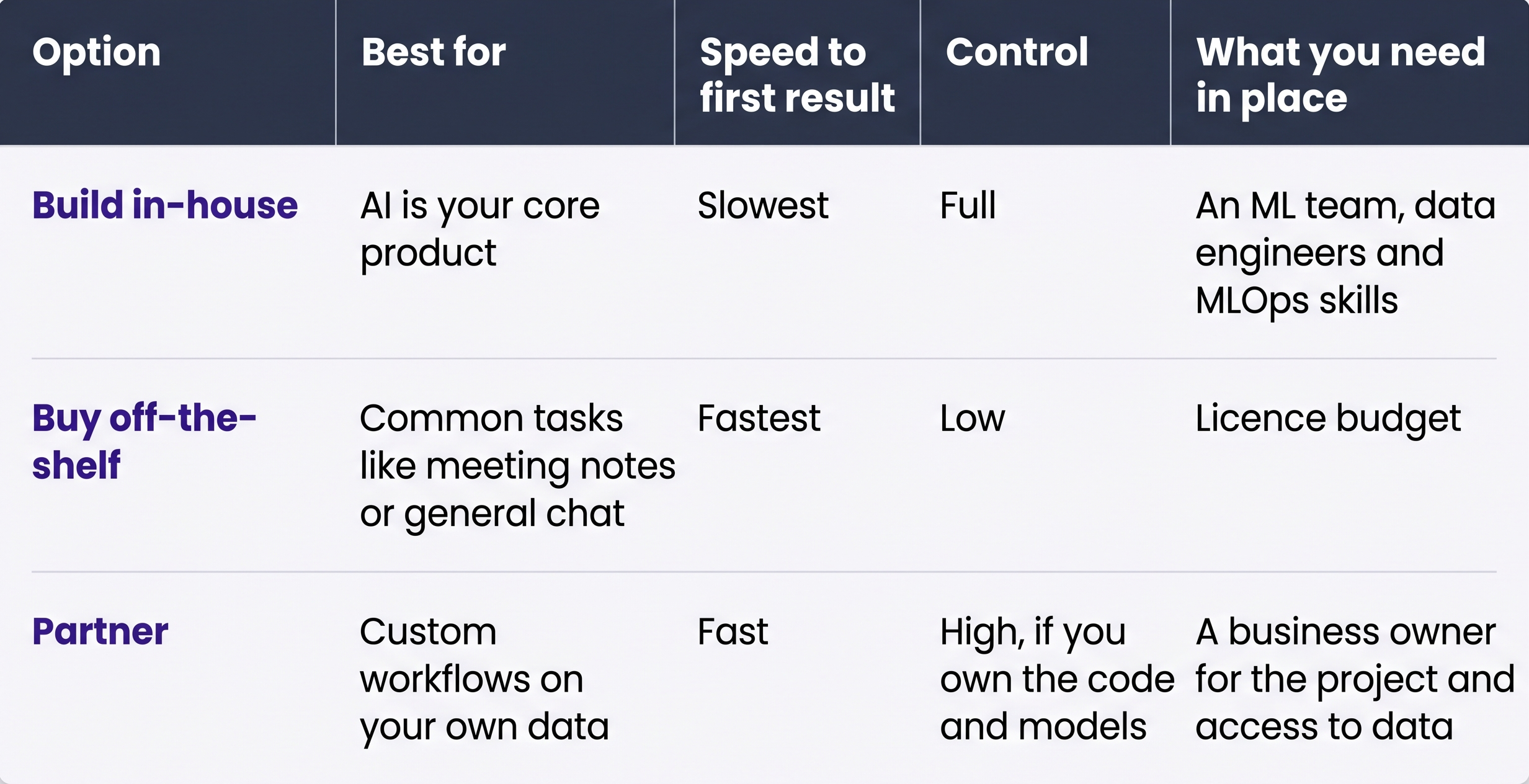
Buy off-the-shelf when the task is common and a ready tool does it well.
Build in-house when AI is your core product.
Partner when you need custom AI on your own data, without hiring a full ML team first.
The MIT research above found that buying from specialised vendors and building partnerships succeeded about 67% of the time. Internal builds succeeded only about one-third as often. The study focused on generative AI, so treat it as a strong signal rather than a rule for every project.
A partner offering AI and ML development services should also tell you when a ready-made tool is enough. If a $30 subscription solves the problem, you don't need a custom build.
How Should a Partner Handle your Data and Security?
A good partner treats data protection as part of the design, not an add-on. That means clear access controls, answers grounded in your own documents, and human review wherever a decision carries real weight.
- Grounded answers:Our HRMS policy chatbot answers only from official policy documents. When a policy doesn't cover a question, it says so clearly.
- Human in the loop:Low-confidence results go to a person before anything is final
- Access control:Only approved people and systems can reach your data
- Industry rules: HIPAA for health data, plus your own internal policies
- A shared framework: the NIST AI Risk Management Framework is a useful common reference for US teams
How do You Evaluate an AI/ML Development Company?
Look for real production examples, clear ownership terms and honest advice. The best way to test this is to ask direct questions. Watch how specific the answers are.
Questions worth asking any AI ML development company, including us:
- Can you show a system that's running in production today, with real numbers?
- Will we own the code, the trained models and our data at the end?
- How do you handle results the model isn't confident about?
- Can you share a project where your first approach didn't work, and what you changed?
- When would you tell us not to build custom AI?
The last two are the hardest to answer well. A partner who answers them openly is usually one you can trust.
What Should You do Next?
Pick one back-office process. Count how many times it runs each week, and note how long each run takes. Bring those two numbers to a discovery call, with us or anyone else. You'll get a far more useful conversation.
When you're ready, our team offersAI ML development services for US businesses, from discovery to production. Book an AI discovery call to talk through your first use case.