

Quick Answer
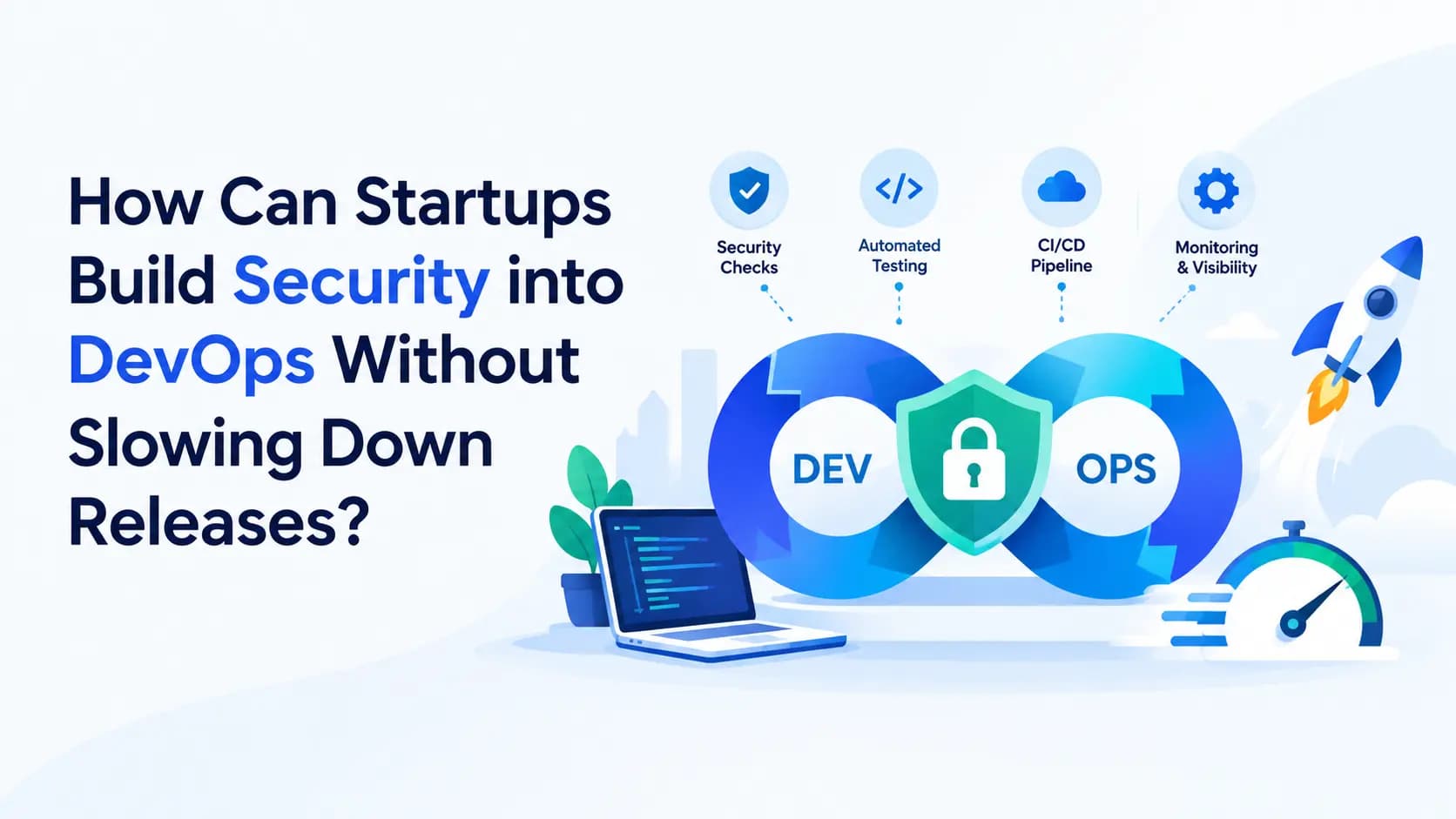
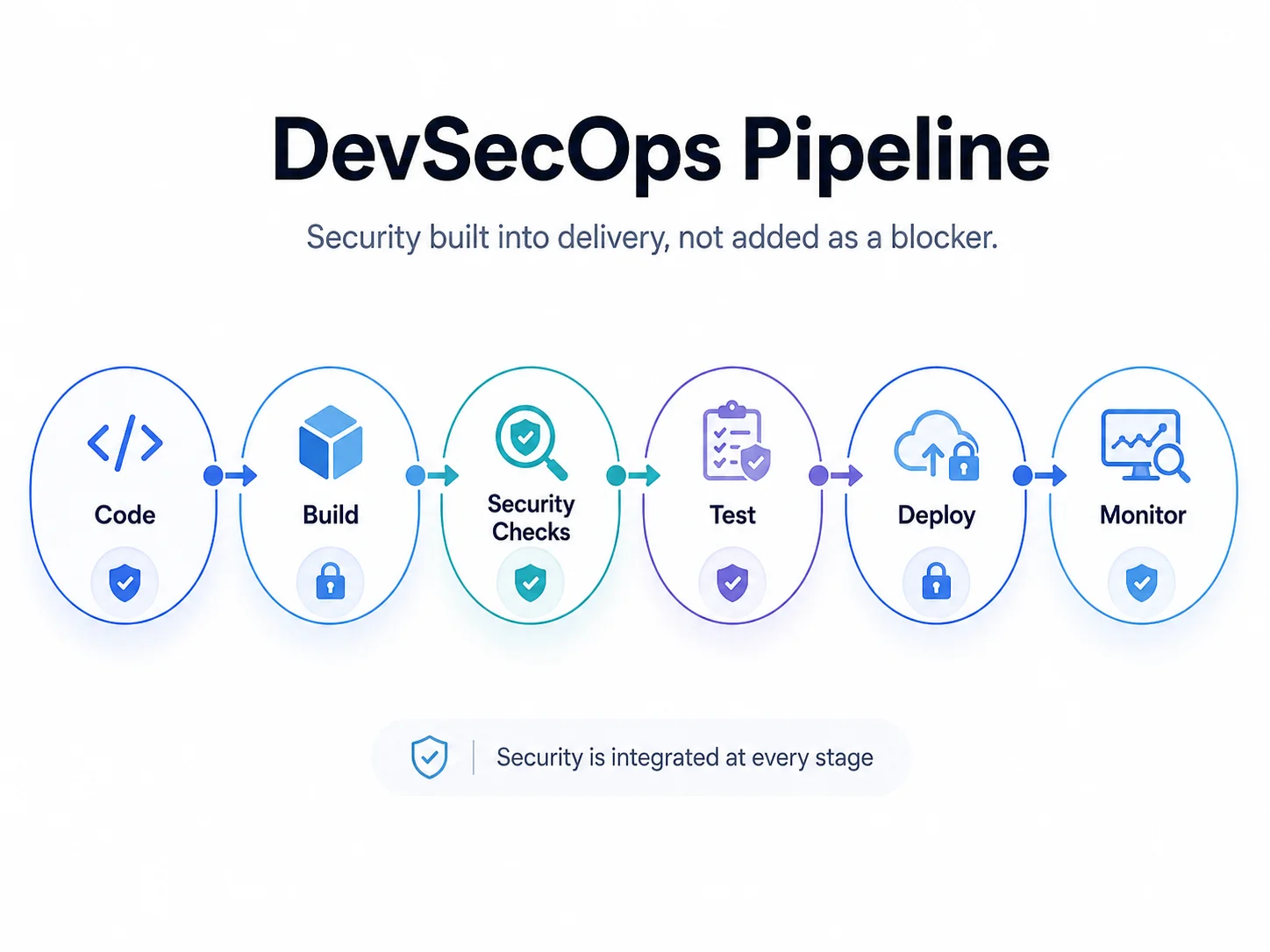
Startups can integrate security into DevOps without slowing releases by reducing the number of security decisions developers need to make.Businesses implementing DevOps Services can automate security controls, streamline CI/CD pipelines, and improve software delivery without sacrificing release velocity. Instead of blocking every deployment for every vulnerability, automate high-confidence checks, build secure defaults into development workflows, and apply stricter controls to changes with a larger security impact. The goal is not to put a security gate in front of DevOps, but to make the safest development path the easiest one to follow.
Why Does Security Slow Some Teams Down but Not Others?
The usual assumption is that startups have to choose between development speed and stronger security. In practice, security itself is rarely the problem. Poorly designed security processes are.
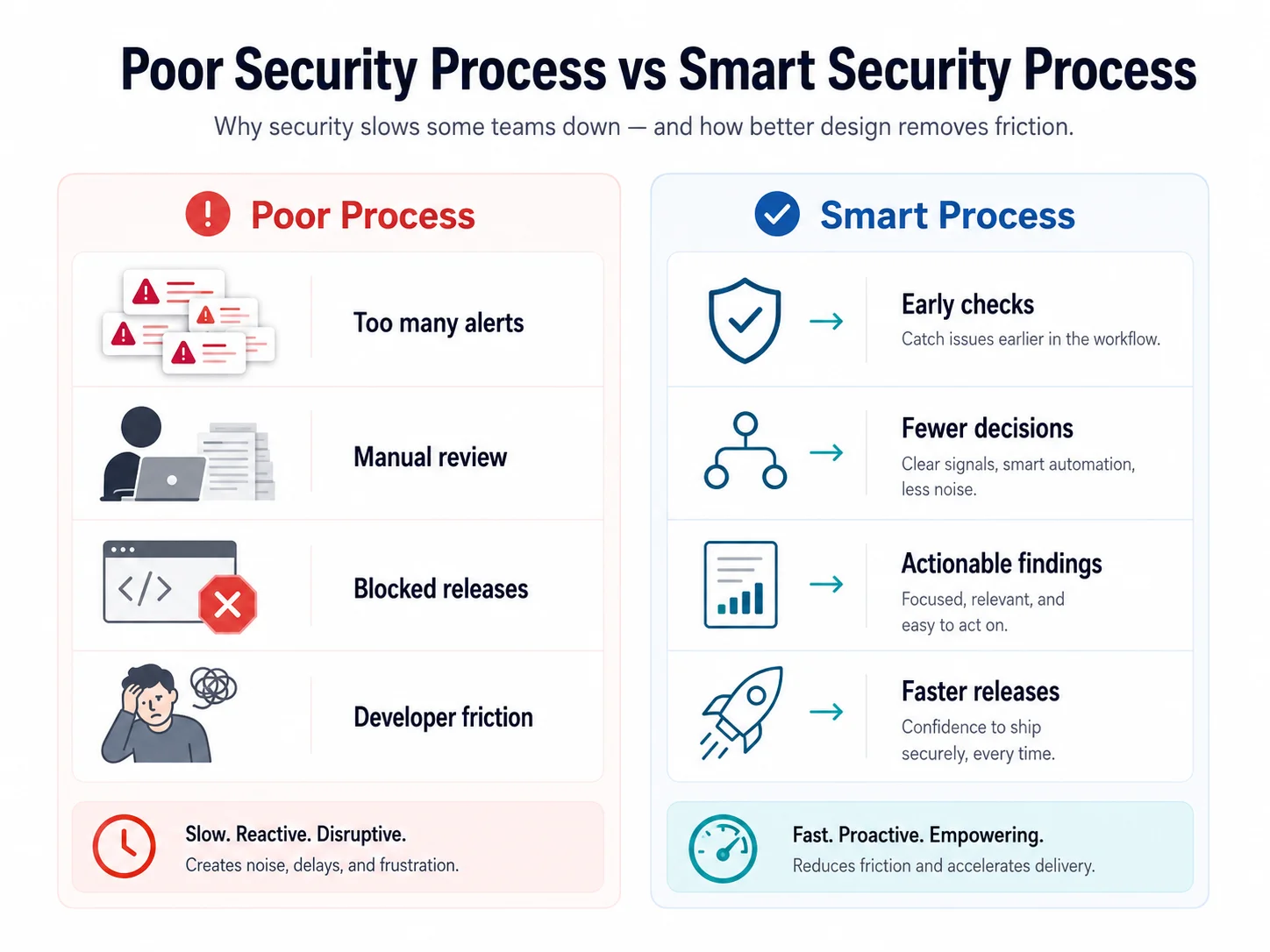
Consider a CI/CD pipeline that introduces five security scanners. Together, they generate hundreds of findings, including vulnerable dependencies, configuration warnings and potential code issues. If developers must investigate every alert before they can deploy, the startup has automated security scanning without automating security decision-making.
That distinction matters. DORA's research on pervasive security found that high-performing teams integrating security throughout the development lifecycle spend significantly less time addressing security issues than lower-performing teams. Security can support delivery speed when problems are discovered early and handled within normal development workflows rather than accumulated for a final review.
Businesses modernising cloud infrastructure should also understand Kubernetes for Application Teams before scaling production workloads.
Don't Just Shift Security Left. Shift the Complexity Down.
"Shift left" has become standard DevSecOps advice - find vulnerabilities earlier in the software development lifecycle, when they are generally easier to resolve.
But startups can go further. Instead of expecting every developer to understand every security requirement, businesses can adopt Software Development Services that incorporate secure-by-design architecture, reusable templates, and automated deployment workflows.
Suppose developers regularly create new cloud services. One approach is to give them a security checklist covering encryption, network access, logging, IAM permissions and secret management, and expect them to configure everything correctly every time.
A better approach is to create an approved infrastructure template where encryption is enabled, public access is restricted, logging is configured and least-privilege access is the default.
The developer still moves quickly, but several security decisions have already been made correctly.
This principle can extend to service templates, repository settings, CI/CD workflows, infrastructure modules, access policies and deployment configurations. DORA's platform engineering guidance similarly emphasises reducing developer cognitive load by providing internal capabilities that abstract unnecessary complexity.
Organisations planning cloud-native platforms should also read Why Enterprises Are Outgrowing Their CMS and How Strapi Fills the Gap to understand how infrastructure and content architecture evolve together.
For a startup, this can be one of the most effective forms of DevSecOps -don't repeatedly tell developers how to build securely when you can give them a secure way to build.
Not Every Vulnerability Should Stop a Release
One of the quickest ways to make developers dislike security tooling is to make every finding equally urgent.
A leaked production credential and a low-risk vulnerability in an unused development dependency are not equivalent. Your pipeline shouldn't treat them as if they are.
A practical startup policy can divide findings into three responses:
--table-image--
For example, a production API credential committed to a repository should trigger immediate action. Secret protection tools can detect supported credentials before they reach the repository and prevent the push.
By contrast, automatically stopping production for every low-severity dependency warning can create so much noise that developers eventually stop trusting the system.
The purpose of a security gate should be to stop dangerous releases, not simply demonstrate that a scanner found something.
Match Security Effort to the Blast Radius
Startups can also preserve development speed by asking a simple question before deciding how much scrutiny a change requires:
What happens if this change is compromised or fails?
Changing the wording on an onboarding screen does not create the same security exposure as changing password-reset logic. Updating an internal dashboard is different from changing a payment API. Modifying authentication, customer permissions, sensitive data flows or production infrastructure deserves greater scrutiny than a low-risk UI update.
This creates a more practical security model.
Low-risk changes can rely primarily on automated controls and standard code review. Higher-risk changes can trigger additional requirements such as threat modelling, security review or penetration testing.
Instead of forcing the entire engineering organisation to move at the pace required by its most sensitive systems, the startup concentrates security effort where the potential impact is greatest.
Measure Signal, Not the Number of Alerts
Security teams can easily measure how many vulnerabilities their tools discover. That doesn't necessarily tell you whether the DevSecOps programme is working.
A scanner that produces 500 alerts developers routinely ignore may be less valuable than one that surfaces 15 findings engineers consistently investigate and resolve.
GitHub's approach to secret push protection illustrates the importance of this principle. Its controls focus on supported secret patterns and can block detected credentials before they enter a repository, putting actionable feedback directly into the developer workflow.
Startups should evaluate security automation in a similar way. Are developers acting on alerts? How many findings are false positives? How quickly are critical vulnerabilities fixed? Do the same types of vulnerabilities repeatedly return?
A good security pipeline doesn't necessarily produce more warnings. It produces better decisions.
Secure the Factory That Builds the Software
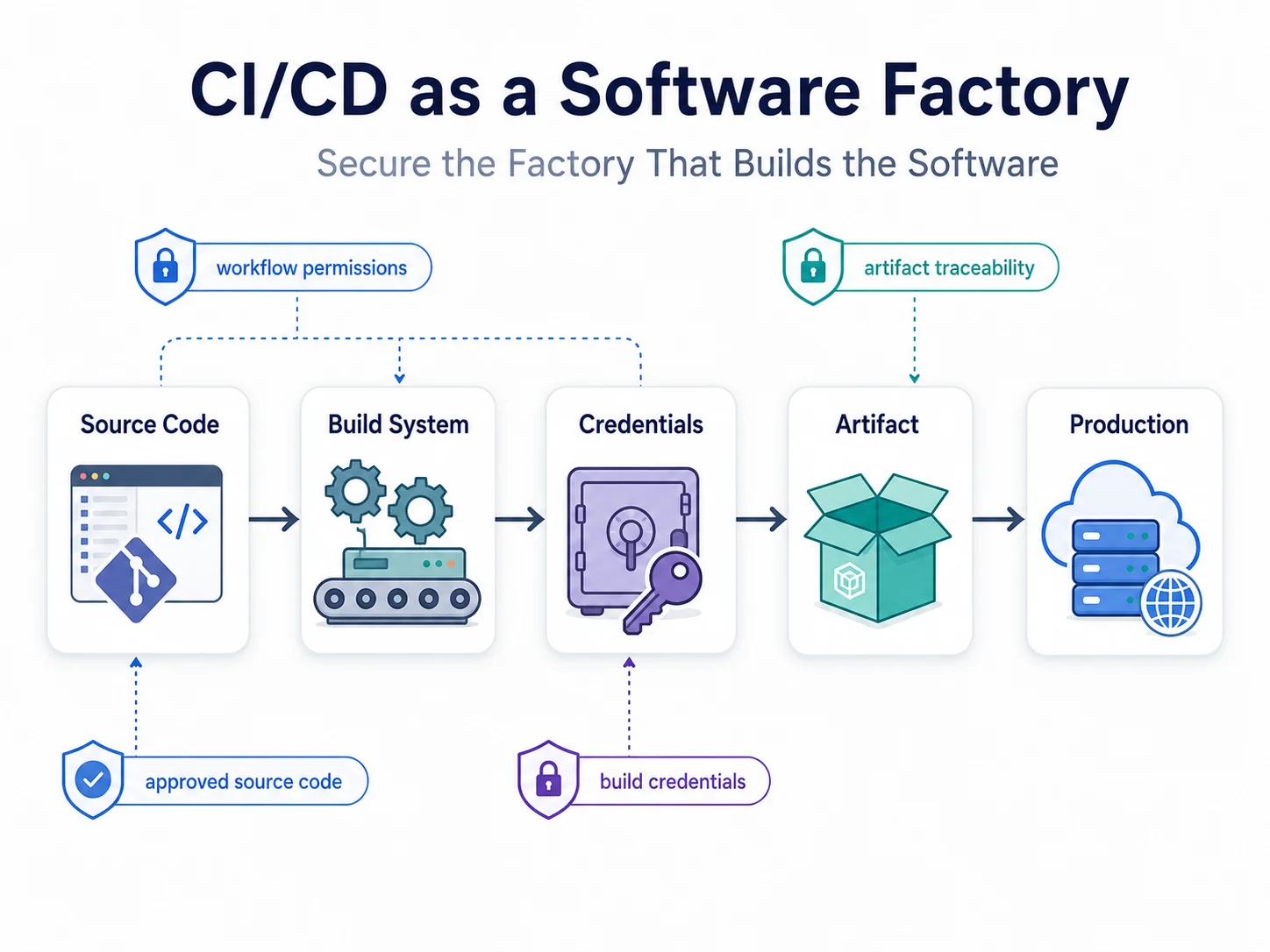
Another common mistake is concentrating on application vulnerabilities while paying less attention to the systems that build and deploy the application.
Your CI/CD environment is effectively a software factory. If an attacker gains control of that factory, secure source code alone may not protect what reaches production.
Startups should therefore ask who can change deployment workflows, who can publish production builds, how build credentials are protected and whether production artifacts can be traced back to approved source code.
Frameworks such as SLSA (Supply-chain Levels for Software Artifacts) focus specifically on improving software supply-chain integrity through practices including build provenance and increasingly hardened build processes.
You don't need to implement the highest maturity level immediately. The important insight is that DevSecOps should protect how software reaches production, not just the code inside it.
Know Where Automation Should End
Automated security checks are excellent at finding repeatable patterns. They are less effective at understanding business context.
A scanner might detect an outdated package. It won't necessarily tell you whether your new account-recovery journey allows someone to take over another user's account.
Similarly, automated tooling cannot fully reason about a complicated authorization model, fraud scenario or sensitive customer-data flow.
This is where human security expertise remains valuable. Authentication changes, payment flows, permission models, sensitive-data architecture and other high-impact features may require threat modelling or manual security review.
The goal is not to automate security completely. It is to automate predictable work so human expertise can be spent on problems that genuinely require judgement.
DevSecOps Can Become a Sales Capability
There is another reason startups should think about these practices earlier than they might expect.
The first enterprise prospect can change the security conversation overnight.
Suddenly the startup is answering questions about its secure development lifecycle, which is why many growing organisations invest in Strapi CMS Development Services and scalable software architecture that meet enterprise expectations. NIST's Secure Software Development Framework (SSDF), for example, provides a common set of secure development practices that can also support communication between software producers and purchasers.
At that point, DevSecOps isn't only about preventing breaches. Mature security practices can help demonstrate that the company is ready to handle larger and more demanding customers.
Security can therefore evolve from an engineering requirement into part of the startup's commercial readiness.
How OpenSpace Services Approaches DevSecOps
At OpenSpace Services, we see effective DevSecOps as an exercise in reducing friction, not adding more checkpoints. That means integrating high-value security controls into CI/CD pipelines, designing secure cloud and infrastructure defaults, prioritising vulnerabilities according to risk, and ensuring critical systems receive the additional scrutiny they require.
For growing startups, the objective should be a security model that can mature with the product. Teams should be able to release quickly today without creating security debt that becomes expensive to address when enterprise customers, larger workloads or compliance requirements arrive tomorrow.
Final Thoughts
Startups do not need enterprise-scale security bureaucracy to practise DevSecOps effectively. They need to make a few important decisions well.
Automate security checks where the answer is predictable. Build secure defaults so developers don't repeatedly solve the same security problems. Stop releases when the risk genuinely warrants it, not whenever a scanner produces a warning. Apply greater scrutiny to changes with a larger blast radius, and use human expertise where business context matters.
The best DevSecOps implementation is therefore not the one with the most security tools. It is the one where developers can continue shipping quickly because security has become part of the way good software is built.