


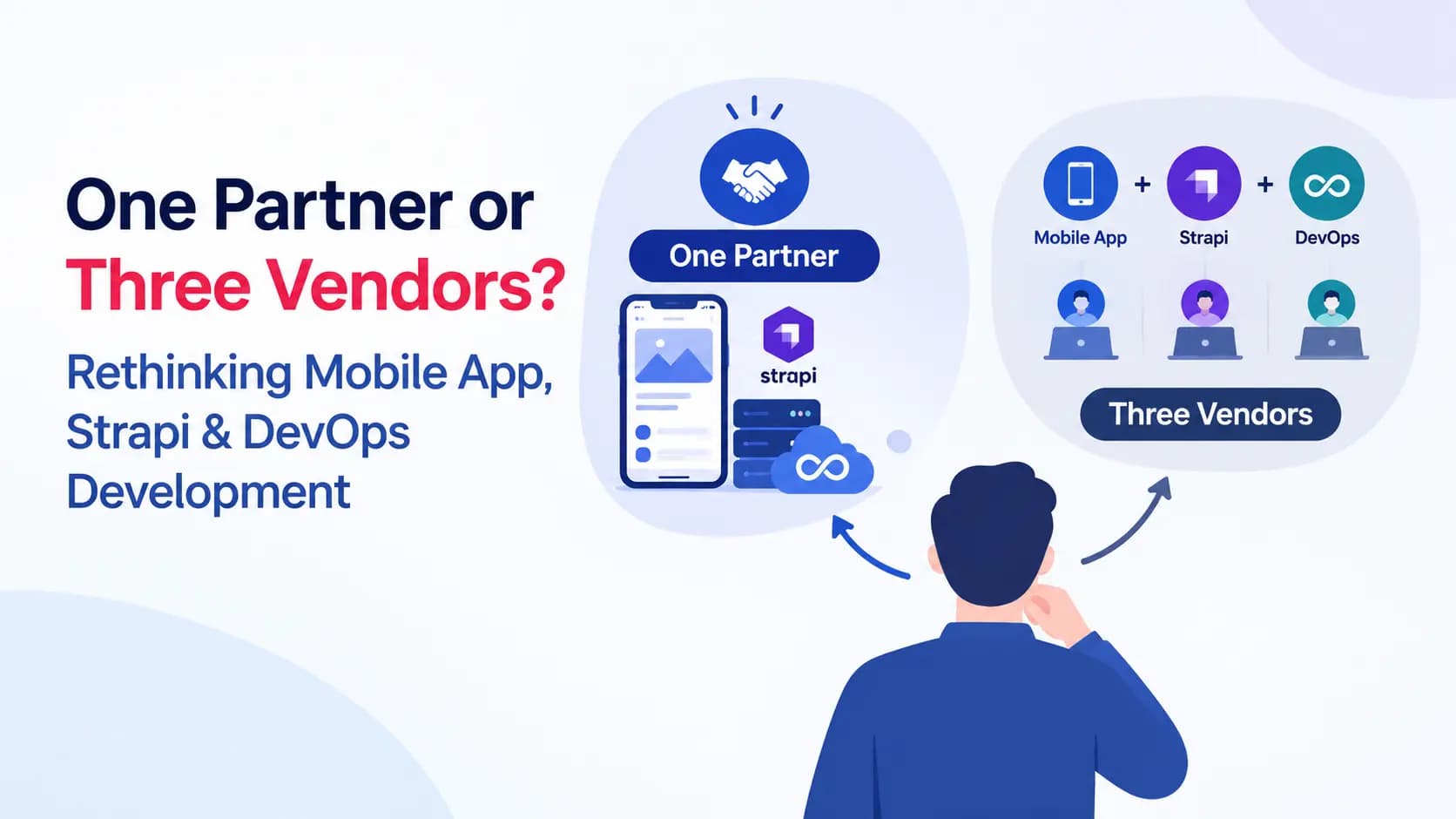
Using one technology partner for mobile app development, Strapi and DevOps can reduce integration gaps, duplicated work and ownership ambiguity because the application, content layer and deployment infrastructure are designed as one system. Separate specialist vendors can still make sense for highly specialised or independently managed workloads. The real advantage of an integrated partner is not having fewer vendors; it is having fewer handoffs between teams responsible for interconnected parts of the same product.
Businesses looking to reduce technical complexity often benefit from partnering with a single Mobile App Development Company that can manage application development, backend systems, and infrastructure under one delivery model.
Your Mobile App Is Not Really One Product
Modern applications rely on API-first architectures. If you're new to headless CMS, learn what Strapi CMS is and how it powers scalable applications before planning your product architecture.
A customer opens your mobile app and sees one experience. Behind it, however, several systems may be working together.
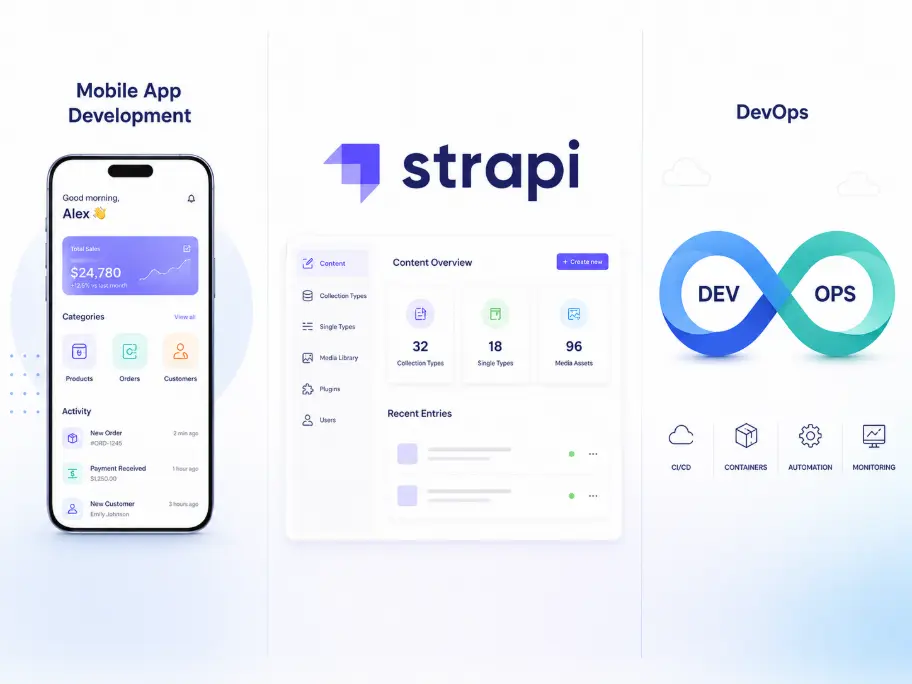
The mobile application handles the interface and user interactions. A headless CMS such as Strapi may manage content and expose it through APIs. Cloud infrastructure keeps the services running, while CI/CD pipelines, monitoring and other DevOps practices help teams release and operate the product reliably.
Strapi itself is designed for this kind of decoupled architecture. It can generate REST or GraphQL APIs from content models, which mobile applications can consume independently of the CMS interface. It can also be self-hosted or deployed through Strapi Cloud.
Technically, these layers can be built by three different vendors.
The harder question is whether they should be.
Consider what happens when a new mobile feature requires a change to the content model, a new API response and an infrastructure update. The mobile team cannot finish until the CMS work is ready. The CMS vendor needs specifications from the app team. DevOps needs to understand both changes before modifying the deployment pipeline.
The work itself may not be particularly difficult. Coordination becomes the difficult part.
The Hidden Cost of a Three-Vendor Setup Is the Handoff
Many organisations experience delivery delays because the technology stack wasn't planned correctly. Learn how to evaluate a custom mobile app development partner before selecting your engineering team. Suppose a retail company wants to introduce personalised promotional banners in its app.
The mobile developer needs to know which content fields will be available and how the API will return them. The Strapi team needs to understand how marketers want to create the promotion, which audiences it applies to and what the app expects. The DevOps team may need to configure environments, secrets, caching, deployment processes or monitoring around the change.
With three independent vendors, a seemingly simple feature can produce a chain of tickets, calls, specifications and approvals.
When something fails, another problem appears - Where does the problem belong?
Is the app displaying the response incorrectly? Is Strapi returning the wrong data? Is the API timing out because of infrastructure? Is caching serving stale content?
Each team can reasonably say that its own component is functioning correctly while the complete customer experience is still broken.
That is the integration tax businesses often underestimate when comparing vendor proposals.
Why Mobile App + Strapi + DevOps Are Closely Connected
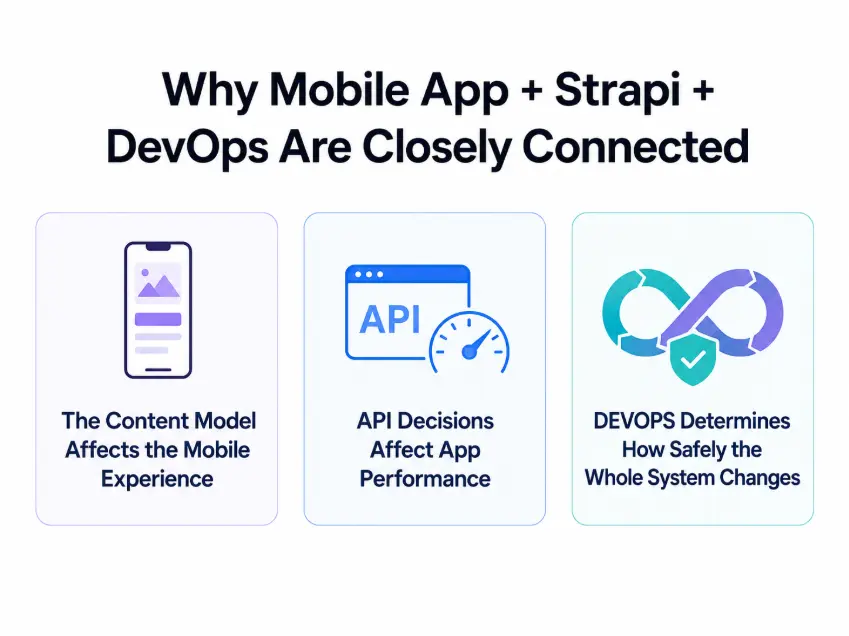
These aren't three unrelated services bundled together for convenience. In a modern mobile architecture, decisions made in one layer can directly affect the others
The Content Model Affects the Mobile Experience
A headless CMS does more than store copy and images. Well-structured content models built through Strapi CMS Development Services improve content reuse, API efficiency, and omnichannel customer experiences.
How content is modelled determines how easily the app can retrieve, reuse and display it. Strapi supports structured content relationships and automatically exposes content through APIs, allowing the same backend to serve mobile and other digital experiences.
Imagine building a food delivery app.
A restaurant promotion could be stored as one large block of page content. Or it could be modelled as structured fields such as:
- Promotion name
- Restaurant
- Offer type
- Discount value
- Validity period
- Location
- Customer segment
- Terms and conditions
- Promotional image
The second approach gives the mobile team far more flexibility. Promotions can be filtered, personalised, reused and displayed differently across screens without asking content editors to recreate them.
But that model works best when the people designing the CMS understand how the mobile application will actually consume the informatio
API Decisions Affect App Performance
API optimisation is only one part of application performance. Learn how to optimise mobile app performance in 2026 using proven engineering practices. Headless architecture creates flexibility, but APIs become part of the user experience.
A mobile screen that requires several unnecessarily large requests can feel slow even if the interface itself is well designed. Poor pagination, excessive payloads, inefficient media delivery or badly planned content relationships can all affect performance.
Strapi supports features such as filtering, pagination and API customisation, giving development teams room to shape content delivery around the needs of the consuming application.
This is where shared architectural ownership matters. Instead of the mobile team compensating for an inefficient backend later, the API and content structures can be designed around real app journeys from the beginning.
DEVOPS Determines How Safely the Whole System Changes
Building the feature is only half the job. Teams also need to test, release, observe and recover it. Modern DevOps consulting services enable automated testing, CI/CD implementation, and reliable software deployments across development environments.
CI/CD practices automate stages of software delivery so teams can release changes more frequently and reliably. AWS, for example, describes CI/CD as automating the path through building, testing and deployment, while Google's DORA research evaluates software delivery using measures including deployment frequency, change lead time, change failure rate and time to restore service.
That matters when a mobile release depends on a Strapi schema change.
If the CMS update reaches production before the mobile application is ready, existing users may encounter unexpected behaviour. If the app ships first but expects fields that aren't available yet, the feature can fail.
A coordinated team can plan compatibility, testing, deployment order and rollback as part of the feature itself rather than treating DevOps as the final step after development. Integrating Cloud Infrastructure Services with DevOps processes allows engineering teams to deploy, monitor, and scale applications more efficiently while maintaining business continuity.
What Changes When One Team Owns the Product End to End?
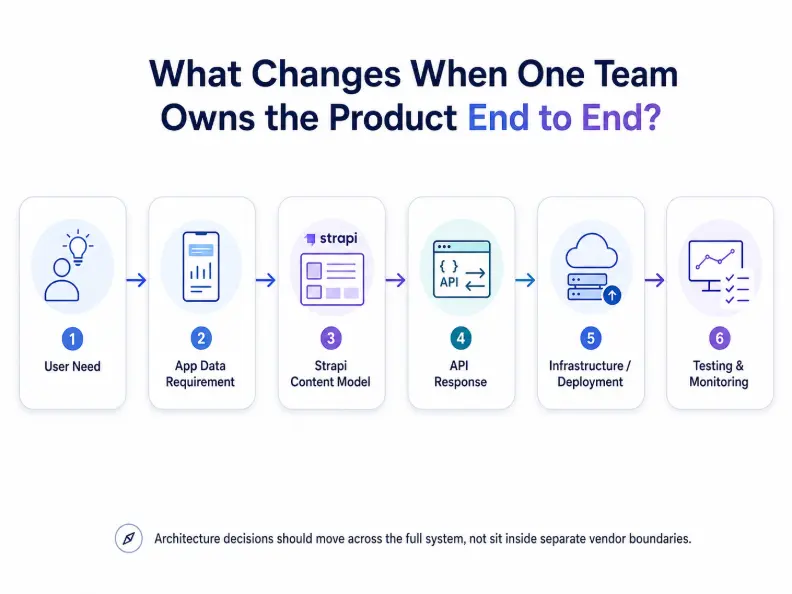
The strongest argument for an integrated technology partner isn't that you'll have fewer meetings.
It's that architecture decisions can be made across the system instead of within individual vendor boundaries.
A feature request can begin with the customer journey and move backwards -
What should the user be able to do? → What data does the app need? → How should Strapi model and expose it? → What infrastructure and deployment changes are required? → How will the complete journey be tested and monitored?
That is fundamentally different from giving three vendors three separate scopes of work.
At OpenSpace Services, this is where bringing mobile app development, Strapi and DevOps capabilities together can create practical value. The goal isn't to bundle services that happen to sit under the same company. It is to design the frontend experience, content architecture, APIs and delivery environment with an understanding of how changes in one layer affect the others.
But Is One Vendor Always Better?
No.
There are situations where specialist vendors are the better choice. A business may already have a mature internal platform engineering team, for example, and only need external mobile expertise. Another organisation may have highly specialised infrastructure requirements that justify a dedicated cloud partner.
The case for consolidation becomes stronger when the systems are tightly coupled, the product is evolving quickly, and changes frequently cross the boundaries between mobile, CMS and infrastructure.
So, the question is - How many critical handoffs does your product require every time you want to change something?
That is usually a much better indicator of whether your current delivery model is helping you move faster; or quietly slowing you down.
Does One Technology Partner Actually Reduce Costs?
Not automatically.
A single vendor can still be expensive, inefficient, or poorly managed. The financial advantage comes when integrated ownership removes work that would otherwise be repeated across multiple teams.
Consider a new mobile feature that requires changes to the Strapi content model and deployment environment. With separate vendors, each team may need its own discovery, technical documentation, estimation, testing and project management. Integration issues then create another layer of work that may not appear in the original estimates.
With one team responsible for the complete product, some of that duplication disappears. Developers can agree on API contracts earlier; infrastructure requirements can be identified during development, and testing can cover the complete journey rather than three individual components.
This is why businesses should compare total delivery cost, not simply hourly rates or individual vendor proposals.
The useful question is - how much are you spending to build the product, and how much are you spending to coordinate the people building it?
One Team Can Make Releases Easier to Coordinate
The advantage becomes particularly visible after launch.
Mobile applications keep changing. Content models evolve, APIs are extended, dependencies require updates, infrastructure needs scaling, and customer feedback leads to new features.
Modern CI/CD practices automate much of the process of building, testing and preparing software for deployment. AWS notes that CI/CD can help teams release features faster while improving software quality through smaller, more frequent changes and automated testing.
But automation alone does not solve organisational fragmentation.
Imagine a mobile app update requires a new field from Strapi. The CMS change must be deployed without breaking customers still using an older version of the app. The mobile release then needs to pass App Store or Play Store processes, while monitoring needs to detect whether the new journey works correctly in production.
When the same engineering organisation understands all three layers, backward compatibility, deployment sequencing, testing and rollback can be planned together.
That can be more valuable than simply delivering each component faster.
Accountability Becomes Much Clearer
One of the less visible costs of a multi-vendor environment appears when something breaks.
Imagine customers report that product information takes several seconds to appear inside the mobile app.
- The mobile vendor investigates the application and finds nothing unusual.
- The CMS vendor confirms that Strapi is responding correctly.
- The infrastructure vendor reports that the servers are healthy.
- All three assessments can technically be correct.
- The customer still has a slow app.
An integrated team has less room for this kind of ownership gap because the question changes from "Is our component working?" to "Why is the experience not working?"
That distinction matters.
Performance problems can originate from inefficient mobile requests, API design, database queries, media delivery, caching, network latency or infrastructure configuration. Finding the cause is much easier when troubleshooting follows the request across the system rather than stopping at contractual boundaries.
Security Also Sits Across the Architecture
Security is another area where fragmented ownership can create blind spots.
The mobile team may be responsible for secure local storage and authentication flows. The Strapi implementation may control API permissions and access to content. The DevOps environment manages secrets, network configuration, deployment permissions, backups and monitoring.
A weakness in any one layer can affect the complete application.
Strapi can be self-hosted on an organisation's own cloud, data centre or isolated network, which gives businesses control over where their content and database reside. It can also run through Strapi Cloud when a managed deployment is preferred.
The right choice depends on the organisation's security, compliance, operational and data-residency requirements. That decision is stronger when infrastructure planning happens alongside application and CMS architecture rather than after development has finished.
What About Scaling?
The same principle applies when the product succeeds.
Suppose an app that initially served 20,000 users suddenly needs to support several times that volume following expansion into a new market.
Scaling may require more than increasing server capacity. Teams may need to examine API traffic, database performance, caching, media delivery, application behaviour and infrastructure simultaneously.
If every layer belongs to a different vendor, each provider may optimise its own system without seeing the complete bottleneck.
An integrated engineering team can look at the request from the user's device all the way to the content and infrastructure layers and determine where optimisation will have the greatest effect.
That doesn't guarantee better scalability. It simply makes system-level optimisation easier.
When Three Vendors May Actually Be the Better Choice
Bringing mobile, Strapi and DevOps under one partner isn't automatically the right model for every organisation.
Separate specialists can make sense when:
- You already have a strong internal DevOps or platform engineering function.
- Your infrastructure has unusually specialised requirements.
- Your CMS supports many products beyond the mobile application and has its own dedicated team.
- You deliberately use multiple suppliers to reduce vendor concentration risk.
- You have strong internal technical leadership capable of owning architecture and coordinating vendors.
The crucial difference is who owns integration.
If you have an experienced internal architecture team defining API contracts, environments, security requirements and release processes, multiple specialist vendors can work extremely well.
If nobody internally owns those boundaries, three highly capable vendors can still produce a fragmented product.
One Partner vs Multiple Vendors: A Simple Decision Framework
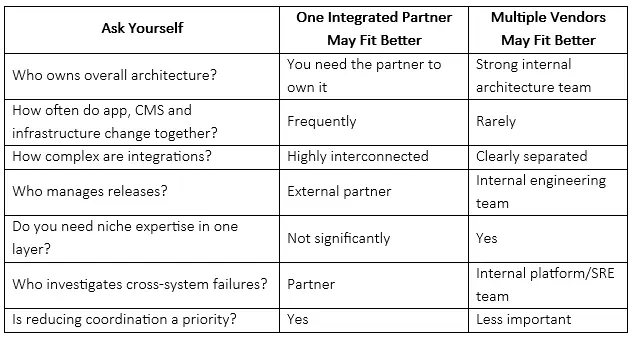
This is ultimately a better decision framework than simply comparing the number of vendors.
How Should You Measure Whether the Model Is Working?
Don't measure success by the number of people assigned to the account or even by how many releases they complete.
Look at delivery outcomes.
Useful indicators include how long it takes a feature to move from development into production, how frequently teams can deploy safely, how often releases cause failures, and how quickly service is restored when something does go wrong.
These closely resemble the software-delivery measures used in DORA research. Google identifies deployment frequency, lead time for changes, change failure rate and time to restore service as useful measures of software delivery performance.
For a business, the practical questions are even simpler:
- Are features reaching customers faster?
- Are releases becoming safer?
- Are incidents resolved quickly?
- Is less management time being spent coordinating suppliers?
If consolidating vendors doesn't improve those outcomes, consolidation itself has achieved very little.
Where OpenSpace Services Fits
At OpenSpace Services, bringing mobile app development, Strapi and DevOps together is not about selling three services in one contract.
It is about owning the connections between them.
That means thinking about the mobile experience while designing content models, considering API requirements while developing features, and planning deployment, security and observability as part of the architecture rather than as tasks added at the end.
For businesses without large internal engineering organisations, this can provide a clearer line of technical ownership from product idea through production.
Final Thoughts
The argument for bringing mobile app development, Strapi and DevOps under one roof isn't that managing one invoice is easier than managing three.
The real advantage is architectural continuity.
Customers don't experience your CMS, mobile application and infrastructure separately. They experience one product. A slow API becomes a slow app. A poorly designed content model becomes a frustrating interface. A deployment problem becomes downtime.
Your technology teams need to understand those connections just as clearly.
For businesses with strong internal engineering leadership, multiple specialist vendors can be an effective model. But when much of the technical ownership sits outside the organisation, reducing the boundaries between teams can make development, troubleshooting and scaling considerably simpler.