


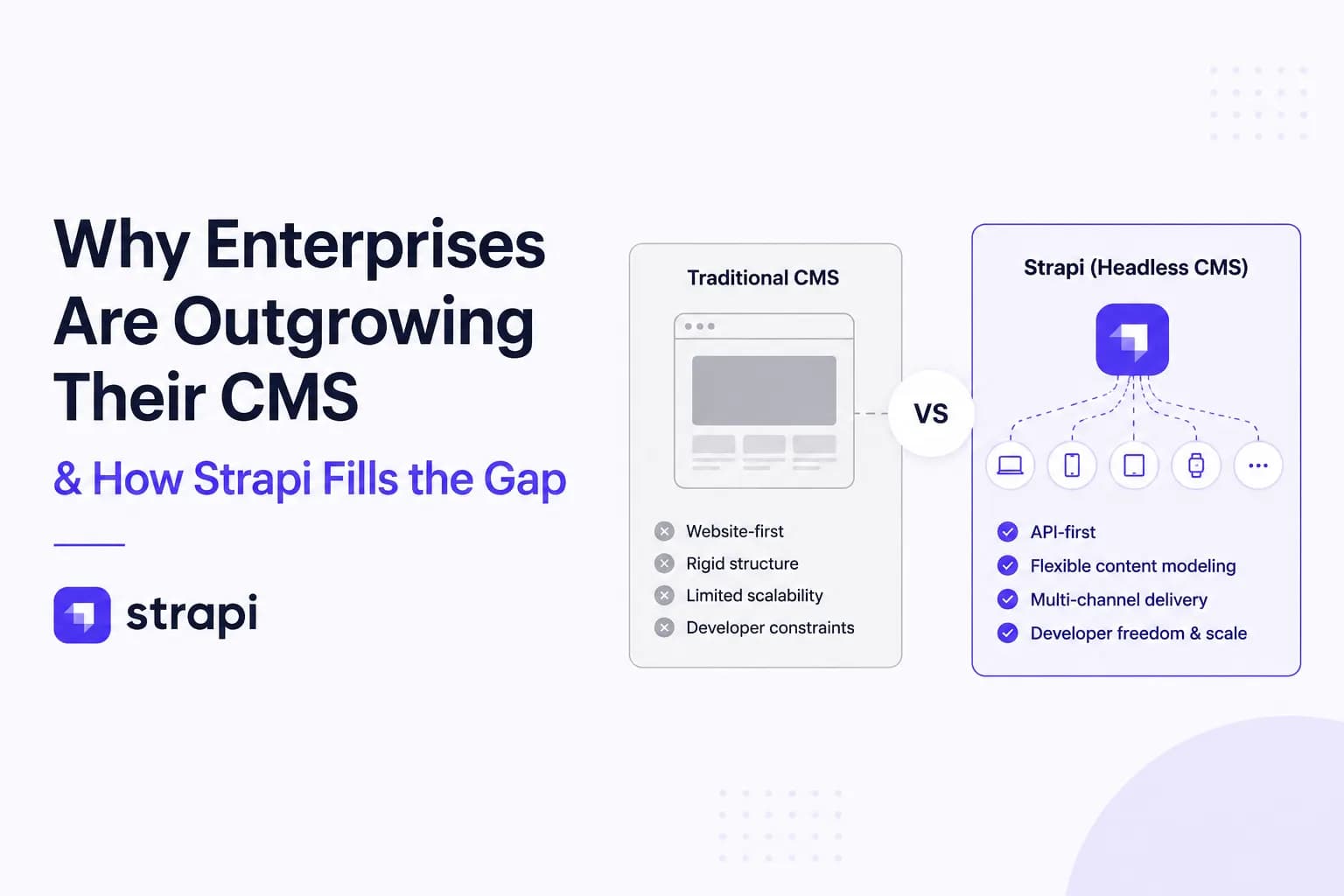
Digital content is no longer just about websites. This is why many growing businesses are now exploring headless CMS architecture instead of relying only on website-first CMS platforms. Today, enterprises need to deliver content across mobile apps, customer portals, regional platforms, smart devices, and more. And they need to do it fast, consistently, and at scale.
Most enterprises started their content journey with a traditional CMS. For teams still evaluating the basics, it is important to first understand how Strapi CMS works compared to traditional CMS platforms. It was the right call. It got the job done. But as business needs grow more complex, some teams are finding that their CMS is struggling to keep up.
This is not a story about traditional CMS being bad. It is a story about growth. And about having the right tool for the right job at the right stage.
In this blog, we will look at where traditional CMS still shines, where enterprises start to feel the limits, and how Strapi steps in to fill that gap without disrupting what already works.
TLDR
- Traditional CMS (like WordPress) works well for websites, blogs, and marketing content with quick go-live and simple workflows.
- Enterprises now need multi-channel content delivery across websites, apps, portals, smart devices, and regional platforms.
- Traditional CMS hits limits with rigid content structures, developer constraints, and regional/multi-language scaling challenges.
- Strapi, a headless CMS, offers flexible content modeling, APIs, developer freedom, and centralized multi-channel delivery.
- Many enterprises adopt a hybrid stack, using traditional CMS for website/blog content and Strapi for apps, portals, and complex multi-channel needs.
When Does Your Traditional CMS Needs an Upgrade?
For a long time, a CMS was all an enterprise needed. You built a website, your marketing team published content, and that was the job.
Platforms like WordPress made this easy. No heavy coding needed. Editors could log in, write, and publish. It worked and for many businesses, it still does.
But enterprises are no longer just running websites. They are running apps, portals, kiosks, voice assistants, and regional platforms all at once. This is where API-first content infrastructure becomes more useful than page-based publishing. And that is where some teams start hitting a wall.
What Traditional CMS Was Built For
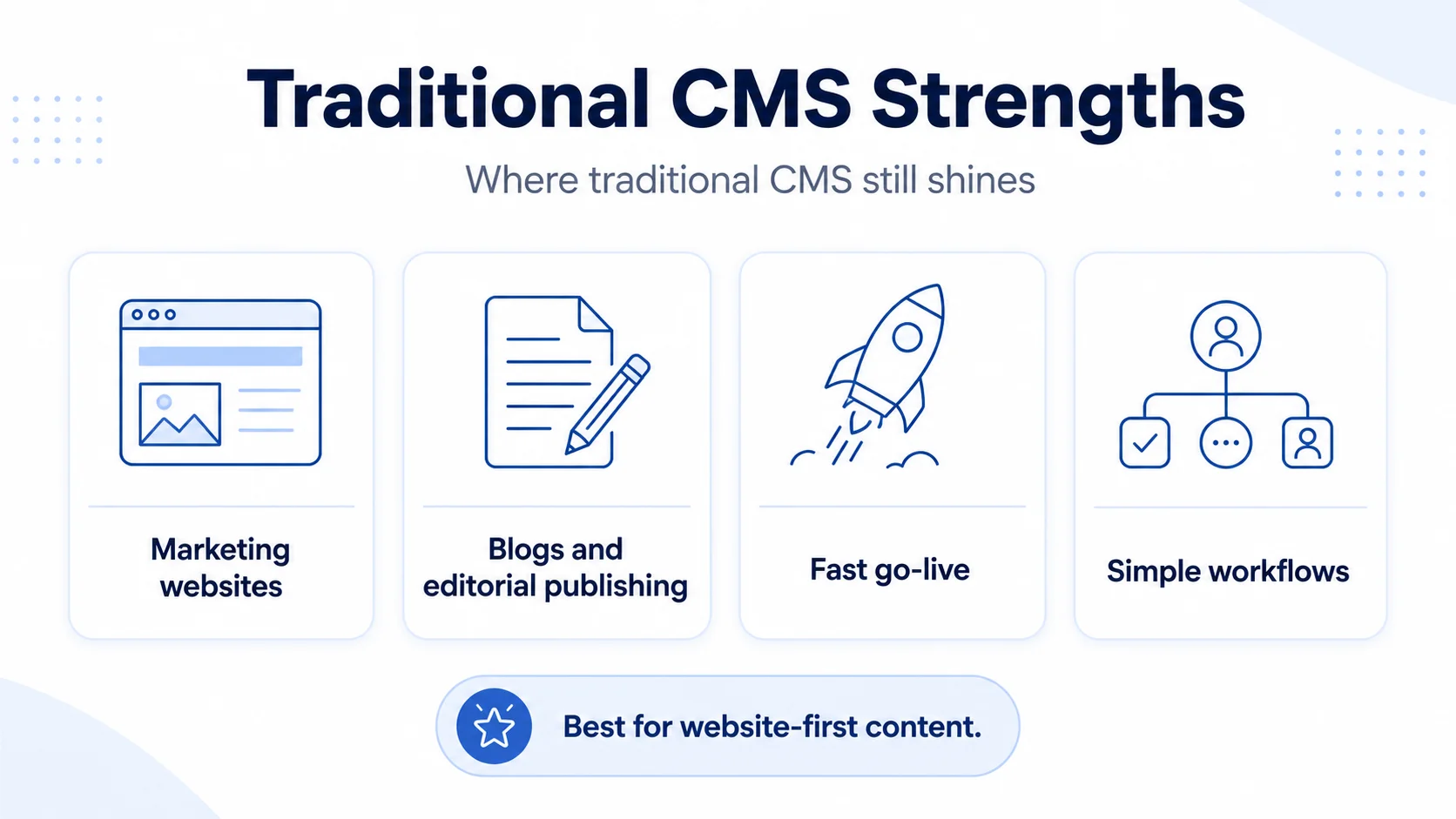
Traditional CMS platforms were designed with one goal: publish content to a website, fast.
They bundle the back-end (where content is stored) and the front-end (what users see) together. This is called a coupled architecture. Think of it like a combo microwave-oven. Convenient, but limited if you need to cook for a restaurant.
This model works really well for:
- Marketing and editorial teams who publish regularly
- Brand websites that do not change structure often
- Teams without large developer resources
- Businesses that need to go live quickly
Brands that prove this works:
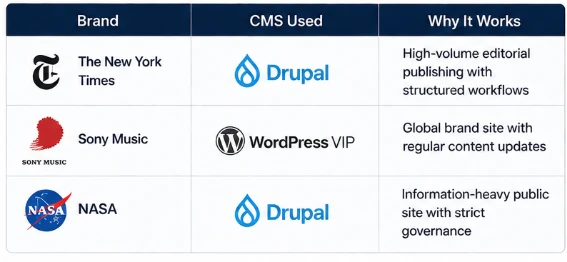
These brands have consistent, website-first content needs. A traditional CMS is the right tool for that job.
Where Enterprises Start to Feel the Ceiling with Traditional CMS
The challenge is not that traditional CMS is broken. The challenge is that enterprise needs have grown beyond what it was originally designed for.
Here is where teams typically start feeling the friction:
1. Content needs to go everywhere, not just a website
Today, the same product description might need to appear on a website, a mobile app, a smart TV, and a third-party marketplace. Pushing content through a website-first CMS to all of these channels is slow and messy.
2. Rigid content structures
Custom content modelling in Strapi CMS is one of the biggest reasons enterprises consider Strapi over traditional page-based CMS platforms. Most traditional CMS platforms have fixed content types. A "page" looks like a page. A "post" looks like a post. When your business needs a custom structure, like a product database with 40 unique fields, things get complicated fast.
3. Developers get slowed down
When developers need frontend freedom with React, Next.js, or React Native, Strapi gives them API-first flexibility without locking the frontend to the CMS. When the front-end is locked to the CMS, developers cannot freely choose their technology. For example, a developer who wants to build a mobile app in React Native cannot easily pull content from a traditional CMS without heavy workarounds.
4. Scaling across regions becomes painful
Running content in 12 languages across 8 regional teams inside a traditional CMS often means messy workarounds, duplicate sites, or expensive custom builds.
The Shift: API-First and Headless CMS
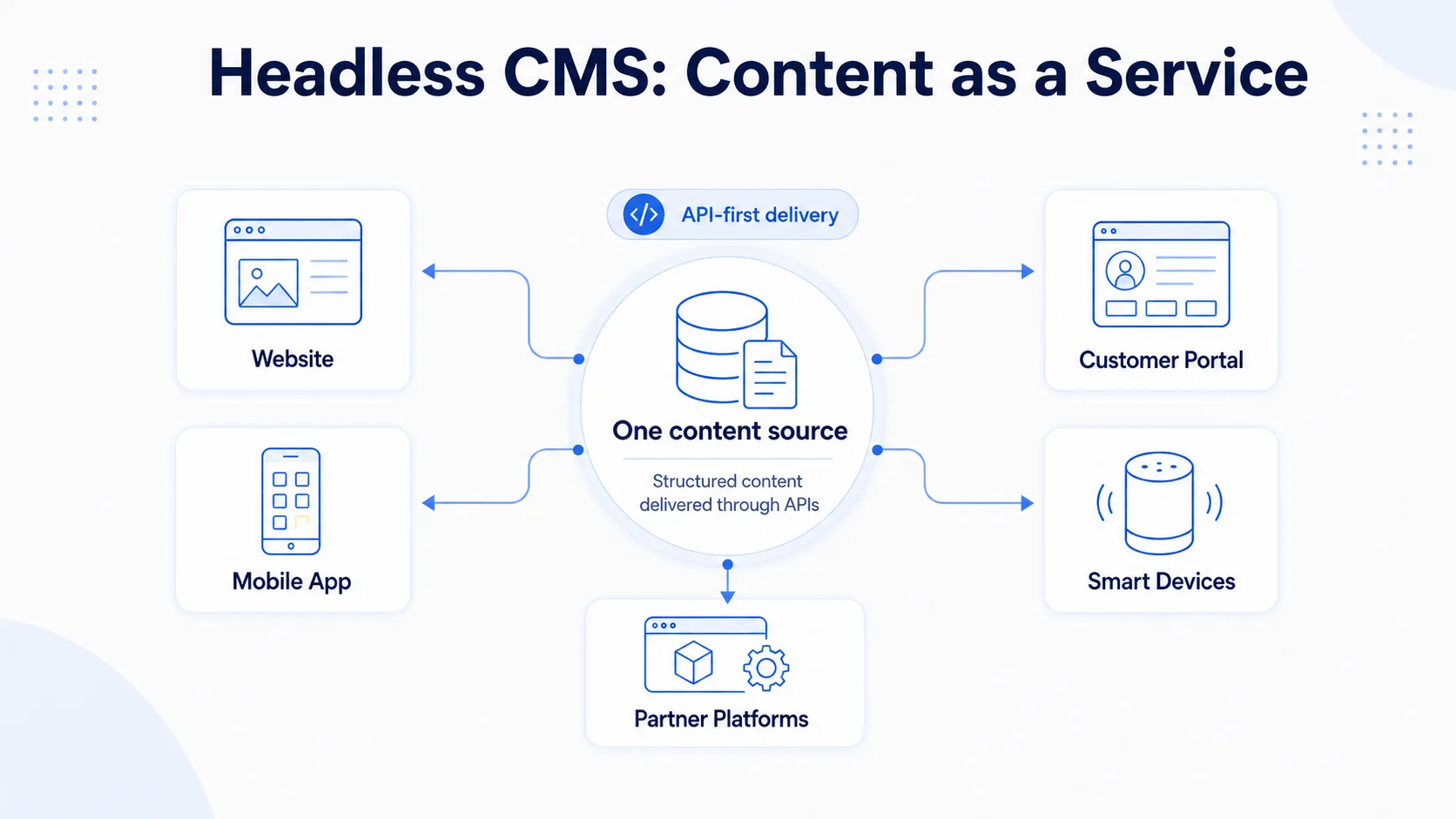
Many enterprises are moving toward a headless CMS approach.
A headless CMS stores and manages your content in the back-end, but has no fixed front-end attached to it. Instead, it delivers content through an API to wherever you need it.
Example: Imagine a hotel chain. Their content team manages room descriptions, offers, and policies in one place. That same content is pulled by their website, their booking app, their in-room tablet, and a partner travel site. One source, many destinations.
This is what "content as a service" means.
Where Strapi Comes In
Strapi is an open-source, headless CMS built for developers and enterprises that need flexibility.
Here is what makes it different:
- Custom content types: You build the structure your business actually needs, not a pre-set template
- API out of the box: Every content type automatically gets a REST or GraphQL API. No extra setup needed.
- Self-hosted or cloud: Your data stays where you want it, which is important for enterprises with compliance needs
- Developer-friendly: Built on Node.js, easy to extend, no vendor lock-in
- Role-based access: Different permissions for editors, developers, and admins
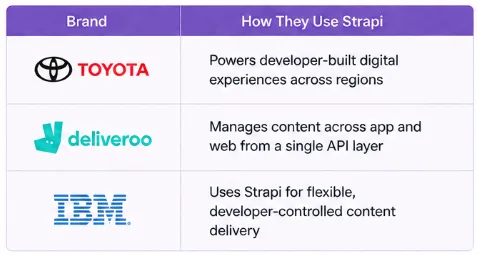
Brands using Strapi:
Traditional CMS + Strapi: A Smarter Stack
Here is the most important point: You do not have to choose one over the other.
Many enterprises run both, and it makes complete sense.
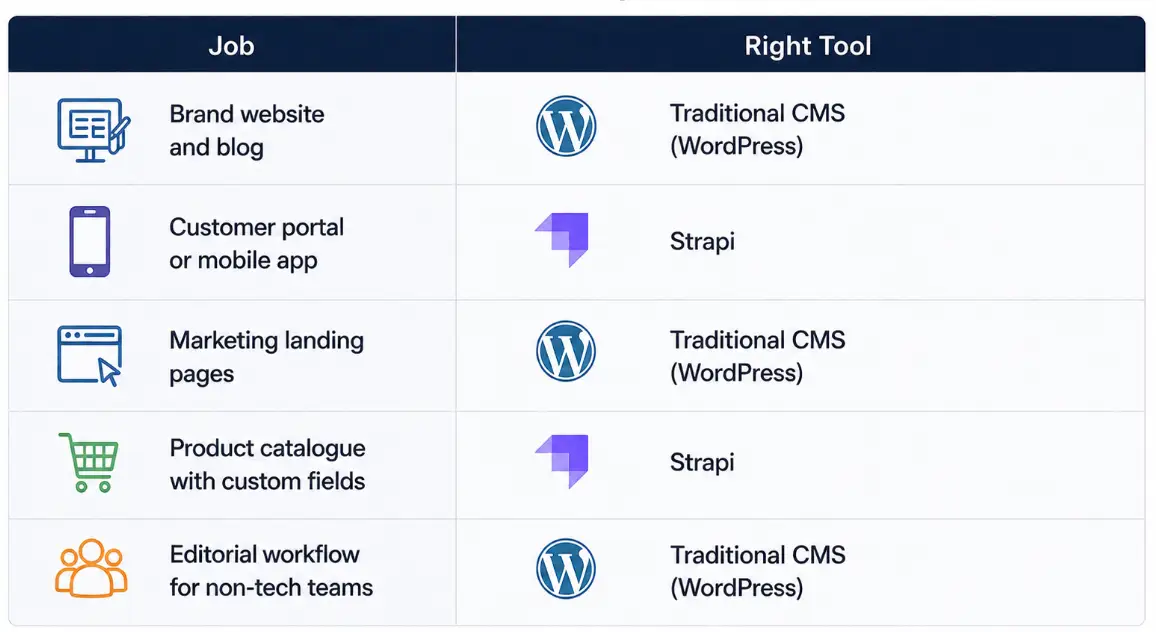
A retail enterprise uses WordPress for its marketing site. The content team loves it. But they also need to power a mobile shopping app and a partner API feed. They add Strapi to handle that layer. Both tools run side by side. No migration headache. No disruption to the existing team.
Who Should Be Thinking About Strapi
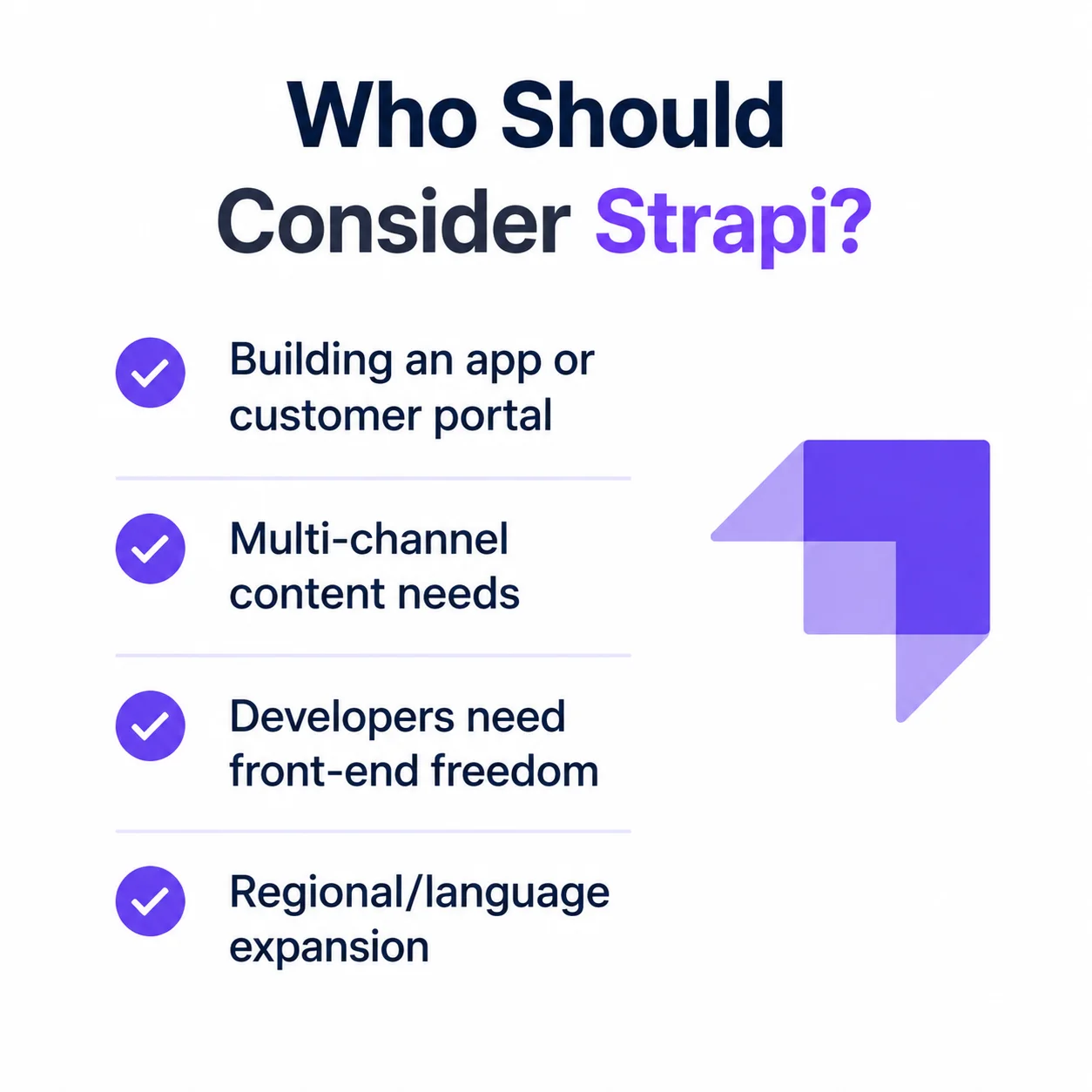
You might be ready to explore Strapi if:
- You are building or rebuilding a digital product like an app or a customer portal
- Your content needs to reach more than just a website
- Your developers keep asking for more control over the front-end
- You are expanding into new regions or languages, and content management is getting complicated
Conclusion
Traditional CMS platforms built the foundation of enterprise content. They are still the right tool for a large part of the job, and millions of teams rely on them every day.
But as digital experiences grow, some needs go beyond what they were designed for. That is not a flaw. It is just growth.
Strapi fills that gap. It gives development teams the flexibility and control to build content-driven products without starting over or throwing away what already works.
The right question is not "which CMS should we use?" It is "which tool fits which job?" And the best enterprises are learning to use both.
If you are looking for either Wordpress or Strapi services for your business, you should book a call with us at OpenSpace Services. We have experts for both traditional CMS and headless CMS that will help you unlock its full digital potential. Whether you need a flexible, scalable website with Strapi’s headless CMS capabilities or a feature-rich, user-friendly WordPress site, our team ensures seamless development, smooth integrations, and optimized performance.