

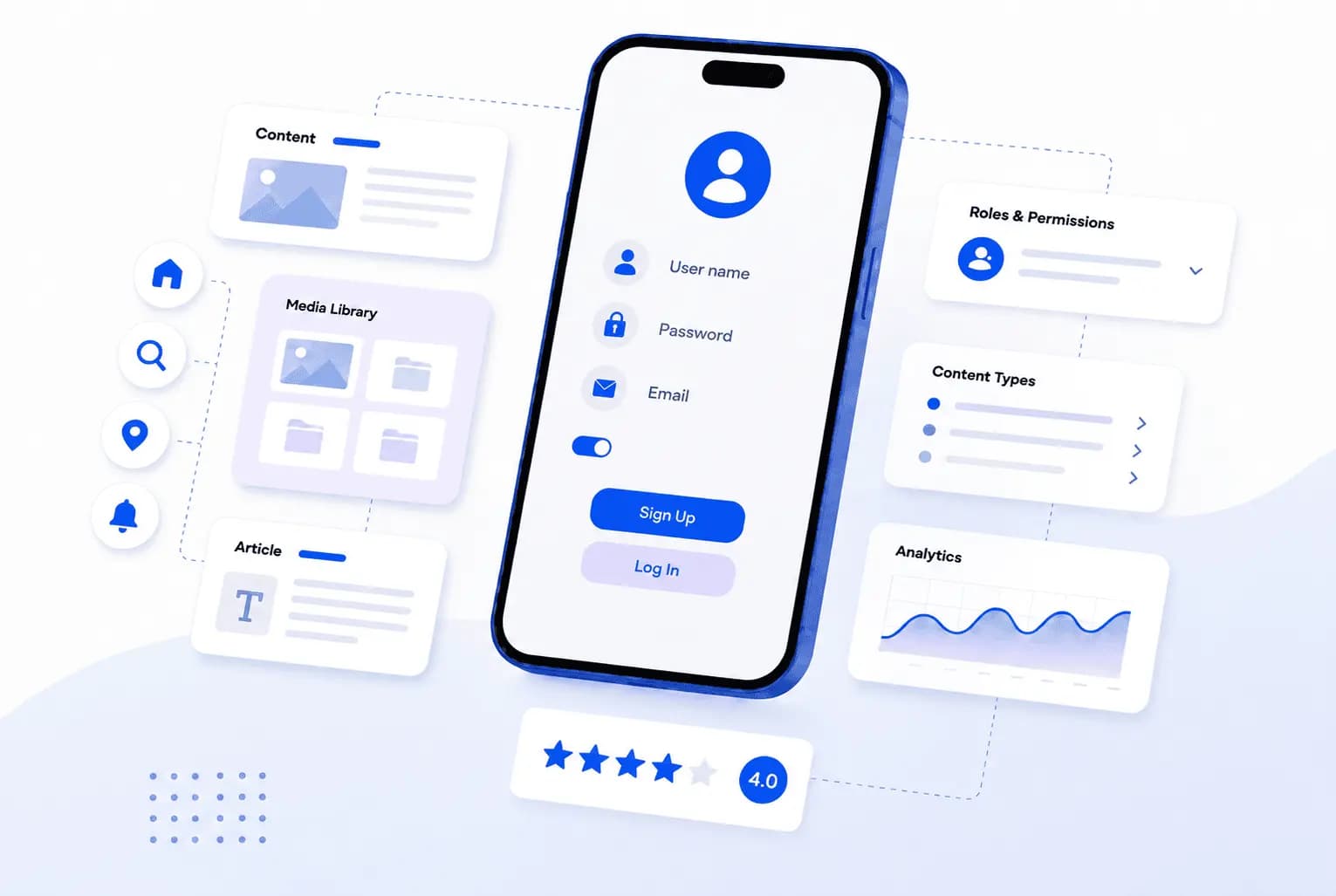
A mobile app redesign improves the user experience while retaining the existing application architecture. Businesses should evaluate whether they need mobile app development services or a complete modernization strategy. A rebuild replaces the application's underlying technology to address issues such as technical debt, poor scalability, outdated frameworks, or security limitations. The right choice depends on whether your biggest challenge lies in the user experience or the application's foundation.
Every Mobile App Reaches a Turning Point
No mobile app remains modern forever.
The application that delivered an excellent customer experience three years ago may now struggle with slower releases, rising maintenance costs, compatibility issues, and declining user engagement. Meanwhile, user expectations continue to evolve. They expect faster performance, intuitive navigation, seamless integrations, and regular feature updates.
When an app begins falling behind, many organisations ask the same question:
Should we redesign the app or rebuild it from scratch?
The answer isn't always straightforward.
A redesign may improve customer satisfaction while preserving your existing investment. A rebuild, on the other hand, requires a larger commitment but can eliminate years of accumulated technical debt and prepare the application for future growth.
Making the right decision requires understanding the root cause of the problem rather than reacting to visible symptoms.
Redesign Fixes the Experience. A Rebuild Fixes the Foundation.
Although these approaches are often discussed together, they solve very different business challenges. Rebuilding applications with modern mobile app development frameworks improves long-term scalability.
A redesign focuses on improving how users interact with the application. Navigation, visual design, accessibility, onboarding flows, and usability are refined without fundamentally changing the application's architecture.
A rebuild goes much deeper. The application is reconstructed using modern frameworks, updated APIs, scalable infrastructure, and cleaner code. This creates opportunities to improve performance, security, maintainability, and future development.
A useful way to think about it is this:
If customers complain that your app is difficult to use, you're likely facing a design problem.
If your developers complain that every new feature takes weeks to implement, you're probably facing an architectural problem.
Understanding which problem you're solving prevents expensive mistakes later.
Signs Your App Needs a Redesign
Not every ageing application needs to be rebuilt.
Sometimes the underlying technology remains reliable, but the customer experience no longer meets user expectations.
A redesign is often the better choice if you notice:
- Users abandoning the onboarding process before completing registration.
- Falling App Store or Play Store ratings despite stable application performance.
- Increased customer support requests related to navigation or usability.
- An interface that no longer reflects your brand identity.
- Accessibility issues affecting usability across different user groups.
- Lower engagement following new feature releases.
For example, imagine a banking application that performs well technically but still uses navigation patterns introduced several years ago. Customers struggle to locate account statements, bill payments, or investment options because the interface has become cluttered over time.
In this case, rebuilding the application would add unnecessary cost. Improving the information architecture, simplifying navigation, and redesigning key user journeys would likely deliver better business outcomes with significantly lower investment.
Signs Your App Needs a Complete Rebuild
There comes a point where improving the interface no longer solves the underlying problems.
Many organisations continue redesigning applications built on ageing architectures, only to discover that development becomes slower, maintenance costs continue increasing, and performance issues remain unresolved.
These are strong indicators that rebuilding should be considered.
1. Technical Debt Is Slowing Development
If every feature request requires developers to work around outdated code, technical debt has become a business problem rather than an engineering problem.
A modern application should make innovation easier; not harder.
2. The Technology Stack Is No Longer Supported
Applications built using deprecated frameworks, unsupported SDKs, or legacy libraries become increasingly difficult to maintain.
As operating systems evolve, compatibility issues become more frequent while finding developers familiar with older technologies becomes more challenging.
3. Performance Problems Continue Returning
Persistent issues can often be resolved through mobile app performance optimization services.
Occasional bugs are normal.
Persistent crashes, long loading times, excessive battery consumption, and memory issues usually indicate deeper architectural limitations.
Improving the user interface won't solve these problems.
4. Scaling New Features Has Become Difficult
Modern applications rarely exist in isolation.
Today's mobile apps integrate with payment platforms, customer relationship management systems, analytics tools, AI services, identity providers, and cloud infrastructure.
If introducing new integrations requires extensive redevelopment every time, the application's architecture may no longer support business growth efficiently.
5. Security Requirements Have Changed
Security expectations continue evolving, particularly in industries such as healthcare, financial services, insurance, and eCommerce.
Legacy authentication methods, outdated encryption libraries, or unsupported third-party dependencies can introduce unnecessary risk.
In many cases, rebuilding provides a stronger long-term security foundation than repeatedly patching ageing code.
Ask These Five Questions Before Making a Decision
Rather than asking whether the application is old, leadership teams should ask whether it still supports the business.
Before committing to a redesign or rebuild, consider the following questions:
- Can developers release new features quickly without introducing regressions?
- Is customer feedback primarily about usability or application performance?
- Does the existing architecture support future business goals?
- Will upcoming integrations require significant redevelopment?
- Are maintenance costs increasing faster than the application's business value?
The answers often make the right direction much clearer.
Redesign vs Rebuild: A Practical Comparison
Before committing budget and development resources, it's helpful to compare both approaches across the areas that matter most to the business.
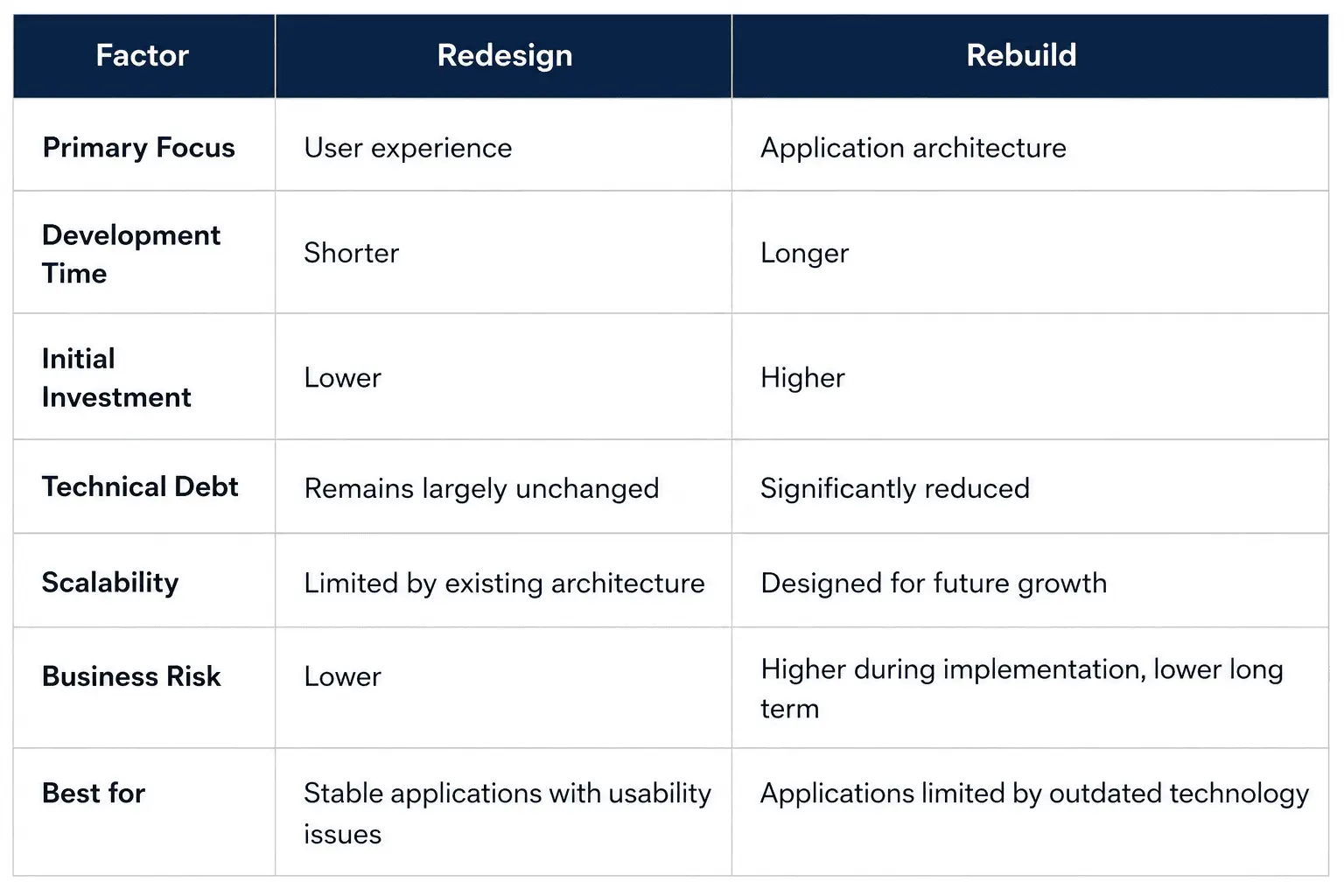
A redesign is ideal when the technology is still reliable and the main challenge is customer experience. A rebuild becomes the better investment when the application itself is slowing the business down.
Don't Let Cost Be the Only Decision Factor
Many organisations choose a redesign because it appears less expensive.
While that may reduce short-term costs, repeated redesigns on top of an ageing codebase often become more expensive over time.
Consider an application that's been running for six years.
Each year, developers spend time fixing compatibility issues, upgrading libraries, resolving bugs, and working around legacy code before they can build new features.
Eventually, the organisation isn't paying for innovation; it's paying to keep the application operational.
A rebuild requires a larger upfront investment but often reduces maintenance costs, improves development velocity, and creates a stronger foundation for future products and services.
The question isn't simply "Which option costs less?"
It's "Which option delivers greater value over the next three to five years?"
Common Mistakes During App Modernisation
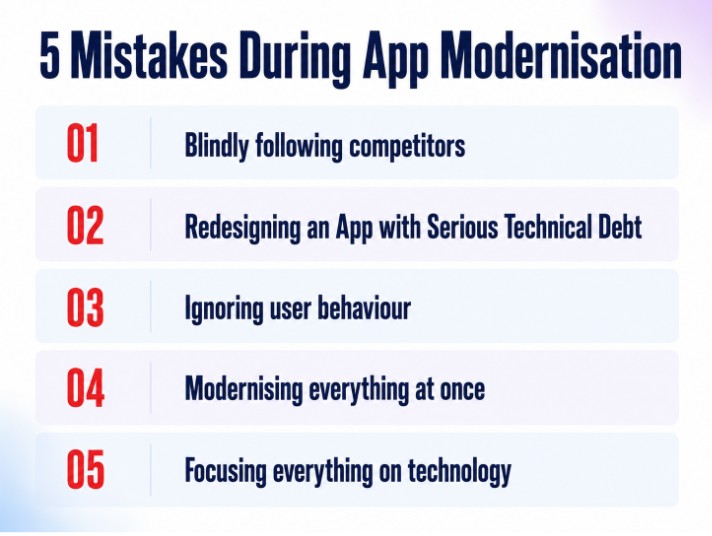
Avoid modernization risks with mobile app consulting services. Successful modernization projects begin with understanding the business problem, not choosing technology.
These are some of the most common mistakes organisations make.
Rebuilding Because Competitors Did
Just because another company rebuilt its mobile application doesn't mean your organisation should follow the same approach.
Every application has different business goals, technical constraints, and customer expectations.
Redesigning an App with Serious Technical Debt
A visually appealing interface cannot compensate for unstable architecture.
If performance issues continue after every release, rebuilding may deliver far greater long-term value than another design refresh.
Ignoring User Behaviour
Internal opinions should never replace user data.
Analytics, customer feedback, usability testing, and app store reviews often reveal whether the real challenge lies in navigation, performance, or missing functionality.
Modernising Everything at Once
Trying to redesign the interface, migrate the backend, replace APIs, and introduce new features in a single project increases complexity and risk.
Many successful organisations modernise in phases, prioritising the areas that deliver the highest business impact first.
Focusing Only on Technology
Modernisation isn't an engineering exercise. The objective is to improve customer experience, reduce operational costs, accelerate product delivery, and support future business growth. Technology is simply the enabler.
A Simple Framework for Making the Right Decision
If you're unsure which path to take, start with these questions.
Choose a redesign if:
- Customers struggle to use the application.
- Navigation feels outdated.
- Your branding has evolved.
- Accessibility needs improvement.
- Performance remains stable.
Choose a rebuild if:
- Releases are becoming increasingly difficult.
- Technical debt delays development.
- The technology stack is outdated.
- Security and compliance requirements have changed.
- Your application can no longer support future business goals.
Some organisations ultimately choose a hybrid approach; modernising the user interface first while gradually rebuilding the application architecture in phases. This can reduce business disruption while spreading investment over time.
How OpenSpace Services Approaches Mobile App Modernisation
At OpenSpace Services, we believe modernisation decisions should be driven by evidence rather than assumptions.
Before recommending a redesign or rebuild, our teams evaluate the application's architecture, performance, scalability, security, technical debt, and user behaviour. This assessment helps identify the real constraints affecting the business and ensures investment is directed where it delivers the greatest long-term value.
Whether the objective is improving customer experience, migrating from legacy technology, or preparing an application for future growth, we help organisations modernise with a strategy that balances business priorities with technical sustainability.
Final Thoughts
A mobile app doesn't become outdated simply because it's old. It becomes outdated when it can no longer support the needs of your customers or your business.
A redesign can improve engagement, usability, and customer satisfaction when the underlying technology remains strong. A rebuild becomes the right choice when technical debt, scalability challenges, or legacy architecture begin limiting innovation.
The most successful organisations don't modernise because technology changes - they modernise because their business has evolved. Taking the time to assess your application's architecture, user experience, and long-term objectives ensures every investment contributes to sustainable growth rather than short-term fixes.