


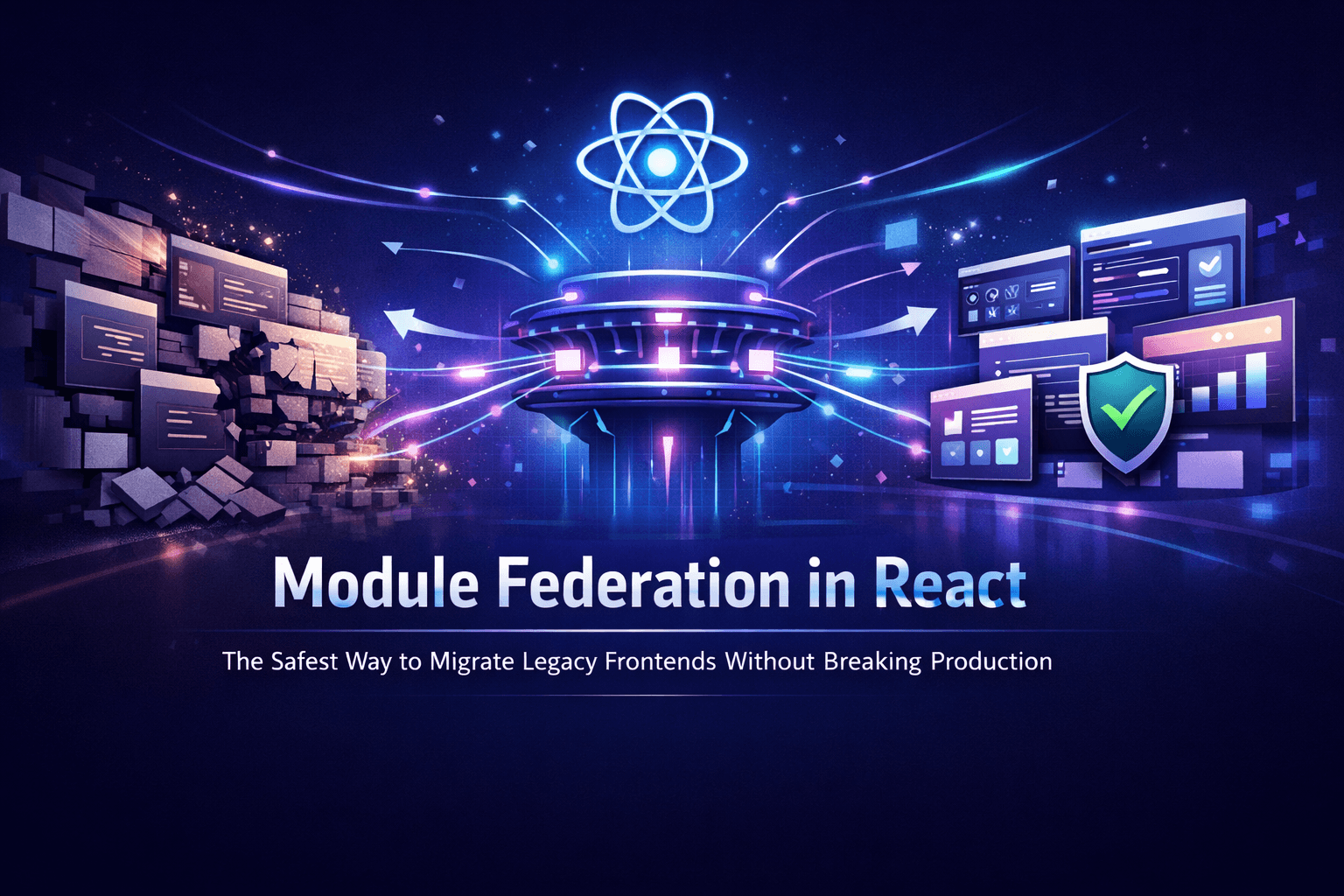
Key Takeaways:
- The Problem: Full frontend rewrites are high-risk and often lead to feature freezes.
- The Solution: Module Federation allows for incremental migration using the Strangler Fig Pattern.
- How it works: A "Shell" application hosts legacy code while new features are injected as "Remote" React modules at runtime.
- Key Benefits: Independent deployments, shared dependencies (singletons), and zero downtime for users.
Migrating a legacy frontend is one of the most difficult challenges modern engineering teams face. Your application is live, users rely on it daily, and the business expects continuous delivery. However, older codebases often suffer from outdated patterns, fragile dependencies, and mounting technical debt.
Engineering teams facing legacy modernization often rely on React JS development services to gradually rebuild scalable frontend architectures without disrupting production systems.”
When technical debt reaches a breaking point, teams face a dilemma: Should we rewrite everything from scratch?
In most cases, the answer is no. A "Big Bang" rewrite is often too risky and expensive for production systems. This is where Module Federation in React emerges as the most practical strategy for legacy frontend modernization.
What is Module Federation in React?
Module Federation is an architectural pattern (introduced in Webpack 5 and expanded in Module Federation 2.0) that allows an application to dynamically load code from another application at runtime.
Unlike traditional NPM packages—which require a full rebuild and redeployed to update—Federated modules are shared at the browser level. In a migration context, this means:
- The Shell (Host): The main container that controls the user experience.
- Remote Modules: Independent features or screens built in modern React.
- Shared Dependencies: Core libraries like react and react-dom are loaded once and shared across the entire ecosystem.
Why Full Frontend Rewrites Often Fail
In enterprise environments, a complete rewrite usually introduces:
- Feature Freezes: The business cannot ship new value while the "new version" is being built.
- Documented Logic Gaps: Years of hidden business logic and edge cases are often missed in the new build.
- Cutover Risk: Turning off the old system and turning on the new one creates a massive "blast radius" for bugs.
The Modern Alternative: The Strangler Fig Pattern
Instead of a total replacement, you use the Strangler Fig Pattern. You build a new system around the edges of the old one, gradually "strangling" the legacy code until only the modern architecture remains. Module Federation is the engine that makes this possible in the browser.
A Step-by-Step Migration Strategy
Phase 1: Deploy the "Shell" Application
The Shell acts as the orchestration layer. It handles top-level routing and authentication. Initially, the Shell simply "wraps" the legacy application, serving it to users without any visible UI changes.
Best Practice: Keep the Shell "thin." It should only manage:
- Global Layout (Navigation/Footer)
- Authentication & Session State
- Routing logic (deciding which route loads which module)
Phase 2: Building New Features as Federated Remotes
Once the Shell is active, every new business requirement should be built in modern React (React 18+) as a federated remote. This prevents the legacy codebase from growing and allows your team to utilize modern state management and design systems immediately.
Phase 3: Incremental Replacement
Identify high-value or high-maintenance screens in the legacy app. Rebuild them as modern remotes and update the Shell's router to point to the new remote instead of the legacy screen. This allows for a "Route-by-Route" migration.
Critical Technical Requirements
To ensure a smooth transition using Module Federation, teams must address three technical pillars:
1. Singleton Dependency Management
To avoid "Invalid Hook Call" errors and performance bloat, libraries like react and react-dom must be configured as singletons. This ensures the browser only loads one instance of React, regardless of how many remotes are active.
2. CSS Isolation
Legacy systems often use global CSS that can "leak" into modern modules.
- Solution: Use CSS Modules, Tailwind CSS, or Shadow DOM to ensure modern styles don't conflict with legacy stylesheets.
3. Shared Authentication
The user should never have to log in twice. The Shell should own the authentication token and share it with remotes via React Context or a shared global state.
Why Module Federation 2.0 is a Game Changer
For enterprise teams, Module Federation 2.0 (now supported via tools like Rspack and enhanced Webpack plugins) offers:
- TypeScript Type Safety: Share types across application boundaries to prevent runtime errors.
- Better Tree Shaking: Reduces the bundle size of shared modules.
- Improved Dev Tools: Easier debugging of remote-to-host relationships.
Common Challenges to Watch For
- Caching: If your remoteEntry.js file is cached too aggressively, users may load outdated code. Use short TTLs or cache-busting headers.
- Performance: Loading multiple remotes can impact "Time to Interactive" (TTI). Use lazy loading to ensure remotes are only fetched when the user navigates to that specific route.
Conclusion
Module Federation in React provides a safe, scalable path away from legacy technical debt. By allowing old and new code to coexist, engineering teams can modernize their stack at the pace of the business—not at the risk of the business.
Organizations planning large-scale frontend modernization often leverage enterprise React development solutions to implement modular architectures like Module Federation safely.
FAQ: React Legacy Frontend Migration
Is Module Federation better than iframes for migration?
Yes. While iframes provide isolation, they suffer from SEO issues, poor performance, and difficult state sharing. Module Federation offers a native-feeling experience with shared memory and dependencies.
Do I need Webpack 5 to use Module Federation?
While Webpack 5 introduced it, you can now use Module Federation with Rspack (for speed) or Vite (via plugins), though Webpack remains the industry standard for complex enterprise migrations.
How does Module Federation affect SEO?
If implemented with Server-Side Rendering (SSR) support, Module Federation is excellent for SEO. However, if using client-side federation, ensure your Shell application is optimized for search crawlers.
What is the "Strangler Fig" pattern in React?
It is a migration strategy where you wrap a legacy application in a modern "Shell" and replace individual features or routes one by one until the legacy system is entirely decommissioned.