



Quick Answer
FinTech and healthcare organisations operate under strict regulatory requirements, making content governance as important as application security. Strapi enables teams to build structured, reusable content models with role-based permissions, approval workflows, and API-first delivery. Organizations implementing enterprise CMS platforms should adopt Strapi CMS development services for scalable content governance. When designed correctly, these content models simplify compliance, reduce duplication, and ensure that accurate information is delivered consistently across every digital channel.
Compliance Isn't Just About Security. It's About Content
A structured governance strategy begins with enterprise CMS development solutions. When people think about compliance in regulated industries, they often focus on encryption, authentication, or data protection. While these are essential, content itself is equally critical.
A bank publishing an outdated interest rate disclaimer or a healthcare provider displaying an old treatment guideline can face regulatory scrutiny, customer complaints, and reputational damage. The issue isn't always the CMS; it's often the way content has been structured.
Many organisations still manage compliance-related information by copying and pasting the same text across websites, mobile apps, customer portals, PDFs, and email templates. Every regulatory update becomes a race to find every instance before it reaches customers.
A better approach is to treat content as structured data rather than static page copy. That's where Strapi proves valuable.
Why Strapi Works Well for Regulated Industries
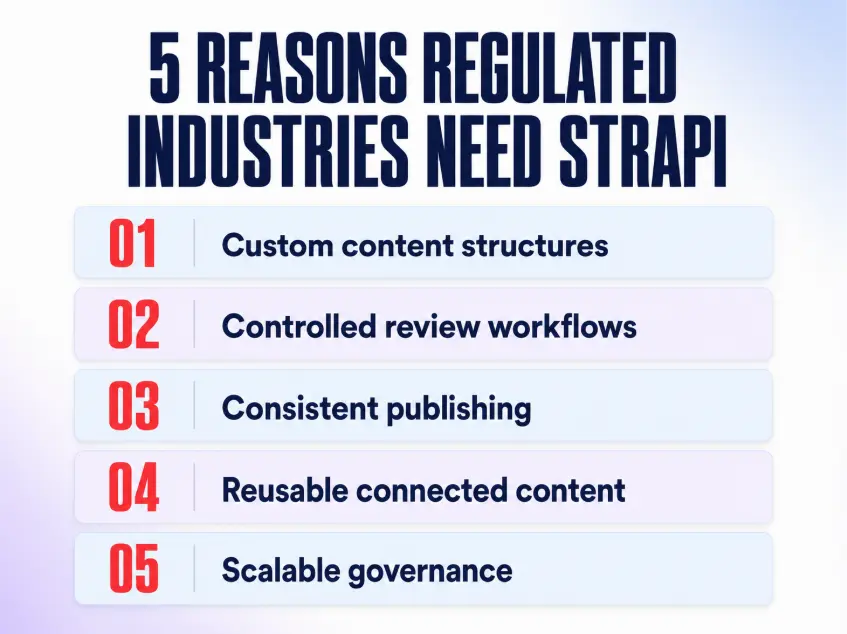
Strapi isn't a compliance platform. It won't automatically make your business HIPAA, PCI DSS, or GDPR compliant. Learn why enterprises are moving to Strapi Headless CMS for regulated environments.
What it does provide is the flexibility to design content structures that support governance, review processes, and consistent publishing.
Instead of locking organisations into predefined content models, Strapi allows development teams to create schemas that reflect their business processes. Whether you're managing insurance policies, investment products, patient education material, or regulatory disclosures, each content type can be modelled independently while remaining connected through reusable relationships.
This flexibility becomes particularly valuable as organisations expand into multiple products, markets, or languages.
The Biggest Mistake Organisations Make
One mistake appears repeatedly across regulated industries.
Teams build pages instead of building content.
Imagine a lending company launching ten financial products. Each landing page includes:
- Interest rates
- Eligibility criteria
- Legal disclaimer
- Risk warning
- Regulatory information
Most traditional CMS implementations store all of this inside a single page.
Six months later, the regulator updates a mandatory disclosure.
Now someone has to manually update every page where that disclaimer appears.
Miss one page, and customers receive inconsistent information.
Instead, that disclaimer should exist as a reusable content component referenced across every product. Reusable components improve enterprise content governance with Strapi. Update it once, and every connected experience reflects the latest approved version.
This isn't simply a development preference, it's a governance strategy.
Designing a Compliance-Ready Financial Product Model
Rather than storing an entire product page as one block of content, break it into reusable business objects.
For example:
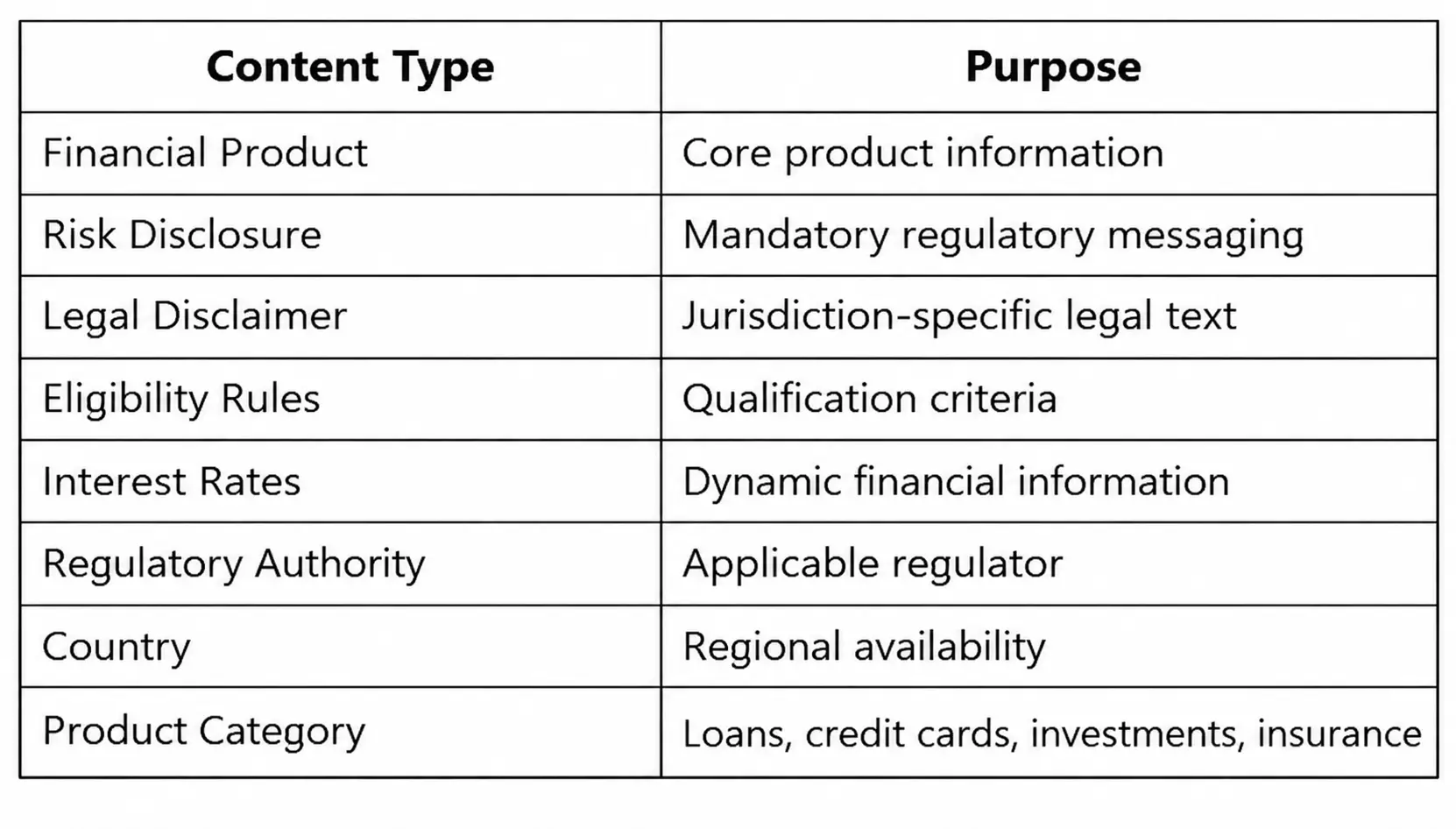
Within the Financial Product content type, include fields such as:
- Product name
- Product description
- Interest rate
- Eligibility criteria
- Linked disclosure
- Linked legal disclaimer
- Product owner
- Compliance reviewer
- Review date
- Effective date
- Expiry date
- Approval status
- Version number
This structure makes future updates significantly easier while creating a clear approval process for regulated information.
Healthcare Requires Even More Granular Content
Healthcare organisations face different challenges.
Medical information changes continuously. Treatment recommendations evolve. Drug approvals are updated. Clinical guidelines are revised.
Publishing this information as static webpages creates unnecessary operational risk.
Instead, healthcare providers should separate content into reusable components.
Rather than storing one large article, consider modelling information like this:
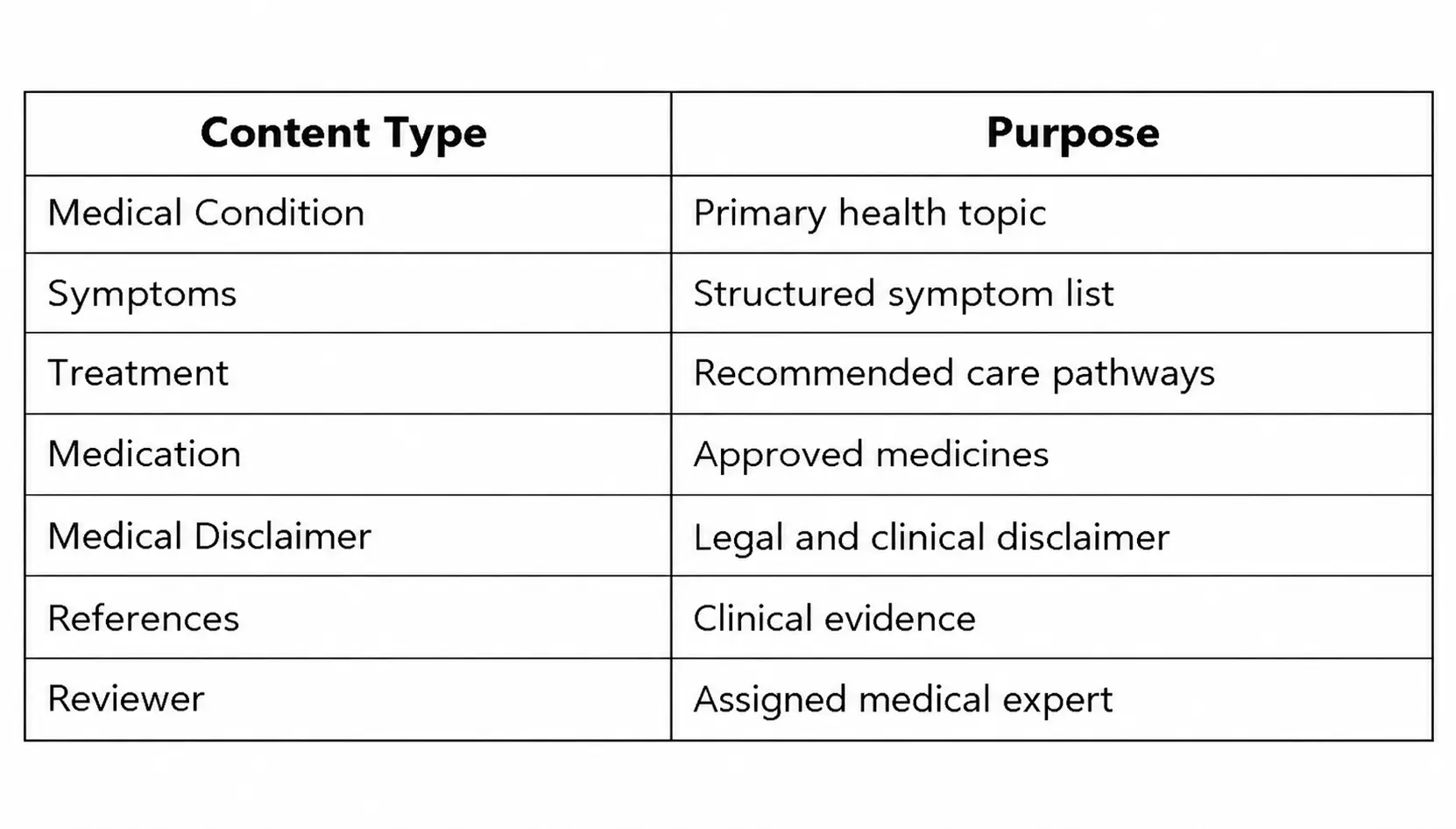
Each healthcare article can then reference these approved components rather than duplicating information across multiple pages.
This ensures consistency while making updates much easier whenever medical guidance changes.
Think in Relationships, Not Pages
One of Strapi's biggest strengths is its ability to create relationships between content types.
For example, a healthcare provider may have one approved medical disclaimer that applies to hundreds of patient education articles.
Similarly, a financial institution might maintain one central library of regulatory disclosures that automatically appears across dozens of investment products.
Instead of editing dozens of pages individually, content teams update a single approved record.
That reduces manual effort, improves consistency, and supports stronger governance across digital channels.
Build Approval Workflows Around Your Compliance Process
A CMS should reflect the way your organization reviews and publishes content, not the other way around. Organizations should configure custom workflow automation in Strapi CMS.
In regulated industries, publishing usually involves multiple stakeholders. A product manager drafts the content, compliance teams verify regulatory requirements, legal teams review mandatory disclosures, and only then is the content approved for publication.
Instead of using a simple "Draft" and "Published" workflow, consider defining stages such as:
- Draft
- Business Review
- Compliance Review
- Legal Approval
- Ready to Publish
- Published
- Archived
Each transition should have clearly assigned owners and permissions.
For example, a compliance officer may approve regulatory disclosures but should not be responsible for changing marketing copy. Likewise, marketing teams should be able to update campaign messaging without modifying legal statements.
This separation of responsibilities reduces operational risk while creating a clear approval trail.
Design Permissions Around Responsibilities
One of the most common mistakes in CMS implementations is assigning permissions by department rather than by responsibility.
Instead, define roles based on the actions users need to perform.
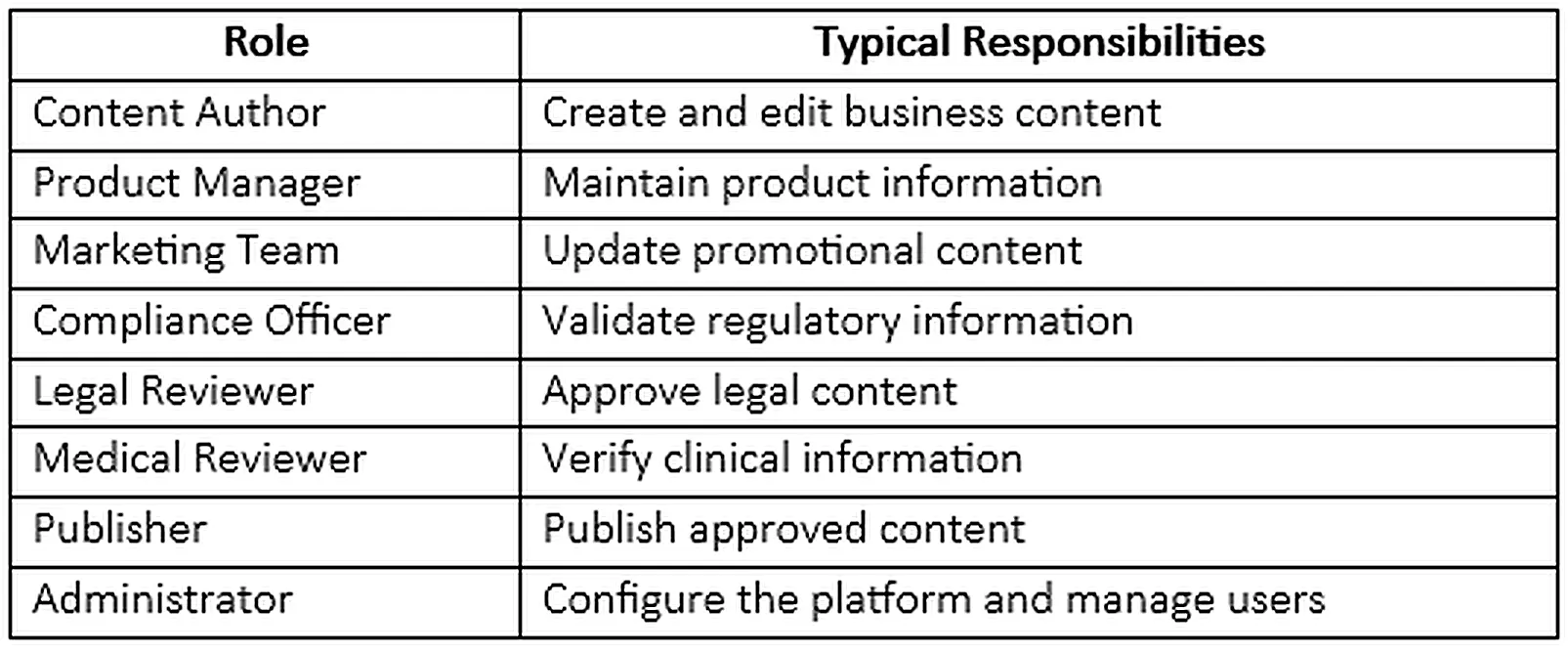
This approach limits unnecessary access while making every approval easier to trace during audits.
Know What Doesn't Belong in Strapi
A common misconception is that a CMS should store all business data. Businesses should understand CMS integration with ERP, CRM, and EHR systems.
For regulated organisations, that's rarely the right approach.
Strapi is designed to manage content, not sensitive operational records.
For example, a healthcare provider shouldn't store patient histories, laboratory reports, prescriptions, or insurance claims inside the CMS.
Similarly, financial institutions shouldn't use Strapi to store customer account details, payment credentials, KYC documents, or transaction records.
Instead, keep regulated business data in systems built specifically for those purposes and use Strapi to manage the content that explains, supports, or references those services.
A practical architecture might look like this:
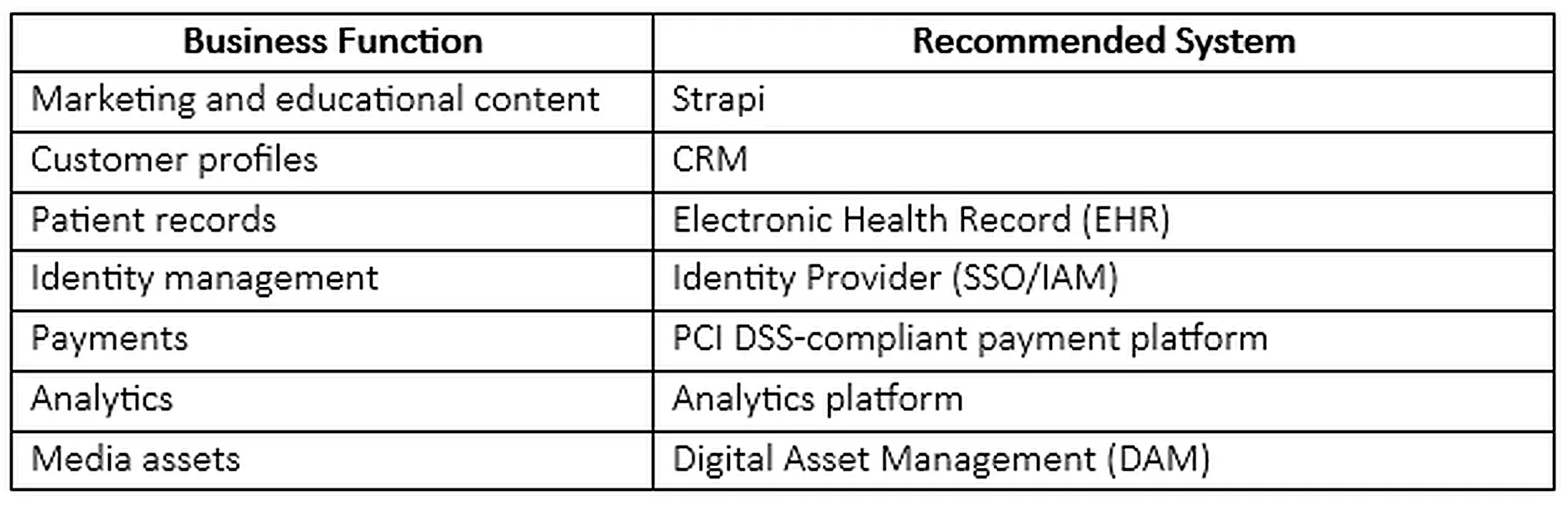
This separation reduces security risks while allowing each platform to do what it was designed for.
Build Reusable Components Instead of Repeating Content
Compliance-related content changes more often than many organisations expect.
Interest rates are revised. Regulatory notices evolve. Privacy policies are updated. Medical recommendations change. Eligibility criteria are refined.
Rather than embedding this information inside individual pages, create reusable components that can be referenced across multiple content types.
For example:
Reusable Components
- Legal Disclaimer
- Privacy Notice
- Risk Warning
- Medical Disclaimer
- Regulatory Contact Information
- Consent Statement
- Country-Specific Compliance Notes
When regulations change, editors update one approved component instead of manually searching dozens of pages.
Over time, this significantly reduces maintenance effort while improving content consistency across websites, mobile apps, and customer portals.
Design for Audits, Not Just Publishing
A well-designed CMS should make audits easier.
Ask yourself these questions:
- Who approved this content?
- When was it last reviewed?
- Which regulation does it relate to?
- Which countries does it apply to?
- When should it be reviewed again?
- Which other pages use this content?
If your CMS cannot answer these questions quickly, compliance reviews become unnecessarily complex.
One effective approach is to include governance metadata within every regulated content type.
For example:
- Content Owner
- Compliance Reviewer
- Legal Reviewer
- Applicable Regulation
- Country or Region
- Review Frequency
- Effective Date
- Expiry Date
- Version Number
- Approval Status
These fields may never be visible to customers, but they become invaluable during internal governance and external audits.
Integrating Strapi into an Enterprise Environment
In most organisations, Strapi is only one part of the technology ecosystem.
It typically works alongside systems responsible for customer management, authentication, analytics, document storage, and business operations.
Common enterprise integrations include:
- CRM platforms for customer data
- Identity providers for secure authentication
- Digital Asset Management systems for images and documents
- Marketing automation platforms for campaigns
- Analytics platforms for performance insights
- ERP systems for operational data
- Electronic Health Record systems for clinical information
- Payment platforms for financial transactions
An API-first architecture allows these systems to exchange information without duplicating business data across multiple applications.
How OpenSpace Services Helps
Choosing Strapi is only the first step. The long-term success of a CMS implementation depends on the architecture behind it.
At OpenSpace Services, we help organisations design content models that are scalable, reusable, and aligned with regulatory requirements. Rather than simply implementing a CMS, our teams focus on creating structured content architectures, governance workflows, API integrations, and deployment strategies that support long-term business growth.
Whether you're modernising a legacy CMS, launching a new digital platform, or expanding into multiple regions, we help build solutions that balance developer flexibility with enterprise governance.
Final Thoughts
For organisations operating in highly regulated industries, compliance is not just about protecting data; it's about ensuring that the right information reaches the right audience at the right time.
A well-designed content model creates the foundation for that consistency. By separating reusable content, defining clear governance workflows, and integrating Strapi with enterprise systems, businesses can simplify compliance while building digital experiences that scale with confidence.
The technology itself is only part of the solution. The real advantage comes from designing an architecture that supports regulatory change, business growth, and operational efficiency over the long term. Contact our team at OpenSpace Services.