

If you have been researching headless CMS options for more than a week, you have probably already come across Strapi. It keeps showing up for good reasons. Open-source, self-hosted, developer-friendly, and flexible enough to power everything from a startup's first content API to an enterprise-grade multi-channel platform. This is why many engineering teams are adopting scalable headless content management systems that separate content infrastructure from frontend delivery.
But here is something that does not get talked about enough: a lot of Strapi projects do not go well.
Not because Strapi is a bad tool. It is one of the best tools. The problem is almost always in how the project is set up, scoped, and handed off. CTOs who have been through one bad Strapi implementation know exactly what we mean.
Why do Strapi Projects Fail?
Most Strapi projects fail because content modeling, editorial workflows, and API architecture are not properly planned before development begins. Poor content structure and unclear system ownership often create scalability and maintenance issues later.
This blog covers three things: what good Strapi development actually involves, where projects typically go wrong, and what to look for when you are choosing a team to build or fix one.
Why Strapi Is Worth the Attention

The headless CMS market is growing at a projected 22.1% CAGR through 2032. Strapi sits squarely in the middle of this shift.
As of 2024, Strapi crossed 5.5 million NPM downloads and 65,000 GitHub stars. Companies like Adidas, Tesco, Toyota, and Amazon have built on it in production. It is not a niche tool anymore. The platform has become especially popular among growing businesses looking for scalable CMS architecture for startups without the limitations of traditional monolithic systems.
What makes it genuinely useful for engineering teams:
- It auto-generates REST and GraphQL APIs from your content models
- The admin panel is fully customisable for non-technical editors
- You control your own hosting, schema, and data
- It integrates cleanly with Next.js, Nuxt, Astro, React Native, and most modern frontend stacks
- There are no API call limits or per-seat pricing surprises
Developer Dre Dyson, who has shipped production applications across multiple headless CMS platforms, put it this way:
"Strapi is the project I've recommended most often over the past two years. It's open-source, it's self-hosted, and it gives you total control over every aspect of your CMS. I've run Strapi on a $20/month DigitalOcean droplet handling 500K API calls per month without issues."
That kind of control is what draws engineering teams to Strapi. But control also means responsibility. If the foundation is wrong, the project pays for it later.
Your Strapi Project Is Stalling. Here Is Usually Why.
Projects that start well often slow down around the 6-to-8-week mark. Deadlines get pushed. A new requirement comes in, and the data model needs rethinking. The frontend team and the content team are stepping on each other.
The root cause is almost always the same: content modelling was treated as a development task, not an architecture decision.
The schema gets built as features are added, not designed upfront to reflect how content actually relates and flows across the system. By the time the problem becomes visible, it is expensive to fi
Skipping the discovery and content modelling phase is one of the most common causes of project delays in Strapi implementations. Teams that begin development without mapping their content types, relationships, and editorial workflows often end up rebuilding significant portions of the project midway through.
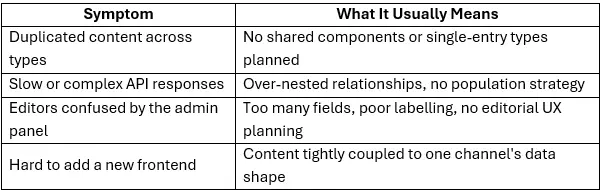
6 Signs Your Content Architecture Will Become a Bottleneck at Scale
These signs often appear quietly. By the time they are obvious, the cost to fix them has already grown.
- Editors are duplicating content across multiple types because there is no shared structure
- Fetching a single page requires several nested API calls
- Adding a new frontend channel, a mobile app, a new market, or a new language feels like starting over
- API responses are bloated with fields that are never actually used
- Queries rely heavily on populate=*, which can inflate API response payloads significantly and hurt performance
Good content architecture starts before the first collection type is created. It requires asking: what is the single source of truth for this content? Who owns it? How many places will it be consumed? What changes frequently versus what stays stable?
These are not developer questions. They are architecture questions. And they need answers before anything is built.
What CTOs Get Wrong When Scoping a Headless CMS Migration
Most Strapi projects are scoped as a list of pages with a rough timeline attached. Teams that do not fully understand how Strapi headless CMS architecture works often underestimate the complexity of content modeling and API planning. That works for simple sites. It breaks down fast when real content complexity is involved.
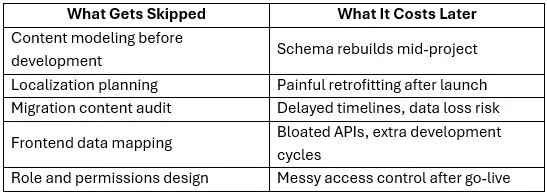
Here is what typically gets missed during scoping:
Content ownership is never discussed: Who publishes what? Are there approval workflows? Does marketing control the blog while engineering controls product data? Strapi supports role-based access control, but it needs to be designed upfront, not retrofitted after launch.
Localization is treated as an afterthought: Strapi has solid internationalization support. But adding it to an existing content model is painful. If your product will need multiple languages, that decision needs to be made before the schema is built.
Migration complexity is underestimated: Content structure rarely maps cleanly between systems. Rich text in particular almost always requires significant transformation work. Moving from a legacy CMS to Strapi without auditing your existing content first is one of the most common causes of project delays.
The frontend data requirements were never mapped: A frontend developer should be involved in content modeling. They know which fields will actually be consumed, what relationships need to be populated, and where GraphQL makes more sense than REST.
As developer Dre Dyson noted after running multiple headless CMS implementations in production:
"Poor content modeling is the single most expensive mistake to fix later. I spent at least a full day designing my content schemas before writing any code on my most successful projects. On my least successful project, I skipped this step and spent three weeks refactoring."
A proper scoping process for a Strapi project should include:
- A content inventory of everything that needs to be managed
- A relationship map showing how content types connect
- A clear definition of which frontends will consume the API and what they need
- A discussion of roles, permissions, and editorial workflows
- An honest assessment of what content needs to be migrated and in what format
What Good Strapi Development Actually Looks Like
None of the problems above are unique to Strapi. They appear in any system where flexibility is high, and upfront planning is low.
The difference with Strapi is that the flexibility can mask problems for longer. Because things can be changed quickly, teams often keep changing things instead of stopping to fix the underlying issue.
Good Strapi development consistently shares a few traits:
- Content modeling happens in a document or whiteboard before it happens in the admin panel
- The team includes someone who understands both content strategy and data architecture
- Many enterprise teams choose to hire experienced Strapi developers to avoid costly architectural mistakes during early implementation phases.
- Scoping explicitly covers editorial workflows, localization needs, and API consumers
- Infrastructure is treated as part of the project, not something figured out at launch
- Handoff includes documentation that a developer who was not on the project can actually use
Businesses investing in long-term digital scalability often rely on enterprise Strapi CMS development services to build flexible content infrastructure that supports multi-platform growth. Strapi is a strong tool when it is set up well. The gap between a well-built Strapi implementation and a poorly built one is significant. And most of that gap comes from the first two weeks.
What We Do at OpenSpace Services
OpenSpace Services builds and fixes Strapi implementations for engineering teams. Our work covers:
- Custom Strapi setup and content architecture
- Plugin and extension development built to be maintainable
- Strapi integration with Next.js, Nuxt, Astro, and React Native
- Migrations from WordPress, Contentful, and legacy CMS platforms
- Takeovers of stalled or poorly structured Strapi projects
- Ongoing support and maintenance retainers
We work mostly with US-based CTOs and engineering leads who either need a clean implementation from the start or need to fix one that went sideways.
If your Strapi project is stalling, or you want to get the foundation right before it does, we are happy to take a look.