
According to Postman’s State of the API 2025, 82% of organisations have adopted some level of an API-first approach, making solutions like Strapi CMS critical to modern architecture decisions.
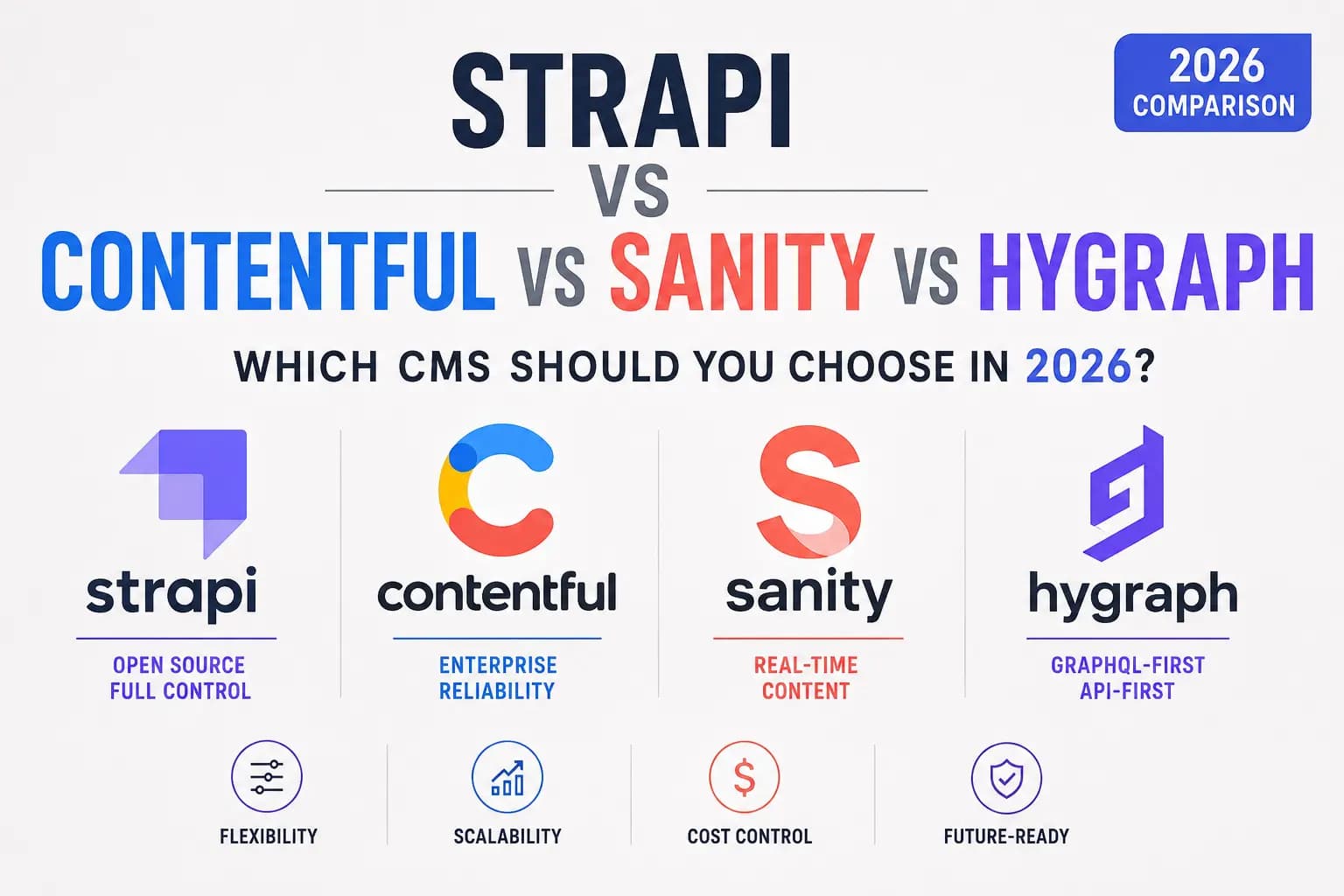
This headless CMS comparison explores Strapi, Contentful, Sanity, and Hygraph to determine the best headless CMS 2026 for growing businesses.
Choosing a CMS in 2026 is no longer JUST about managing content. It directly impacts how fast your team ships, how much you spend on infrastructure, and how easily your product scales across platforms.
For mid-sized businesses, this decision becomes even more critical. You are no longer experimenting. You are scaling.
And the wrong CMS can quietly slow down your roadmap or inflate costs over time.
In this comparison, we break down Strapi, Contentful, Sanity, and Hygraph from a CTO’s lens. Not just features, but real-world implications.
Quick Snapshot: How These CMS Platforms Compare
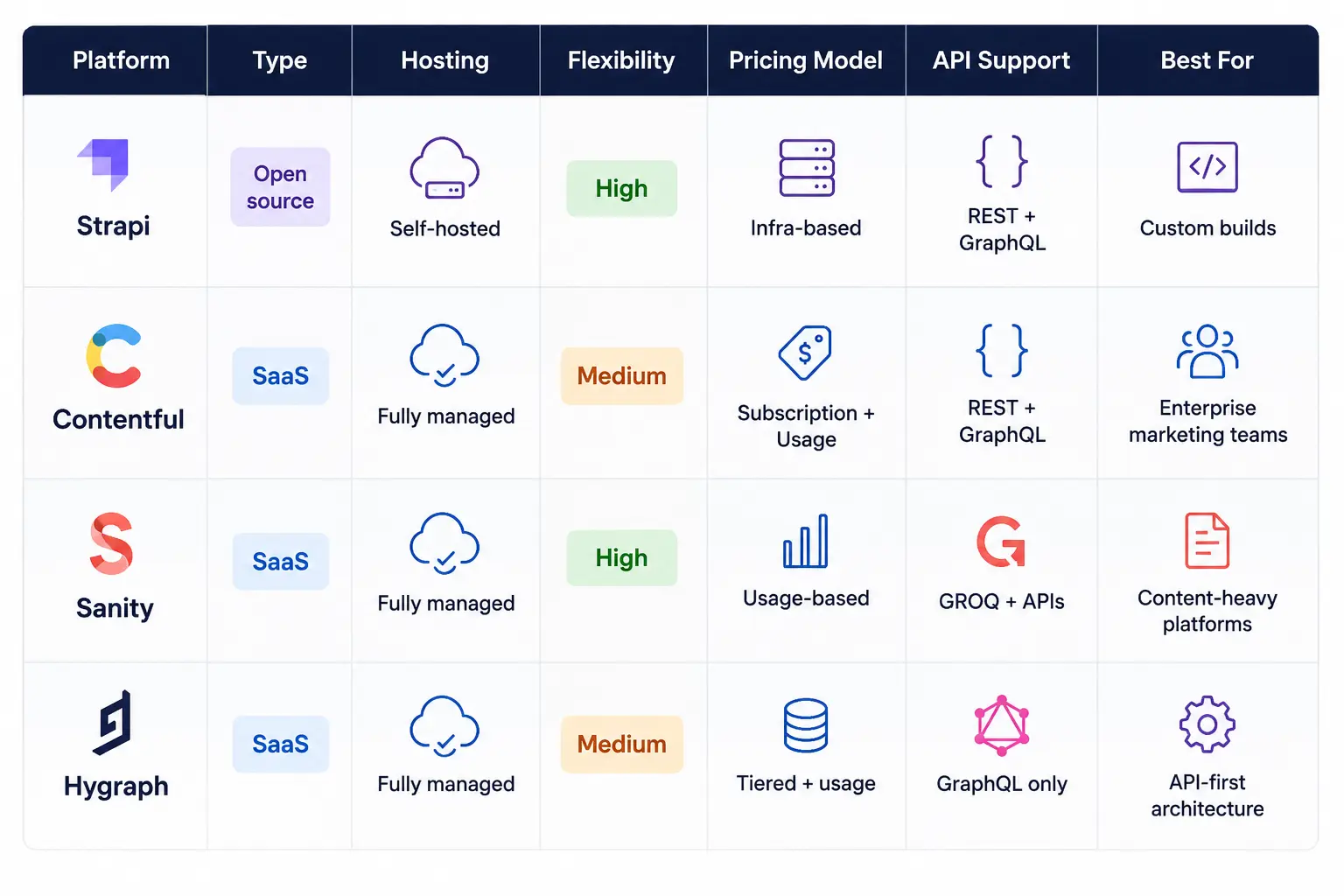
At a high level:
- SaaS tools = optimise for convenience
- Open-source tools like Strapi = optimise for control
The First Question Every Business Should Ask
“What is under discussed is the amount of technical complexity needed to integrate a headless CMS well into a modern website.” - Lee Robinson.
Before comparing tools, clarify this:
Do you want to control your backend, or do you want a managed service that abstracts everything away?
Because that decision alone narrows your options significantly. Here are 2 examples to help you understand.
Scenario 1: Scaling Indian D2C Brand - You are expanding globally, adding apps, regional content, and integrations. Cost predictability and flexibility matters.
Scenario 2: US SaaS Company - You need custom workflows, integrations with internal systems, and fast iteration.
In both cases, the CMS is no longer just a content tool. It becomes part of your core system architecture.
Strapi: Built for Teams That Want Control
What Strapi Gets Right
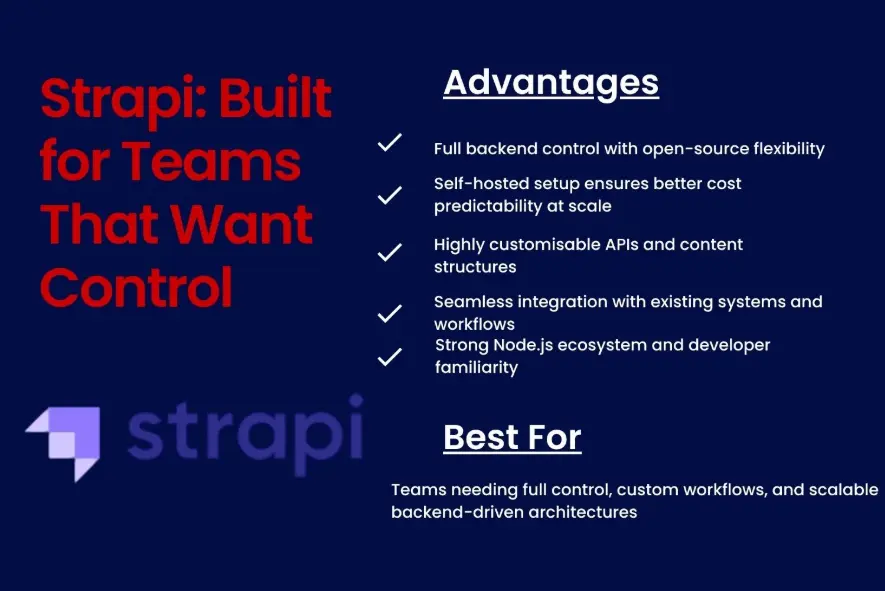
Strapi is an open-source, Node.js-based Strapi headless CMS that gives you full ownership of your backend and supports flexible Strapi CMS development for modern applications. If you are new to headless architecture, this Introduction to Strapi CMS explains how scalable API-first content systems work for modern businesses.
- Self-hosted or cloud-hosted
- REST and GraphQL APIs out of the box
- Fully customisable content structure and logic
- Large developer ecosystem
Also Read: A complete Beginner's Guide to Straip CMS in 2026
Where It Works Best
Strapi performs exceptionally well when:
- You need custom workflows or business logic
- Your CMS needs to integrate deeply with your backend
- You want scalable Strapi headless CMS development without SaaS limitations
Businesses evaluating flexible digital infrastructure should also explore how Strapi CMS for modern web applications supports scalable omnichannel experiences and API-first development.
Real-World Scenario
A mid-sized eCommerce brand in India moves from a monolithic setup to a headless architecture. They need:
- Custom product workflows
- Multi-region content
- Integration with ERP and marketing tools
With Strapi, the team builds exactly what they need without being restricted by platform limitations.
Cost Advantage Over Time
Unlike SaaS CMS platforms, Strapi does not charge based on:
- API calls
- Content entries
- Users
Your cost is tied to infrastructure, which becomes more predictable as you scale. This scalability and cost predictability is also why US startups are choosing Strapi development over traditional CMS platforms.
Where Strapi Requires Thought
- Requires backend and DevOps capabilities
- Initial setup is more involved than SaaS tools
That said, for teams that treat content as infrastructure rather than just a tool, this trade-off often pays off long term.
Contentful: Reliable, but Can Get Expensive at Scale
Strengths
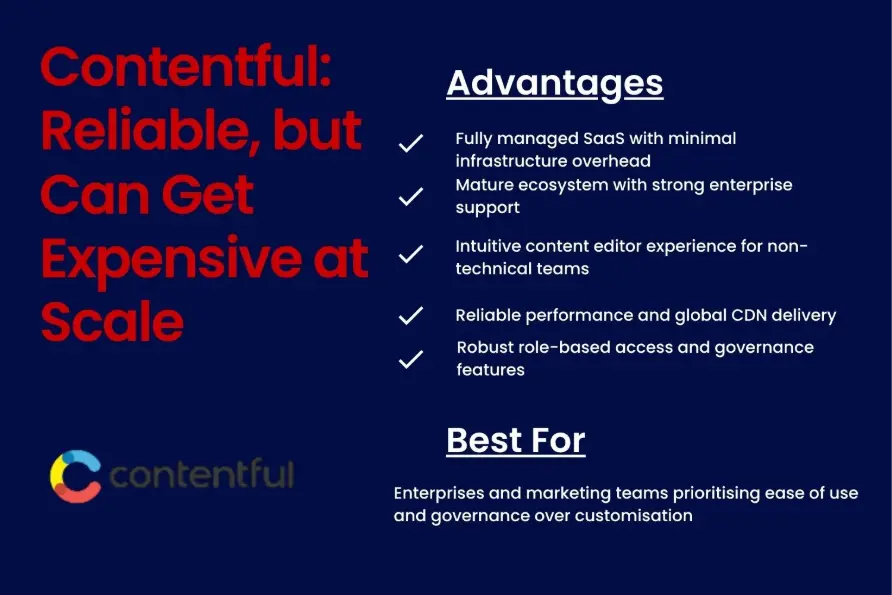
Contentful is one of the most mature headless CMS platforms.
- Enterprise-grade reliability
- Strong UI and editorial workflows
- Large ecosystem and integrations
Where It Works Best
- Marketing-heavy organisations
- Teams that want minimal backend involvement
- Enterprises with structured content needs
Where Businesses Start to Notice Trade-offs
As systems grow:
- API usage-based pricing can increase significantly
- Limited control over backend logic
- Customisation often requires workarounds
For mid-sized companies transitioning into scale mode, these factors become more visible over time.
Sanity: Powerful for Content, Less So for Backend Logic
Strengths
Sanity is known for its flexible content modelling and real-time collaboration features.
- Real-time editing capabilities
- Strong developer tooling
- Highly customisable content schemas
Best Use Cases
- Editorial platforms
- Content-heavy applications
- Teams prioritising collaboration
Limitations
- Pricing tied to usage and data volume
- Requires strong frontend architecture
- Backend customisation is limited compared to open systems
Sanity excels when content is the core product. But when content needs to integrate deeply with business logic, teams may feel constrained.
Hygraph: GraphQL-First, but Not Always Necessary
Strengths
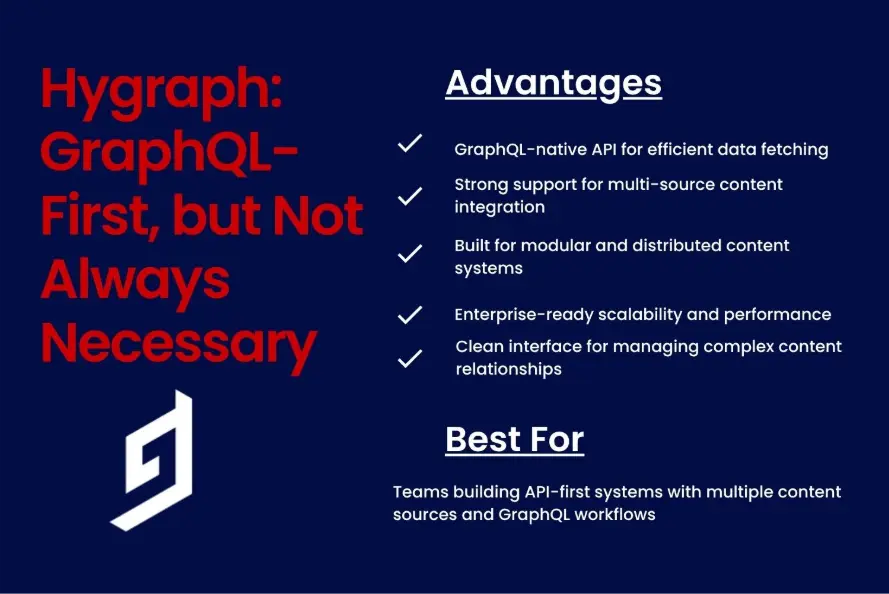
Hygraph is built around GraphQL and fits well into composable architectures.
- GraphQL-native
- Good for multi-source content aggregation
- Enterprise-ready capabilities
Best Use Cases
- Complex content ecosystems
- Teams already committed to GraphQL
Limitations
- GraphQL-only approach may limit flexibility
- Adds complexity for teams that do not need it
- Pricing can scale with usage
For many mid-sized companies, Hygraph can feel like a powerful solution to a problem they do not yet have.
3 Practical Scenarios: Which CMS Wins?
1. Scaling D2C Brand
- Needs flexibility, cost control, integrations
- Best fit: Strapi (headless CMS for eCommerce)
2. SaaS Product with Custom Workflows
- Needs backend control and rapid iteration
- Best fit: Strapi or Sanity (headless CMS for SaaS companies)
3. Enterprise Marketing Team
- Needs governance, workflows, minimal engineering
- Best fit: Contentful
When Strapi May Not Be the Right Fit
Strapi may not be ideal if:
- You do not have backend or DevOps resources
- You need a plug-and-play solution immediately
- Your project is a simple MVP with minimal customisation
In such cases, SaaS tools can help you move faster initially.
Final Verdict: What Matters Most in 2026
The CMS landscape is no longer about features. All four platforms are capable.
The real decision comes down to:
- Ownership vs convenience
- Predictable cost vs usage-based scaling
- Flexibility vs platform constraints
For mid-sized companies building for scale, flexibility and control tend to become more important over time.
Enterprises evaluating scalable content infrastructure should also understand why enterprises choose Strapi headless CMS for flexibility, API-first architecture, and long-term platform ownership. That is where Strapi often stands out. Not because it has more features, but because it allows you to build exactly what your business needs without being boxed into predefined limits.
Planning to build or migrate to Strapi?
If you're planning to implement or migrate to Strapi CMS, working with an experienced Strapi development company ensures faster deployment and scalable architecture. At Openspace Services, we offer Strapi CMS development services in USA, including custom builds, migration, and Strapi headless CMS consulting in USA tailored for growing businesses.
“Openspace Services has been an absolute pleasure to work with throughout this project. We approached them with a clear vision of building a fast, functional, and thoughtfully designed, and they bought this vision to life with great detail” - Harshita, Slow Burn Method.
Along with strapi development, we also provide services like mobile app development, website development, DevOps, AI/ML, and more. Visit Openspace Services to learn more about our services.