


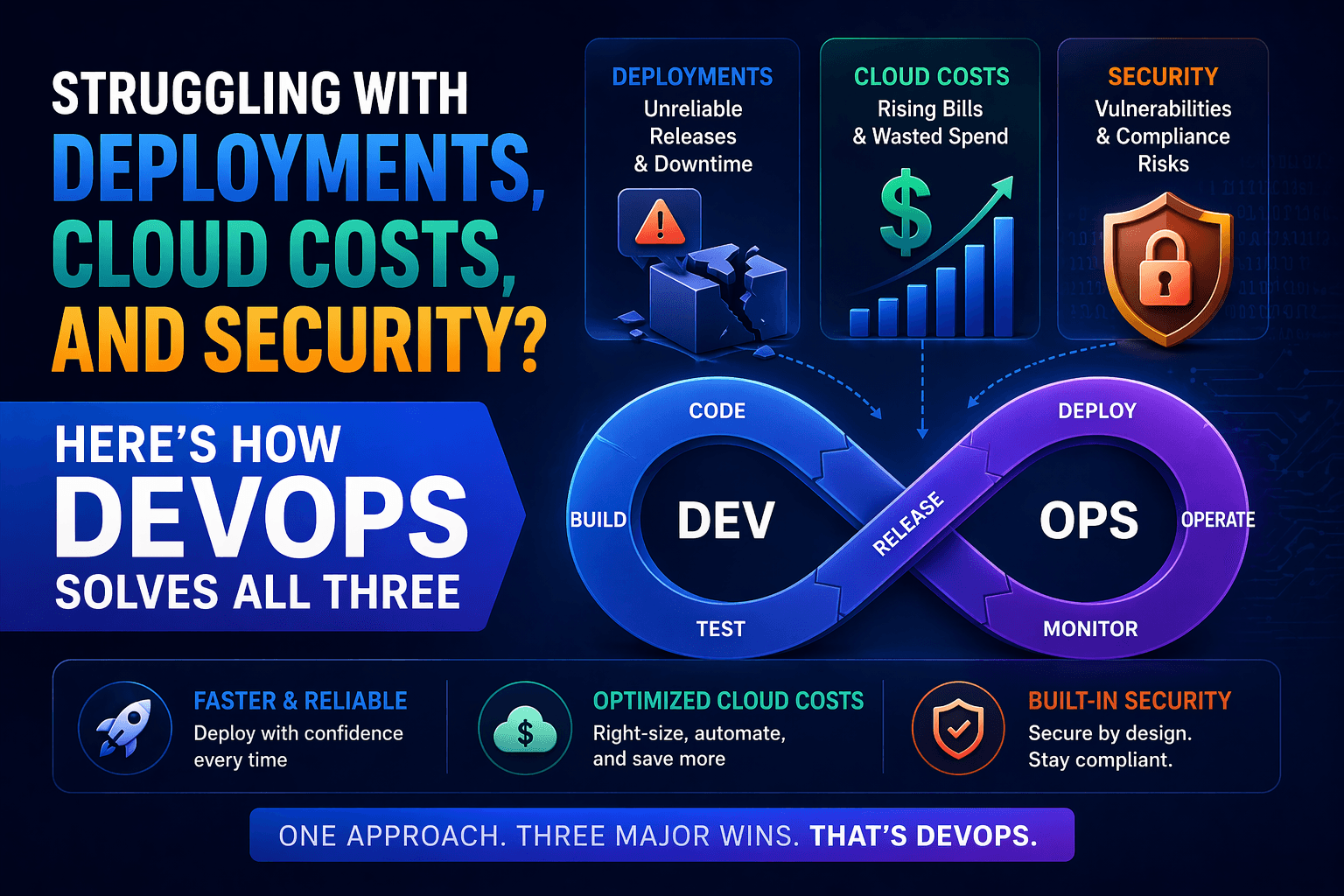
Every engineering team has felt it: the deployment that broke everything, the cloud bill that doubled without warning, the audit that revealed a vulnerability sitting silently for months.
These are the daily reality for thousands of development teams operating in fragmented, manually driven software delivery environments.
This is exactly DevOps services & solutions come in. A reliable DevOps service company helps eliminate deployment risks, control cloud costs, and build security into your delivery pipeline.
Did you know:
- According to Perforce State of DevOps 2026, 78% of low-maturity organisations operate non-standardized delivery models.
- The SentinelOne 2026 states a 154% surge in significant cloud breaches year-over-year.
- 31% of cloud spending wasted on excess or idle resources (Softjourn 2026)
- The average cost of a data breach for US organizations is $10.2M.
The Research and Markets DevOps Report 2026 shows the global DevOps market is growing from $14.95 billion in 2025 to $18.77 billion in 2026 at a 25.6% CAGR: a market signal that organizations are urgently investing in solutions to these exact pain points.
With rising demand for scalable infrastructure, many organisations are now investing in DevOps development services in USA to modernise their delivery pipelines and improve reliability.
The question isn’t whether your team faces these challenges. The question is: do you have a systematic way to solve them? That's exactly what DevOps does and exactly what we at OpenSpace Services (OSSPL) help companies achieve.
Key Takeaways
These outcomes are typically achieved through structured DevOps development services that combine automation, monitoring, and continuous improvement.
- Deployment failures are structural: manual pipelines and non-standardized delivery models are the root cause.
- DevOps compresses release cycles from months to minutes: elite teams deploy multiple times per day with failure rates below 5% (Perforce 2026).
- 31% of cloud budgets are waste: DevOps automation with IaC and continuous right-sizing eliminates the most common sources of cloud waste.
- Security cannot be “bolted on” after deployment: DevSecOps integrates vulnerability scanning and compliance directly into CI/CD pipelines.
- Teams using DevSecOps deploy 208% more frequently than low performers while maintaining tighter security postures (Gitnux 2026).
- Common adoption mistakes: tool sprawl, skipped culture change, and siloed security; kill ROI before it’s ever realized.
Why Teams Struggle with Deployments, Cloud Costs, and Security
1. The Deployment Problem
Manual deployments are the first to blame. When deployment steps live in someone’s head or in a 400-line runbook no one has updated in two years; errors are inevitable. Environments drift. Staging doesn’t match production. A developer pushes a “small fix” that cascades into a multi-hour outage.
The Perforce State of DevOps 2026 data is clear: high-performing teams are 36% more likely to automate the majority of deployments, and 66% more likely to respond effectively to production incidents using automated rollbacks.
And the low-performing teams with manual pipelines report change lead times of one to six months and failure rates up to 40%.
In short:
- Manual deployments create risk.
- Automation makes deployments faster, safer, and more reliable.
2. The Cloud Cost Problem
Cloud costs spiral for predictable reasons:
- over-provisioned infrastructure
- forgotten idle instances
- lack of tagging governance
- no automated scaling policies, and
- no real-time cost visibility.
Softjourn's 2026 cloud report estimates 31% of IT leaders waste half their cloud spend on excess or idle resources, even as 94% of enterprises use cloud services and allocate 45% of IT budgets there.
This shows, cloud is powerful but without control and visibility, it becomes expensive very quickly. This is where strategic DevOps support services play a critical role in stabilising infrastructure and improving operational efficiency.
3. The Security Problem
Security is the most dangerous challenge because its failures are often invisible until it’s too late. Industry data reveals that 65% of organizations use team or shared logins and 42% use shared SSH keys. CloudAware adds that 62% of teams struggle to integrate security into CI/CD pipelines and 51% report cultural resistance as a major barrier.
In short: Security fails when it is treated as a separate step. It needs to be built into the process from the beginning.
What Is DevOps?
DevOps is a set of practices, cultural philosophies, and automation tools that bridge the gap between software development (Dev) and IT operations (Ops). It enables teams to build, test, deploy, and monitor software faster and more reliably than traditional siloed approaches allow.
At its core, DevOps is built on four pillars:
- Collaboration (unified Dev + Ops ownership)
- Automation (eliminating manual, error-prone tasks)
- Continuous Improvement (short feedback loops and iterative optimization)
- Security Integration / DevSecOps (security shifted left into every stage of development).
According to Gitnux's 2026 DevSecOps report, teams using mature DevOps practices deploy 208% more frequently than low performers, recover from failures 2.5x faster, and reduce lead time for changes by 66%. Today, organisations rely on end-to-end DevOps services & solutions to bridge gaps between development and operations while accelerating delivery cycles.
Related read: Platform Engineering vs DevOps vs SRE in 2026
How DevOps Services Fix Deployment Challenges with CI/CD Automation
The single most powerful fix is the Continuous Integration and Continuous Delivery (CI/CD pipeline). When a developer commits code, the CI system automatically triggers: compiling, unit testing, integration testing, static analysis, and artifact generation.
This level of automation is a core component of modern DevOps development services, enabling faster and more reliable software releases.
If anything fails, the developer knows immediately before broken code ever reaches staging or production. The CD pipeline then automatically deploys approved builds through staging and production environments, with pre-defined rollback triggers if error rates spike post-deployment.
This eliminates the biggest sources of deployment failures: human error in manual steps, environment inconsistency, and delayed feedback loops.
Infrastructure as Code (IaC) Compounds These Gains
When your entire infrastructure (servers, networking, security groups, databases) is defined in version-controlled code, environments become reproducible and consistent. Every environment from dev to production is built from the same template. There's no more “it works on my machine.”
At OpenSpace Services, our governed CI/CD pipeline automation is built around one outcome: shortening release cycles from months to minutes, with automated testing and deployment as the foundation.
How DevOps Services Reduce Cloud Costs with Automation and IaC
A mature DevOps services company will implement these optimisation strategies to ensure infrastructure costs are aligned with actual usage and business value.
Cloud cost optimization through DevOps operates across three layers:
A. Provisioning with IaC
Prevents the most common source of cloud waste: over-provisioning. When infrastructure is defined in code and reviewed through pull requests, every new resource is scrutinized before creation. Teams stop creating unnecessary capacities.
B. Autoscaling and Containerization
By packaging applications in containers (Docker, Kubernetes) and defining autoscaling policies, workloads consume exactly the compute they need; scaling up during traffic spikes and back down when demand drops. This alone can cut cloud costs by 30–40% for variable-traffic workloads.
C. Monitoring and Observability
Real-time dashboards tracking resource utilization, cost attribution by service or team, and anomaly alerts ensure that no idle instance runs unnoticed for months. At OpenSpace Services, our monitoring, logging & observability service implements comprehensive monitoring systems that track application performance and infrastructure health 24/7.
How DevOps Services Improve Security with DevSecOps Practices
Traditional security checks happen at the end of development when issues are hardest and most expensive to fix. These practices are now standard across advanced DevOps services US, where security is integrated directly into the development lifecycle.
DevSecOps changes this by building security into every step of the process.
What DevSecOps Looks Like in Practice:
- Automated code scanning (SAST): Finds vulnerabilities early during development
- Dependency checks (SCA): Scans third-party libraries for known security risks
- Container security: Ensures Docker images are safe before deployment
- Policy as code: Enforces security rules automatically for every infrastructure change
- Secrets management: Replaces hardcoded credentials with secure, automated systems
The DevSecOps market is forecasted to reach $41.66 billion by 2030 at a 30.76% CAGR, reflecting the industry’s recognition that secure pipelines are a competitive necessity.
At OpenSpace Services, we never treat security as an afterthought. Our DevSecOps service bakes compliance and vulnerability scanning directly into your automated pipelines, ensuring your software is secure by design and not patched by panic.
The 6 Most Common Mistakes When Adopting DevOps
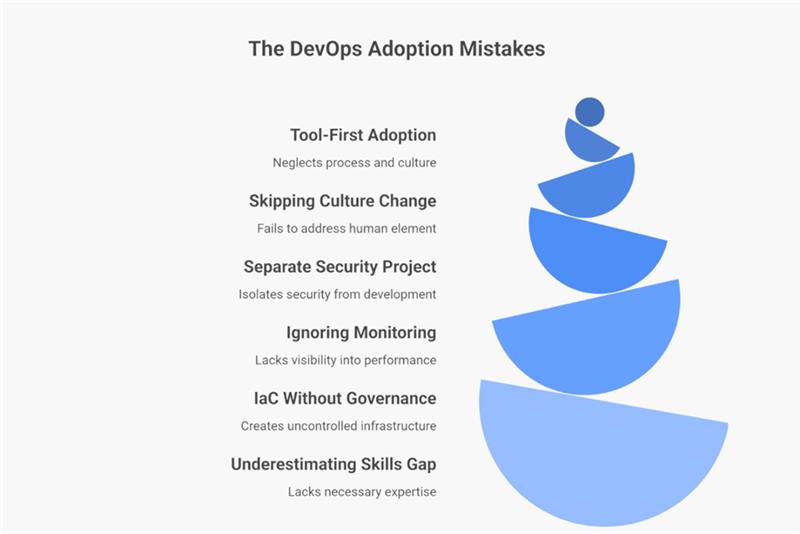
DevOps failures in practice are rarely failures of the concept. They're failures of implementation. Here are the most-costly mistakes we see:
1. Tool-first, process-last adoption
Organizations buy a CI/CD platform and declare “we’re doing DevOps now.” Without redefining workflows and ownership models, tools sit underutilized. Teams using too many disconnected tools often perform worse than teams using a few well-connected ones.
2. Skipping the culture change
DevOps is as much a cultural transformation as a technical one. Shared ownership, blameless post-mortems, and cross-functional collaboration are prerequisites.
3. Treating security as a separate project
When security teams are brought in only at the end of a sprint, integration never takes hold. Security must be embedded in the pipeline from day one, with clear ownership at the team level.
4. Ignoring monitoring and observability
Deploying fast is only half the battle. Without constant monitoring, teams are flying blind. Production issues go undetected until customers report them; eliminating the entire reliability benefit DevOps was meant to deliver.
5. IaC without governance
Infrastructure as Code (IaC) without pull request reviews, drift detection, and policy enforcement is just a faster way to create inconsistent environments. Governance must accompany automation.
6. Underestimating the skills gap
According to Softjourn,76% of organizations report cloud skills shortages. Attempting a full DevOps transformation without experienced engineers or a qualified DevOps services provider, results in half-implemented pipelines that deliver none of the promised benefits.
How OSSPL Helps You Get DevOps Right
At OpenSpace Services (OSSPL), we focuse on practical, end-to-end DevOps implementation and real outcomes.
- CI/CD Automation: Builds reliable pipelines that automate testing and deployments, reducing errors and speeding up releases.
- Cloud Cost Optimization: Uses Infrastructure as Code (IaC), autoscaling, and usage monitoring to eliminate wasted cloud spend.
- Built-in Security (DevSecOps): Integrates security checks directly into the development pipeline, so issues are caught early and not after release.
- Monitoring & Observability: Sets up real-time tracking of system performance to detect and fix problems before users are affected.
- Governed Approach: Ensures automation comes with proper controls, reviews, and best practices; avoiding the common pitfalls of inconsistent environments.
Our DevOps team helps you move from slow, manual processes to fast, secure, and cost-efficient software delivery.
Final Thoughts
The 3 challenges that keep engineering leaders up at night (deployment failures, spiralling cloud costs, and security vulnerabilities), share a common root: fragmented, manual, undisciplined software delivery.
DevOps, implemented correctly, addresses all three simultaneously. But DevOps done right requires expertise, intentionality, and a partner accountable for outcomes. At OpenSpace Services, we bridge the gap between development and operations to help you deliver high-quality software at the speed of business.
The teams winning in 2026 have stopped treating deployments, cloud costs, and security as separate problems and started solving them together.
If you’re looking for a reliable DevOps service provider offering DevOps consulting services, cloud DevOps services, and end-to-end automation, explore our DevOps solutions.
Let’s show you what that looks like for your stack. Contact us for a free DevOps consultation today!