


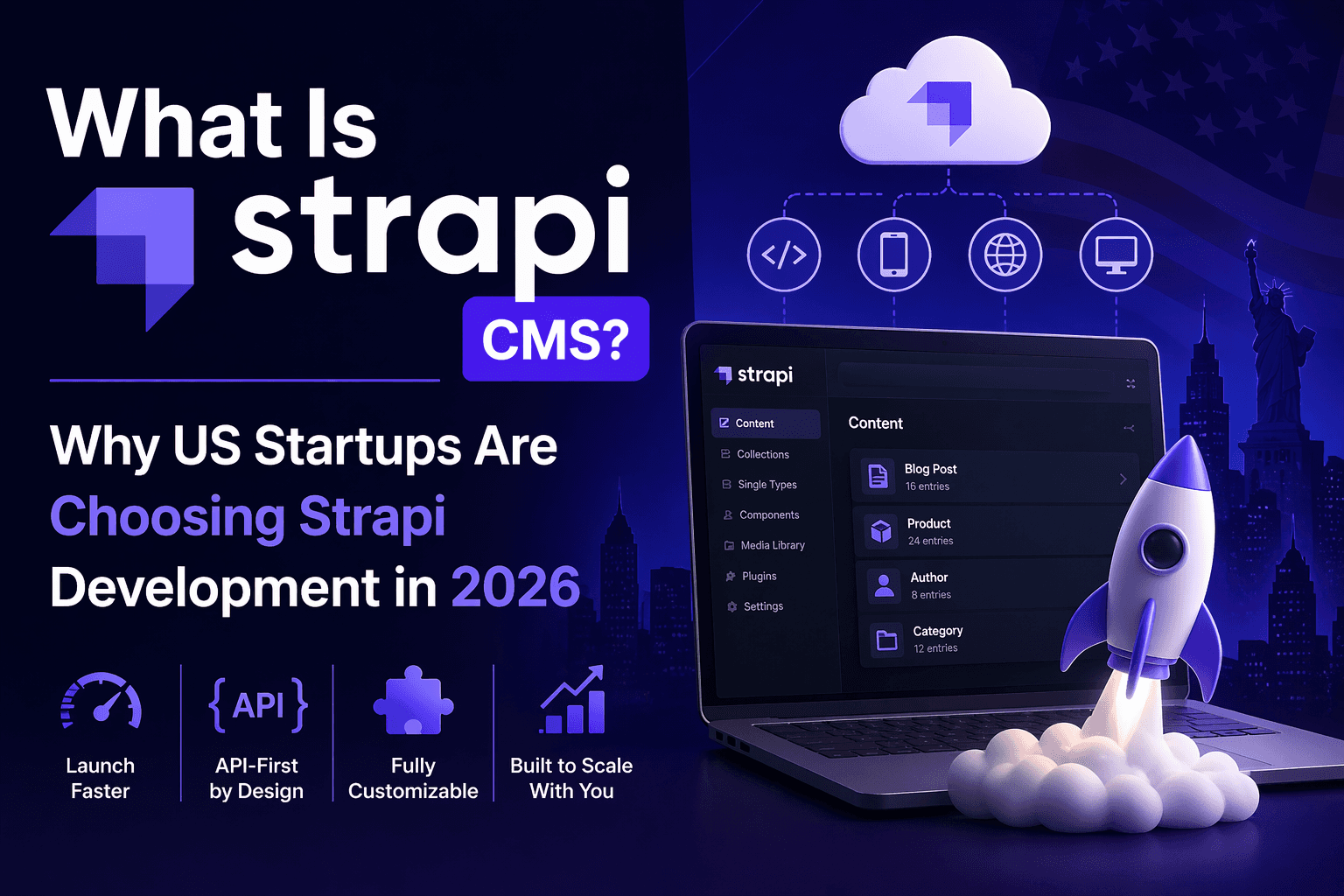
In the US startup ecosystem, launching fast is survival. Founders are under constant pressure to validate ideas, ship MVPs, and scale before competitors catch up.
Yet, traditional content management systems (CMS) often slow teams down with rigid architectures, heavy backend dependencies, and limited scalability.
This is where Strapi website development services come in. A modern headless CMS like Strapi helps startups build faster, scale efficiently, and maintain full control over their backend systems.
Many US startups are now turning to custom development services for Strapi in USA to accelerate product launches without compromising scalability.
Strapi has emerged as one of the most powerful headless CMS solutions helping startups build faster, scale smarter, and maintain full control over their tech stack.
In this guide, we’ll break down:
What Strapi CMS is
- Why US startups are adopting it rapidly
- When it makes sense to use it
- And how it accelerates modern product development
Key Takeaways
- Strapi is a headless, API-first CMS that powers content across web, mobile, and multiple platforms.
- Startups choose it for speed, enabling fast MVPs with auto-generated APIs and minimal setup.
- Highly flexible and developer-friendly, it works seamlessly with modern frameworks like React and Next.js.
- Cost-efficient and scalable, with open-source pricing and no vendor lock-in.
- Best for developer-led teams, not ideal for no-code users or simple websites.
What Is Strapi CMS? A Complete Guide to Headless CMS Development

Strapi is an open-source, API-first headless CMS built on Node.js that allows developers to create, manage, and deliver content across any platform via APIs.
Unlike traditional CMS platforms, Strapi does not control how your frontend looks. Instead, it focuses purely on content management and delivery via APIs (REST or GraphQL).
Key Capabilities of Strapi
- Headless architecture (backend separated from frontend)
- Custom content types without heavy coding
- Auto-generated APIs for CRUD operations
- Flexible deployment (self-hosted or cloud)
- Role-based access control
In simpler terms:
Strapi is the backend engine that powers your content, while your frontend (React, mobile app, etc.) controls how it looks and behaves.
This separation is exactly why it’s becoming the default choice for startups building modern digital products.
This is why Strapi headless CMS development has become a preferred approach for startups building modern, API-first digital products.
Headless CMS vs. Traditional CMS: What’s the Real Difference?
The term ‘headless’ refers to removing the ‘head’ (the frontend presentation layer) from the CMS. Traditional CMS platforms couple backend and frontend tightly. Headless CMS platforms decouple them entirely.
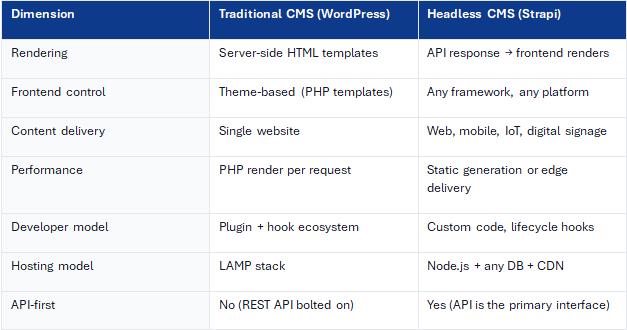
This shift is driving demand for flexible Strapi development solutions that support multi-platform content delivery and composable architectures.
Platforms like WordPress, combine backend + frontend tightly, which limits flexibility.
Headless CMS platforms like:
- Strapi
- Contentful
decouple these layers, enabling teams to build faster and scale efficiently.
Why This Shift Is Happening
The global headless CMS market is projected to reach $3.81 billion by 2032, driven by demand for flexibility and omnichannel delivery. (Netguru)
Modern businesses need to deliver content across:
- Websites
- Mobile apps
- SaaS dashboards
- IoT devices
Something a traditional CMS simply cannot keep up.
Why Startups Choose Strapi CMS Development Services for Faster Growth
Startups increasingly rely on specialised Strapi development solutions to reduce development time while maintaining full backend flexibility.
1. Faster Time-to-Market
Speed is everything in startups.
Research shows startups prioritize rapid product releases to validate market fit early. Delays in development can directly impact funding, user acquisition, and market positioning.
And to match this pace, our Strapi team accelerates development by:
- Automatically generating APIs: Developers can instantly expose content endpoints without writing backend logic from scratch.
- Eliminating backend boilerplate: Core functionalities like authentication, permissions, and CRUD operations are pre-built.
- Enabling rapid MVP (Minimal Viable Product) builds: Teams can go from idea to working backend in days instead of weeks.
This is why many startups report reducing development cycles from 2–3 months to a few weeks, especially during MVP stages.
2. Full Customization and Developer Freedom
Traditional CMS platforms (like WordPress) are tightly coupled systems. While they are easy to use, they restrict developers with:
- Fixed themes
- Plugin dependencies
- Limited backend extensibility
Strapi, on the other hand, is fully decoupled and developer-first.
It integrates seamlessly with modern frameworks such as:
- React
- Next.js
- Vue.js
This enables:
- Frontend independence
- Custom API logic
- Flexible content modelling
This level of flexibility is crucial for startups building non-standard, highly differentiated products, where rigid CMS systems become bottlenecks.
3. Cost Efficiency (Critical for Early-Stage Startups)
Budget constraints are a defining reality for startups. For early-stage startups, working with an experienced Strapi agency can further reduce development overhead while ensuring scalable architecture from day one.
Unlike proprietary CMS platforms, Strapi is open-source and free to use, which eliminates expensive licensing fees. Additionally, it also offers cost benefits such as:
- Lower backend development effort
- Flexible hosting (no vendor lock-in)
- Reduced infrastructure overhead
For bootstrapped or seed-stage startups, this can mean saving thousands of dollars annually, while maintaining full control over infrastructure.
4. API-First Architecture
Strapi’s API-first architecture allows content and data to be delivered anywhere via APIs. This is one of the key reasons why businesses prefer to hire Strapi developers who understand API-first architecture and modern frontend integrations.
This enables seamless integration with:
- Mobile applications
- SaaS platforms
- Frontend frameworks
- Third-party tools (payments, analytics, CRM)
This architectural approach supports composable architecture, where systems are built as modular, interchangeable components.
Result? Now startups can:
- Launch across multiple platforms simultaneously
- Reuse backend systems across products
- Integrate faster with external tools
This dramatically reduces engineering complexity and accelerates scaling.
5. Scalability for Growth
Launching fast is only half the equation. Scaling efficiently is what defines long-term success for US startups. Scalable infrastructure built through Strapi headless CMS development ensures startups can grow without needing to rebuild their backend systems.
Strapi is designed for scalability through:
- Decoupled architecture: Backend and frontend scale independently
- Multi-channel content delivery: One backend serves web, mobile, and other platforms
- Microservices compatibility: Easily integrates into distributed systems
Headless CMS platforms improve content consistency and scalability across channels, reducing duplication and inefficiencies. This means startups can scale from: MVP → growth stage → enterprise-level traffic, without needing to rebuild their CMS infrastructure.
Summary: US startups are choosing Strapi over traditional CMS platforms because it aligns with modern startup needs:
- Speed → Faster product launches
- Flexibility → Full customization
- Cost → Lower total ownership
- Architecture → API-first and composable
- Scalability → Built for growth
In a landscape where time, cost, and adaptability define success, Strapi provides a clear structural advantage.
What is Strapi’s Core Architecture?
Understanding Strapi's architecture helps you make better decisions about when to use it, how to extend it, and how to scale it.
The Four Architectural Layers of Strapi:
1. Data Layer: Strapi uses Knex.js as a query builder abstraction over supported databases: PostgreSQL (recommended for production), MySQL/MariaDB, SQLite (development only), and MongoDB support was dropped in v4 and is not supported in v5. Content types compile to database tables; relations map to standard SQL foreign keys and join tables.
2. Core Services: Strapi's internal service layer handles: Entity Service / Document Service (data access), Upload Service (media handling), Permission Service (RBAC), i18n Service (internationalization), and Email Service (transactional email via plugins).
3. API Layer: Each content type gets a set of routes, controllers, services, and policies. You can override any of these to add custom logic. Policies are middleware-like functions that run before a controller; use them for custom authorization, rate limiting, or request validation.
4. Admin Panel: A React-based SPA served by the same Strapi server. The admin panel can be extended with custom pages, fields, and components. It is an internal tool for content editors.
Strapi vs. Contentful vs. Sanity vs. WordPress: Full Comparison
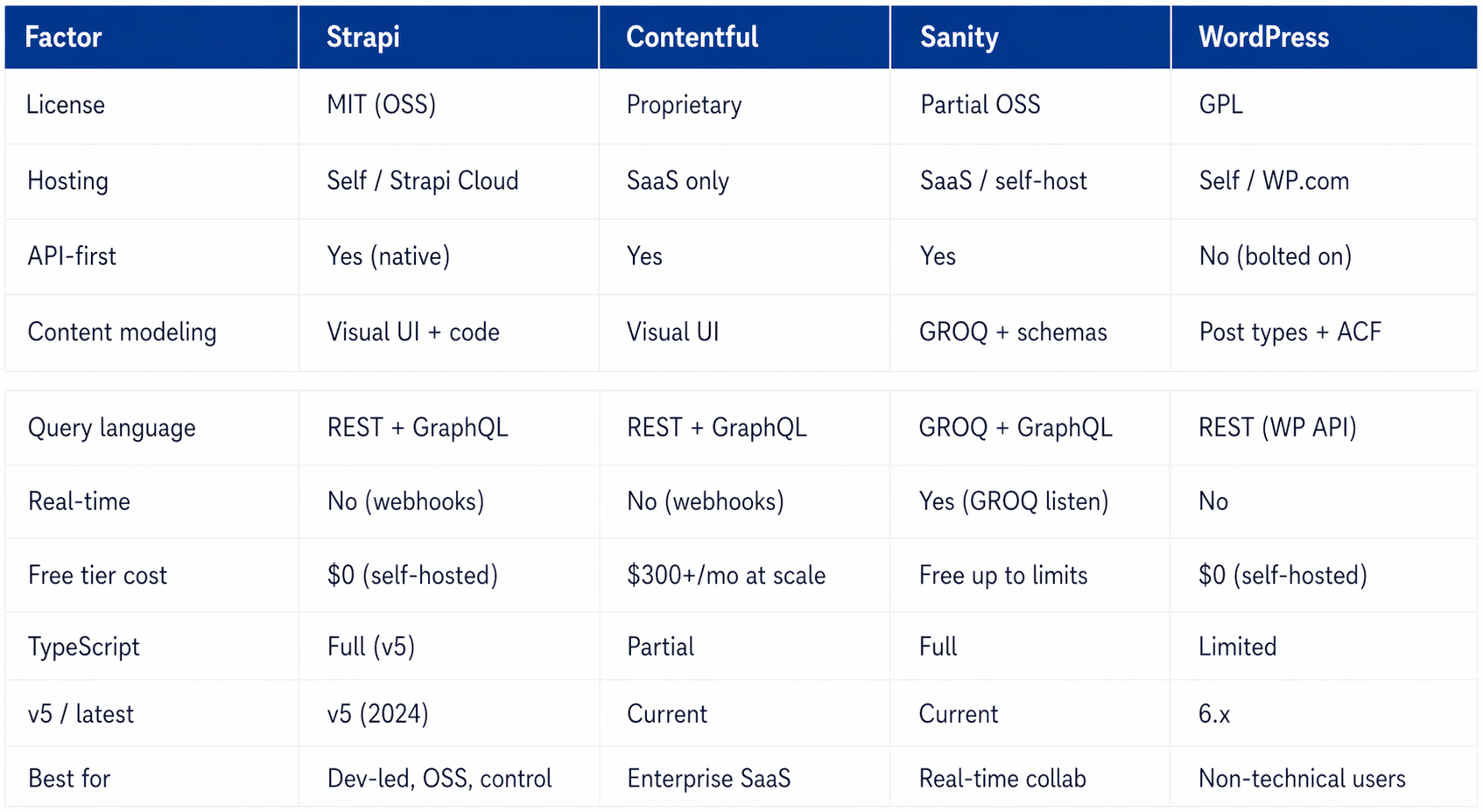
Key Takeaway
- Choose Strapi for control + cost efficiency
- Choose Contentful for fully managed SaaS
- Choose Sanity for real-time collaboration
Startup Stage Fit: How Strapi Evolves with You
1. MVP Stage (0-1)
At the earliest stage, speed is everything. Strapi allows teams—often just a single developer—to set up APIs quickly using a lightweight database like SQLite.
- How Strapi is used: Rapid API setup with a simple development database
- Key benefit: You can ship a working backend in days instead of weeks, accelerating validation and early user feedback
2. Product-Market Fit Stage
As startups begin iterating based on user feedback, flexibility becomes critical. Strapi’s content modeling system allows teams to evolve their structure without complex migrations.
- How Strapi is used: Modify content models on the fly, introduce features like internationalization (i18n)
- Key benefit: Enables fast pivots without breaking the backend or slowing development
3. Growth Stage
Once traction builds, performance and reliability take priority. Teams typically upgrade infrastructure and introduce optimizations.
- How Strapi is used: Transition to PostgreSQL, implement caching layers like Redis, use webhooks to trigger frontend builds
- Key benefit: Improved performance, faster load times, and a more resilient system
4. Scale Stage (Series A and Beyond)
At scale, startups need full control over infrastructure and cost optimization. Strapi supports enterprise-grade deployment strategies.
- How Strapi is used: Horizontal scaling, deployment via Strapi Cloud or containerized environments (e.g., AWS ECS, Kubernetes)
- Key benefit: Greater infrastructure ownership, scalability, and long-term cost efficiency
When Should Startups Choose Strapi (And When Not To)?
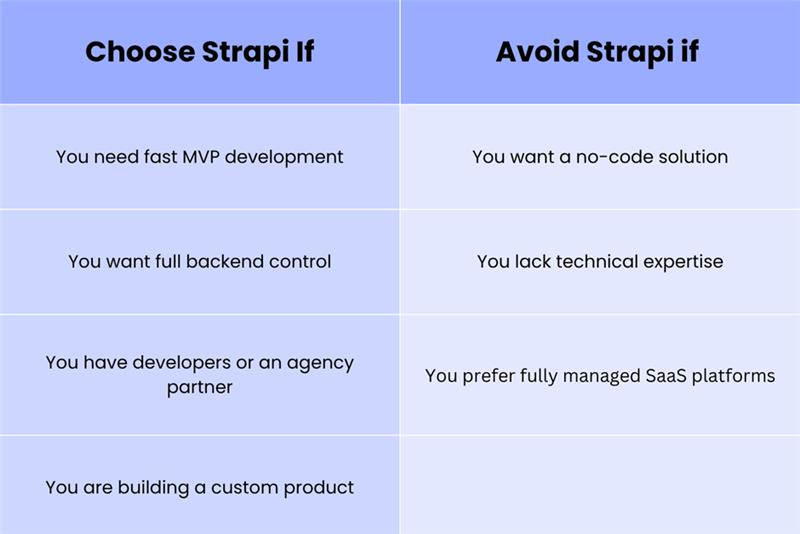
Strapi is powerful but it’s best suited for developer-driven teams.
Also read: Is Strapi Right for You?
Why Partner with Openspace Services for Strapi Development
At Openspace Services Pvt Ltd, we are a trusted Strapi agency specializing in scalable and high-performance solutions.
Our team provides custom development services for Strapi in USA, helping startups design flexible architectures and launch faster.
Whether you need end-to-end Strapi website development services or want to hire Strapi developers for ongoing support, we deliver solutions tailored to your business goals.
What OSSPL Offers:
- Custom Strapi development
- Scalable backend architecture
- API-driven integrations
- Tailored content workflows
We focus on helping businesses:
- Build faster
- Scale efficiently
- Customize deeply
Aligning perfectly with US startup needs where speed + flexibility are essential.
Future of Strapi and Headless CMS in the US Startup Ecosystem
The shift toward headless CMS is structural.
Key Trends
- Composable architecture replacing monolithic systems
- API-first development becoming standard
- Growth of multi-channel digital experiences
As startups continue to prioritize speed and scalability, headless CMS platforms like Strapi will become foundational infrastructure.
Conclusion
In today’s startup landscape, speed is the ultimate competitive advantage.
Strapi delivers exactly what modern startups need:
- Faster development cycles
- Full customization
- Scalable architecture
By decoupling content from presentation, it empowers teams to build products faster and adapt quickly as they grow.
For US startups aiming to launch quickly and scale efficiently, Strapi CMS is a strategic advantage.
Ready to Build Faster? Openspace Services (OSSPL) can help you design, build, and scale your CMS infrastructure efficiently.