
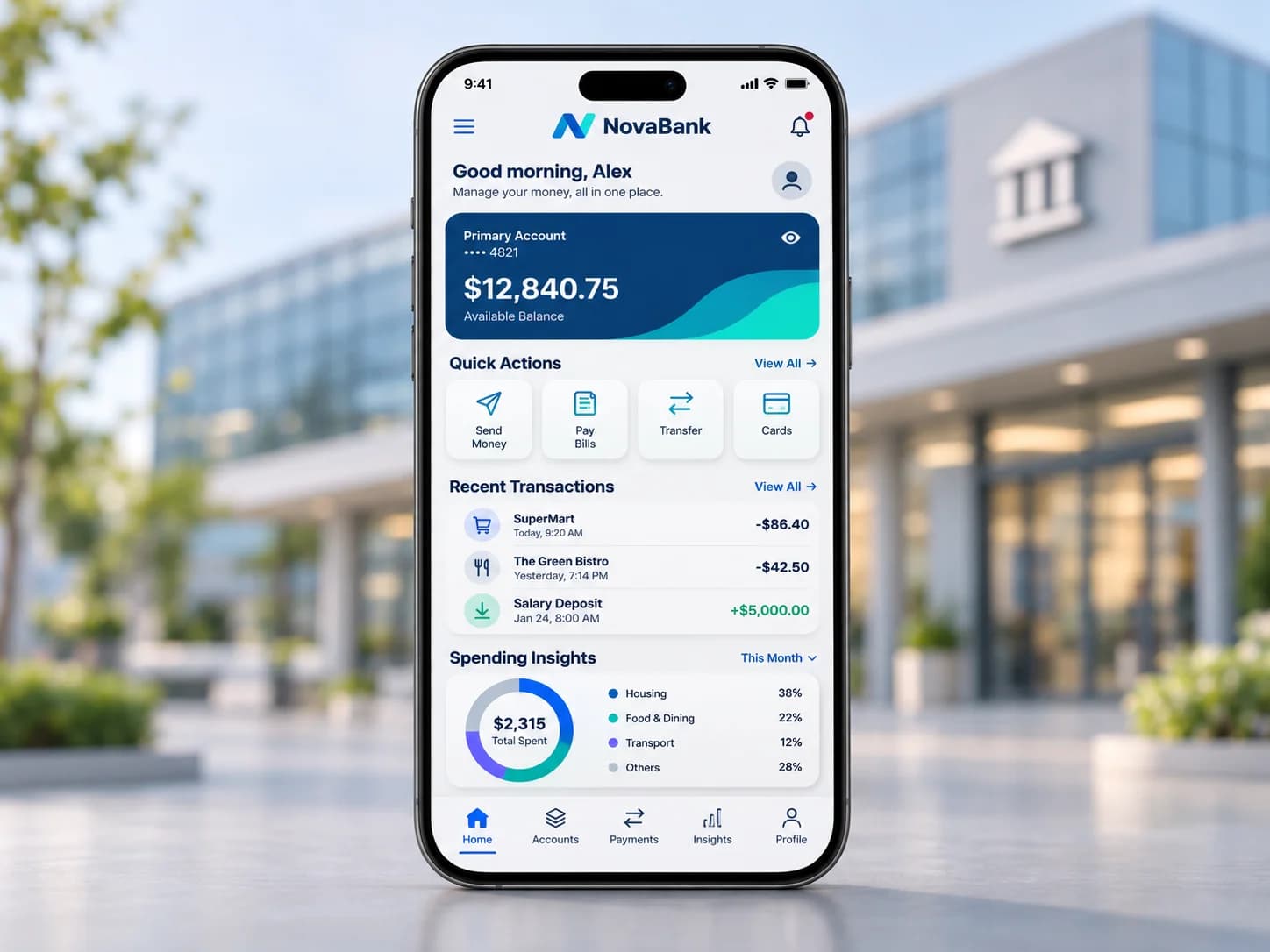
Most financial firms I speak with are not starting from zero. They already have customers, licences, a core system that is older than some of their developers, and a compliance team that signs off every release. Yet most advice on fintech application development is written for startups with a blank page.
That gap is costly. An app built without the regulator in mind stalls in compliance review. One wired straight into an old core system slows down on peak days. One launched without clear metrics cannot show the board what it returned.
Below, I cover how to get each of these right from day one: security and compliance by design, safe legacy integration, a practical ROI framework, and how to choose a fintech app development company that can actually deliver it.
Why Mobile Is Now the Main Channel for Financial Services
Ten years ago, the mobile app was an add-on. Customers opened accounts at a branch, signed paper forms, handed over photocopies of their ID and waited days for approval. The app showed your balance and maybe let you transfer money. The real relationship lived in the branch.
That model does not work any more. Customers now expect to open an account, buy a policy or start an investment in minutes, from their phone. For a financial firm, a well-built app creates value in four places:
- Lower cost to serve: A transaction in the app costs far less than one handled at a branch or call centre.
- Faster onboarding: Digital KYC turns a process that took days into one that takes minutes.
- More cross-sell: The app sees what customers do, so it can offer the right product at the right time.
- Better retention: Customers who use an app every week are less likely to move to a competitor.
The Advantage Established Firms Hold
Neobanks and startups move fast. But established firms already have what startups spend years building: customer trust, regulatory licences, an existing customer base and years of transaction data.
So the goal of fintech mobile app development for an established firm is not to copy a startup. It is to put those strengths in the customer's pocket, without breaking the systems that already work.
Types of Fintech Apps Financial Firms Are Building
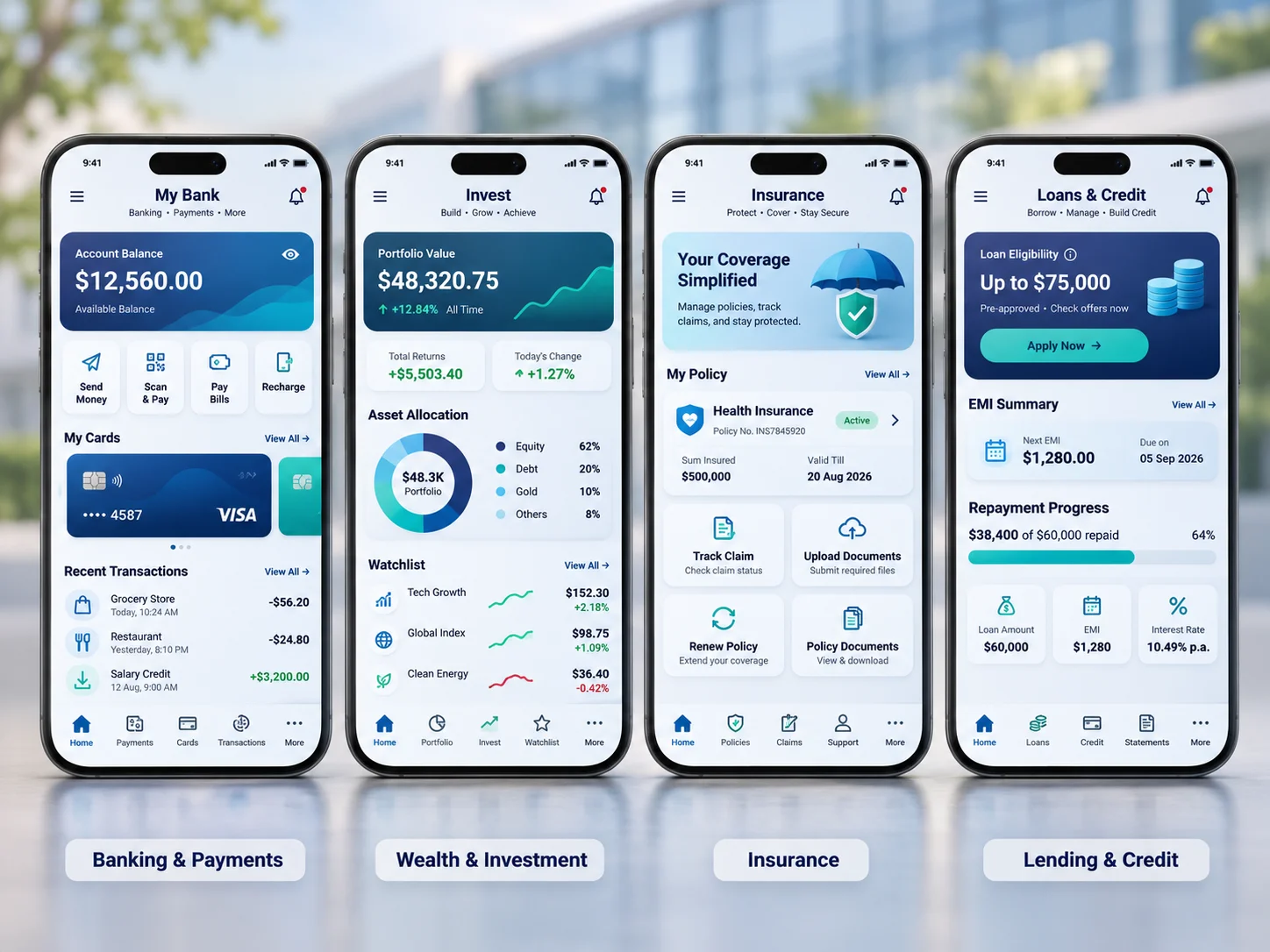
Most financial apps fall into four groups. Each has its own core features and its own main compliance concern, so it helps to know which one you are building before you plan budget or timelines.
Mobile Banking and Payments Apps
Mobile banking app development covers account opening, balances and statements, fund transfers, UPI and card payments, bill pay, deposits and real-time alerts.
In banking app development, the hard part is rarely the screens. It's connecting safely to the core banking system and payment networks and staying fast on peak days such as salary day or a festive sale.
Wealth and Investment Apps
Wealth management app development covers portfolio views across asset classes, mutual fund and stock investing, goal-based planning, risk profiling and chat with an advisor.
Users here care about accuracy and timing. A portfolio value that lags by a few minutes, or an order that fails during market hours, damages trust very quickly.
Insurance Apps
Insurance apps handle policy purchase, renewals, digital policy documents and claims. Claims is where the app earns its keep. A customer who can upload photos of car damage, track the claim and receive the payout without visiting an office is far more likely to renew.
Lending and Credit Apps
Lending apps cover digital KYC, instant eligibility checks, credit bureau checks, e-sign, EMI tracking and collections.
Quick Comparison
| App type | Core features | Main compliance focus |
|---|---|---|
| Mobile banking and payments | Account opening, transfers, UPI and cards, alerts | Payment security (PCI DSS), central bank cybersecurity rules, fraud monitoring |
| Wealth and investment | Portfolio view, investing, goal planning, risk profiling | Securities regulator rules (SEBI in India), suitability, data accuracy |
| Insurance | Buy and renew, policy documents, claims with photo upload | Insurance regulator rules (IRDAI in India), consent for personal and health data |
| Lending and credit | Digital KYC, eligibility, e-sign, EMI tracking | Digital lending rules, fair lending, data privacy |
Must-Have Features in Every Financial App
Whatever type of app you build, a few features are now basic expectations. Customers notice when they are missing.
- Secure login: Fingerprint or face login, backed by multi-factor authentication (a second check such as an OTP).
- Digital onboarding and KYC: ID capture, a live selfie check and video KYC where the regulator allows it.
- Real-time alerts: For every debit, credit and login from a new device.
- Clear transaction history: Searchable, with downloadable statements.
- In-app support: Chat, complaint tracking and a clear grievance process. Many regulators require this.
- Privacy controls: Customers can see and manage what data they have shared, and with whom.
- Personal insights: Spending summaries, reminders and relevant offers.
- Accessibility: Larger text, screen reader support and regional languages.
One rule we follow: Launch with the smallest set of features that solves the customer's main job well. Then add more based on how people use the app.
Security: Building It In, Not Bolting It On
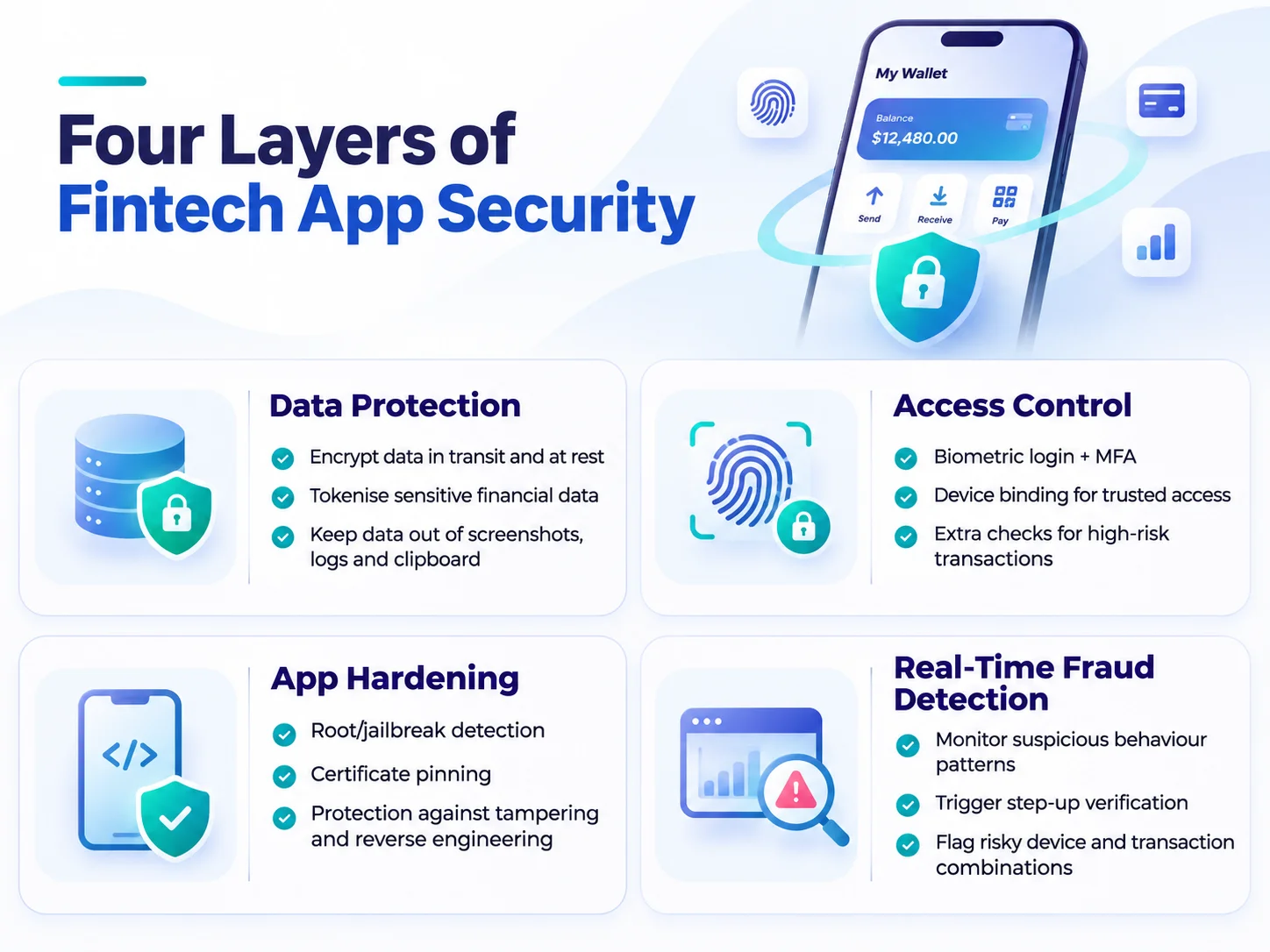
The old way of handling app security was simple. The team built the app, ran a security test a few weeks before launch, fixed the serious issues and went live. Security was a gate at the end.
That approach does not hold up today. Attackers now target mobile apps directly. Releases go out every few weeks, not once a year. And regulators expect firms to show security across the whole life of the app. For us, secure fintech app development means security decisions are made at the design stage, not the testing stage.
Protect the data
- Encrypt data in transit and at rest, use tokenisation for sensitive financial details, and store encryption keys securely on the device.
- Prevent sensitive information from appearing in screenshots, logs or the clipboard.
Control who gets in
- Combine biometric login with multi-factor authentication and device binding to prevent unauthorised access.
- Require additional verification for high-risk transactions and automatically log users out after inactivity.
Harden the app itself
- Detect rooted or jailbroken devices, use certificate pinning, and protect the app against code tampering and reverse engineering.
Watch for fraud in real time
- Use AI-based fraud monitoring to identify suspicious combinations of activities, such as a new device login followed by adding a payee and making a large transfer, triggering additional verification when needed.
Regulatory and Compliance Considerations (Verify With Your Legal Counsel)
Please note: This section is general guidance based on our project experience, current as of November 2026. It is not legal advice. Rules change often, and what applies to you depends on your licence, products and markets. Always confirm requirements with your legal and compliance teams.
Compliance is where many app projects lose months. The usual reason is not that the rules are hard. It is that nobody mapped them to the app's features until the build was almost done.
Global Standards most Financial Apps Need
- PCI DSS if the app handles card data.
- ISO/IEC 27001 for information security management.
- SOC 2 if you or your vendors serve US clients.
- OWASP MASVS as the baseline for mobile app security testing.
Compliance-by-Design in Practice
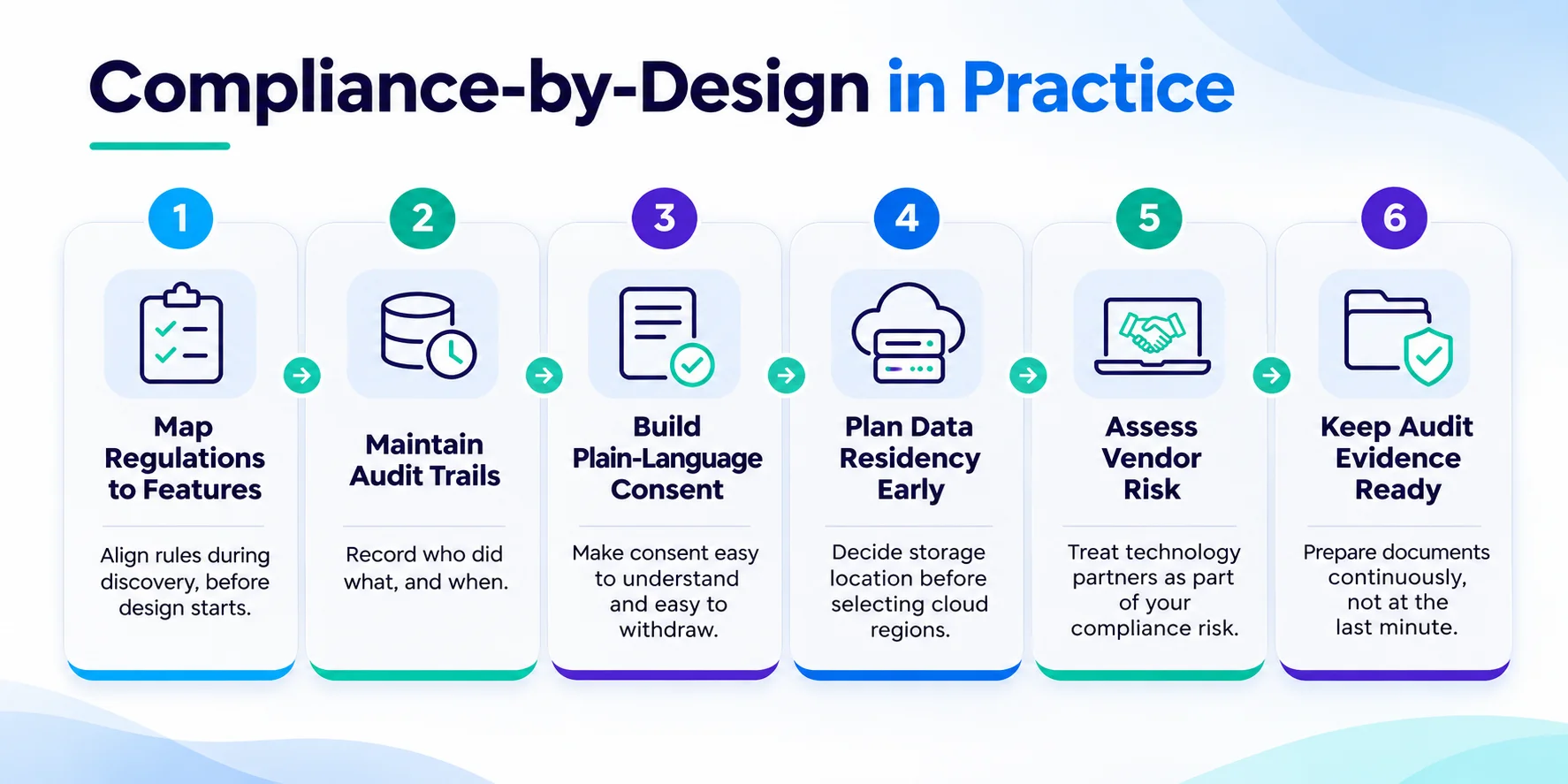
- Map rules to features during discovery, before design starts.
- Keep audit trails for every sensitive action: who did what, and when.
- Build consent into onboarding, in plain language, with an easy way to withdraw it.
- Decide data residency early, before you choose a cloud region.
- Treat vendors as part of your risk. Regulators hold you responsible for your technology partners.
- Keep evidence ready, so an audit is a review of documents, not a scramble.
Architecture, Integrations and Scalability
For an established firm, the most important architecture decision is how the new app talks to the old systems. Get this right and everything else becomes easier.
Native or Cross-Platform?
| Approach | Strengths | Trade-offs |
|---|---|---|
| Native (Swift for iOS, Kotlin for Android) | Best performance, full access to device security features | Two codebases, higher cost and longer timelines |
| Cross-platform (Flutter, React Native) | One codebase, faster delivery, lower cost | Security plugins and device features need careful handling |
In our experience, cross-platform works well for most banking, insurance and lending apps. Native is worth the extra cost for apps with heavy real-time trading screens or very deep device-level security needs.
Working with Legacy Core Systems Without Replacing them
Many banks, NBFCs and insurers run core systems that are decades old. These systems are stable and trusted, but they were never designed for millions of app requests.
The tempting answer is to replace the core first. That is rarely the right first move. It is expensive, slow and risky, and it delays the app by years. A better approach is to put layers in front of the core:
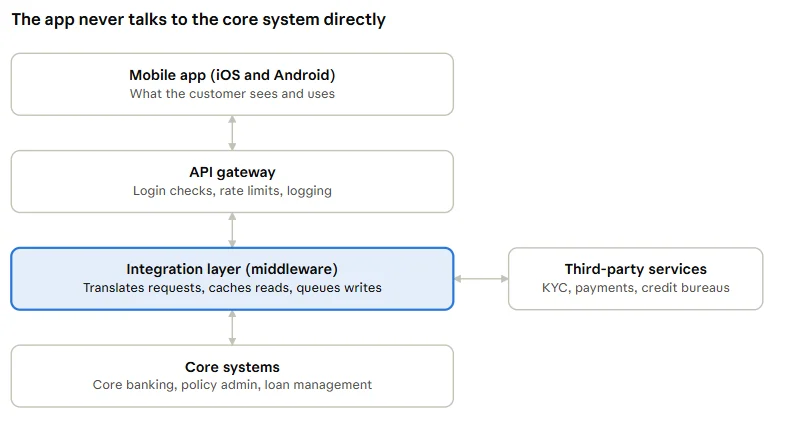
- An API gateway checks who is calling, limits traffic and logs every request.
- An integration layer (middleware) translates app requests into the format the core understands. It also stores frequently read data, such as balances or policy details, so the core is not hit every time.
- A phased rollout starts with read-only features (balances, statements, policy view). Transactions come later, once the integration has proven stable.
Here is a simple example. Say an insurer's policy system can only handle a limited number of requests at once. If the app calls it directly, a single renewal reminder campaign could slow down the whole system, including the branch staff using it. With middleware that stores policy details and queues renewal requests, the app stays fast and the core stays safe.
Third-Party Integrations
Most financial apps connect to several outside services: KYC and identity providers, payment gateways, UPI, credit bureaus, account aggregators and market data feeds. Each one adds features, and each one adds a risk to manage. Plan for what happens when a provider is slow or down.
Scaling for Peak Load
Financial apps face sharp traffic spikes on salary days, at market open and during festive sales. Cloud hosting, auto-scaling and splitting the busiest functions into separate services help the app stay fast. Most important of all, load test for your worst day, not your average day.
Choosing the Right Fintech Development Partner
Before choosing a partner, decide whether you need one at all. There are three common routes.
| Option | Works well when | Watch out for |
|---|---|---|
| Build in-house | You have a strong tech team and a long-term roadmap | Hiring time, and niche skills such as mobile security |
| White-label platform | You need a standard product quickly | Limited customisation, vendor lock-in, a shared roadmap |
| Development partner | You need custom features and speed, with your team in control | Choosing the wrong partner |
If you choose a partner, look beyond the portfolio and the price. Here is what to check when comparing fintech app development services:
- Real fintech experience: Ask for case studies in your segment, not just any mobile apps.
- Security practice: How they handle secure coding, MASVS testing and penetration tests, and whether they hold certifications such as ISO 27001.
- Regulatory understanding: Can they explain the rules that apply to your licence, in plain words?
- Legacy integration experience: Have they connected an app to a core system like yours?
- Clear process: Regular demos, honest reporting and one accountable contact.
- Post-launch support: Response times, OS update support and handling of regulatory changes.
- Ownership and exit: You should own the source code, the IP and the data, with a clear handover plan.
- Audit readiness: They should accept your security reviews and any checks your regulator expects.
"In financial services, an app is only as good as the trust behind it. We tell every client the same thing: security and compliance are not costs you add at the end. They are the foundation that makes the ROI possible. When they are designed in from day one, the app launches faster, passes audits with less friction and keeps earning long after release."
Niket Shah, Founder, OpenSpace Services
How We Approach Fintech App Development at OpenSpace Services
As a fintech app development company, we follow the same principles we have shared above. Here is how a typical project runs:
- Discovery and compliance mapping: We understand your customers, your goals and the rules that apply, and we map each rule to a feature.
- Architecture and integration plan: We design how the app connects to your core and third-party systems, safely and in phases.
- UX design and prototyping: We test clickable prototypes with real users before writing production code.
- Agile build, with security in every sprint: Security checks run on every build, not just at the end.
- Testing and audit readiness: Functional, performance and security testing, with the evidence your auditors will ask for.
- Launch and adoption support: We help plan how existing customers move to the app, not just how it goes live.
- Ongoing support: Monitoring, OS updates, new features and changes when regulations change.
Conclusion
It is tempting to treat security, compliance and ROI as three separate workstreams, owned by three separate teams. In practice, they are one decision. A secure, compliant app launches on time, earns customer trust and gets used. An app that cuts corners on either ends up costing more than it returns.
For established financial firms, the opportunity is clear. You already have the trust, the licences and the customers. The right app puts all of that in your customers' pockets, connects safely to the systems you already run and proves its value with real numbers.
If you are planning a new app, or fixing one that is not delivering, talk to our team at OpenSpace Services. As a fintech app development company that works with banks, wealth managers, insurers and fintech startups, we can help you plan an app that is secure, compliant and built to pay back. Book a consultation with OpenSpace Services