


Choosing a headless CMS isn't just about comparing features. It's about finding a platform that fits the way your team builds, manages, and scales digital experiences. Businesses evaluating CMS platforms should consider Headless CMS development services to align technology with long-term business goals.
A startup launching its first SaaS product has different requirements from an enterprise managing content across multiple websites, apps, and regions. While all three platforms, Strapi, Contentful, and Sanity, support headless architecture and API-driven content delivery, they differ significantly in terms of customization, developer experience, pricing, hosting, and long-term flexibility.
This guide compares Strapi, Contentful, and Sanity to help you identify the right platform based on your team's size, technical expertise, and budget.
Who should choose what?
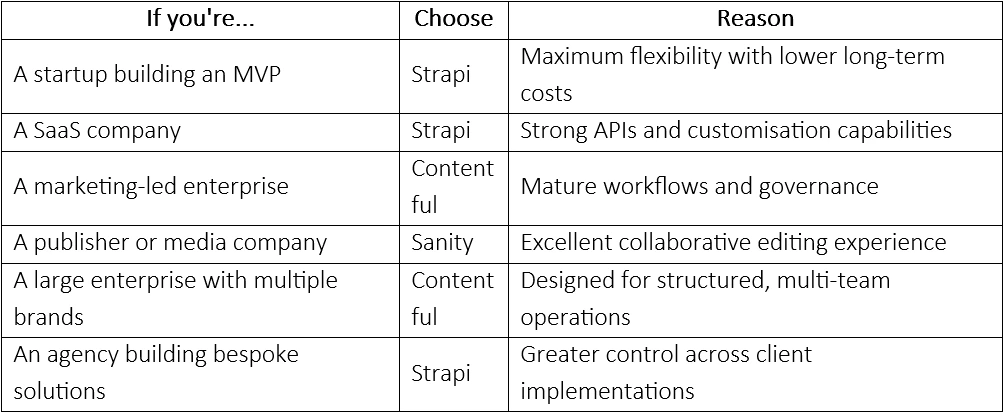
Although all three platforms fall under the headless CMS category, they solve different business challenges. Understanding those differences can prevent expensive migrations later.
What Makes a Headless CMS Different?
Unlike traditional content management systems, a headless CMS separates content from presentation. Instead of creating content specifically for a website, teams manage structured content in one place and deliver it through APIs to websites, mobile applications, kiosks, smart devices, and other digital channels.
This architecture allows development teams to choose modern frameworks such as Next.js, React, Vue, or Angular while giving content teams a central place to manage information.
The flexibility of a headless CMS also makes it easier to scale digital products without rebuilding the entire content infrastructure.
Strapi: Best for Teams That Want Complete Control
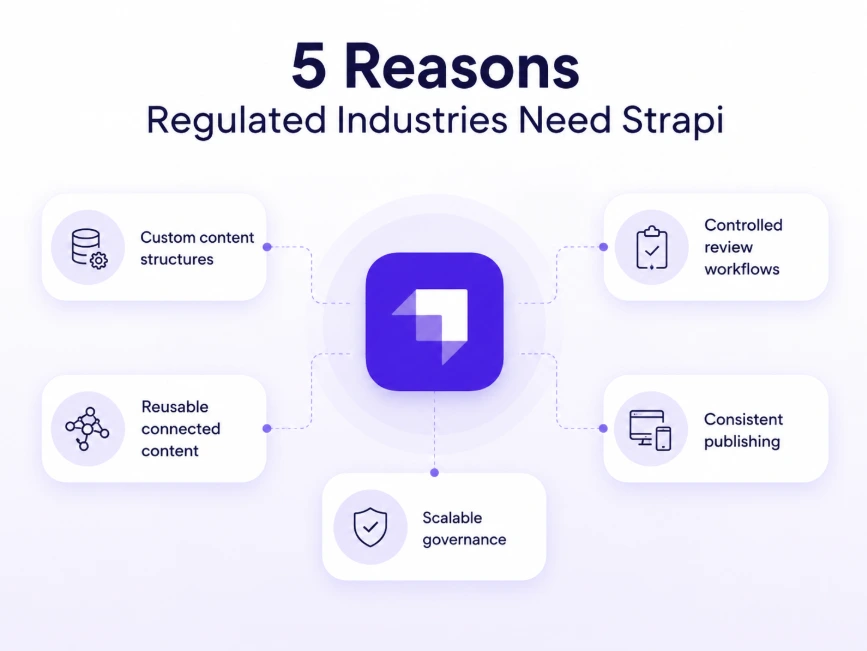
Organizations seeking complete ownership benefit from enterprise Strapi CMS development services. Strapi is an open-source headless CMS designed for organisations that want ownership of their content platform. Unlike SaaS-only solutions, Strapi can be self-hosted, allowing businesses to control their infrastructure, security, and data. Self-hosted deployments work best with cloud infrastructure consulting services.
Developers appreciate Strapi because it doesn't impose strict architectural limitations. It supports custom APIs, authentication workflows, role-based permissions, plugins, and integrations with modern frontend frameworks.
For engineering teams, this means fewer restrictions during development and greater flexibility when business requirements evolve.
Strapi is a good choice if your team:
- Has developers who prefer building customised solutions
- Wants to self-host applications
- Needs complete ownership of content and infrastructure
- Plans to integrate multiple systems through APIs
- Wants to avoid vendor lock-in
The platform is particularly well suited for startups, SaaS companies, digital agencies, and enterprises building custom applications. Learn why enterprises are adopting Strapi instead of proprietary CMS platforms.
Contentful: Built for Enterprise Content Operations
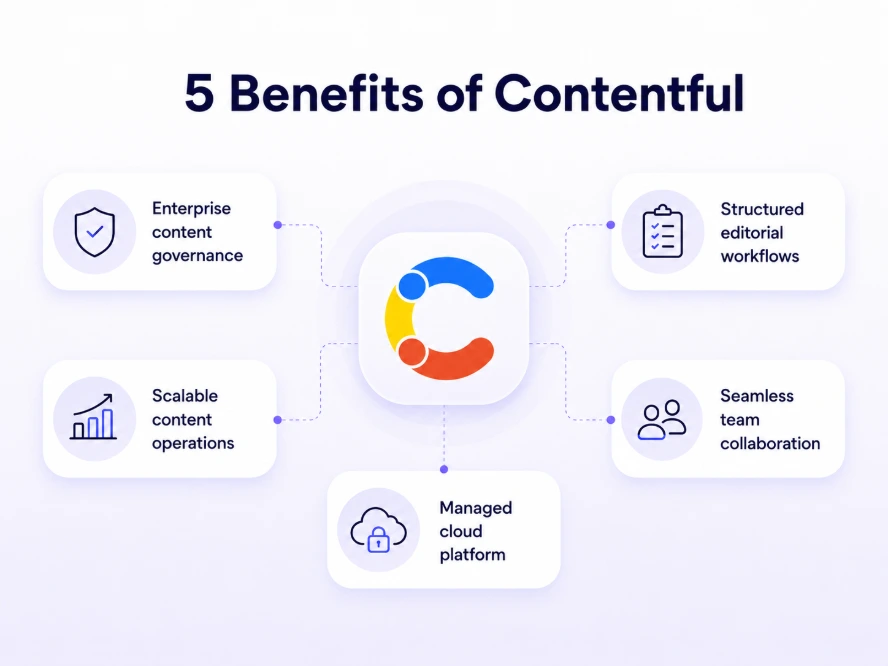
Contentful approaches content management differently. Rather than focusing on infrastructure flexibility, it prioritises collaboration, governance, and scalability for large organisations.
Its cloud-native architecture eliminates server management, making it attractive for companies with distributed content teams. Marketing, product, and editorial teams can work simultaneously while maintaining structured workflows and approval processes.
Contentful also provides a mature ecosystem of integrations, making it easier to connect with digital experience platforms, marketing automation tools, analytics platforms, and eCommerce solutions.
Contentful is a good choice if your team:
- Manages multiple brands or digital properties
- Requires structured editorial workflows
- Has large content operations across departments
- Prefers a fully managed SaaS platform
- Prioritises reliability over infrastructure control
While Contentful offers excellent enterprise capabilities, the subscription costs can increase as content volume, users, and API usage grow.
Sanity: Designed for Custom Content Experiences
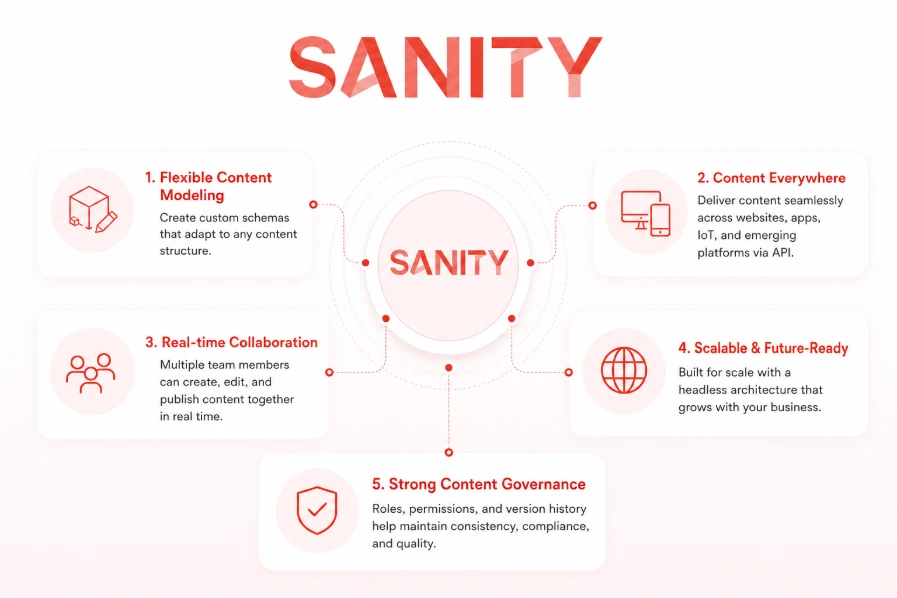
Content-heavy businesses should compare Strapi vs Sanity for enterprise websites. Sanity combines the flexibility of developer-focused tools with an intuitive editing experience for content teams. Instead of providing a fixed interface, it allows organisations to build highly customised editorial workspaces using Sanity Studio.
One of Sanity's distinguishing features is real-time collaboration. Multiple editors can work on the same content simultaneously, making it particularly useful for publishing teams and collaborative environments.
Sanity also introduces GROQ, its own query language, which gives developers precise control over how content is retrieved and displayed.
Sanity is a good choice if your team:
- Needs customised editorial workflows
- Values real-time collaboration
- Builds content-rich applications
- Has experienced frontend developers
- Wants flexibility without managing infrastructure
Although Sanity offers considerable freedom, organisations unfamiliar with custom development may experience a steeper learning curve during implementation.
Which CMS Fits Your Team Size?
Choosing the right platform often depends less on features and more on the people who will use it every day.
Startups and Small Teams
If your organisation has a small engineering team and limited budget, Strapi often delivers the greatest long-term value. Its open-source foundation reduces licensing costs while allowing developers to customise the platform as business needs evolve.
Teams building MVPs or launching new products also benefit from avoiding vendor lock-in, making future scaling more predictable.
Growing Businesses
As companies expand, content workflows become more complex. Marketing teams need faster publishing, developers require scalable APIs, and leadership expects consistent experiences across channels.
At this stage, both Strapi and Sanity become strong contenders.
Strapi offers greater infrastructure control and customisation, while Sanity provides a more collaborative editing environment for content-heavy organisations.
Mid-sized Enterprises
Businesses managing several websites, applications, or regional content teams often need stronger governance features.
Contentful simplifies enterprise content management through structured workflows, permissions, and integrations, while Strapi appeals to organisations with dedicated engineering teams that prefer controlling their own infrastructure.
Neither platform is universally better; the decision depends on whether operational simplicity or technical flexibility is the higher priority.
Which CMS Fits Your Budget?
Cost is one of the biggest deciding factors when choosing a headless CMS, but the cheapest option upfront isn't always the most cost-effective in the long run. Licensing fees, hosting costs, developer resources, and future scalability all contribute to the total cost of ownership.
Choose Strapi if you want predictable long-term costs
Strapi's open-source model gives businesses the flexibility to host the platform on their preferred cloud provider or on-premises infrastructure. This allows teams to optimise hosting expenses while avoiding recurring per-user or per-content licensing fees.
While self-hosting requires technical expertise for deployment, maintenance, and updates, many organisations find the additional operational effort worthwhile because they retain complete ownership of their platform and data.
Choose Contentful if you prefer a managed platform
Contentful removes the responsibility of managing servers, security updates, and infrastructure. For organisations with dedicated content teams but limited DevOps resources, this can significantly reduce operational overhead.
However, as your organisation grows, pricing may increase based on users, content records, environments, and API usage. Businesses planning to scale rapidly should evaluate long-term subscription costs before making a decision.
Choose Sanity if flexibility matters more than fixed pricing
Sanity offers flexible pricing that works well for many growing businesses, particularly those building content-heavy digital products. Since the platform is designed around customisable content workspaces, organisations can tailor the editing experience without managing the underlying infrastructure.
For businesses that expect frequent collaboration between developers and content teams, the productivity gains may outweigh the platform costs.
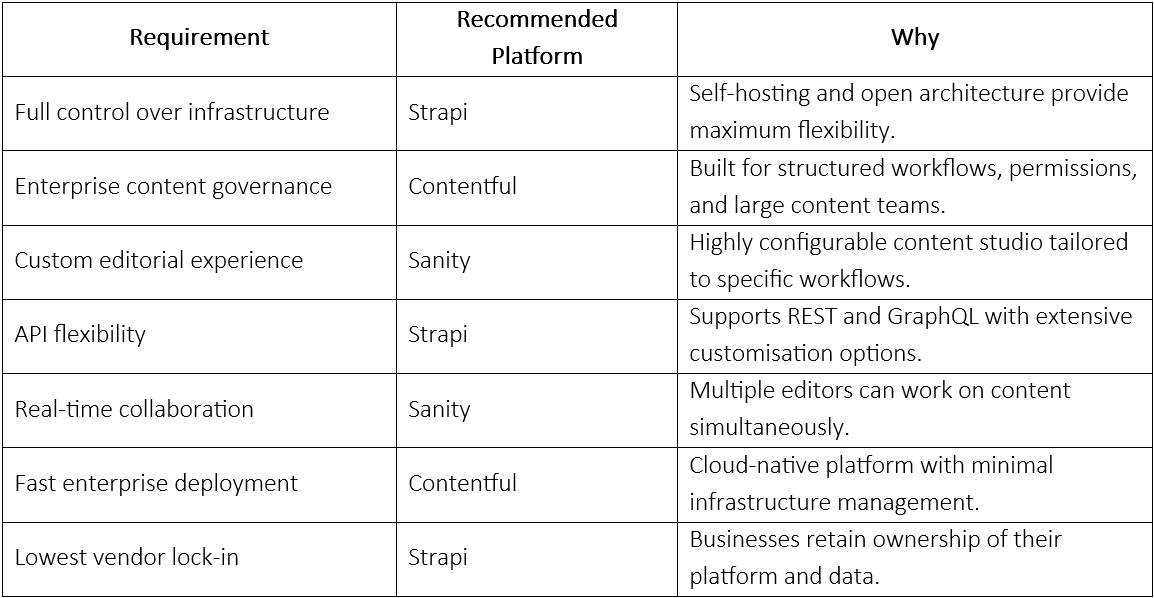
Feature Comparison
Each platform excels in different areas. Rather than looking for a single winner, evaluate which capabilities align with your team's priorities.
Common Mistakes When Choosing a Headless CMS
Many organisations focus heavily on features while overlooking operational requirements. Before selecting a platform, consider these common mistakes.
Choosing based only on pricing. A lower subscription fee doesn't necessarily translate into lower long-term costs. Development effort, maintenance, and future scalability should all be factored into the decision.
Ignoring team capabilities. A highly customisable CMS may be ideal for experienced engineering teams but unnecessarily complex for organisations without in-house developers.
Overlooking future growth. Today's requirements may be very different from those you'll have in two or three years. Consider how easily the platform can support additional websites, languages, integrations, and users.
Focusing only on developers. A successful CMS should improve the experience for both developers and content teams. If editors struggle to manage content efficiently, publishing speed and productivity can suffer.
How to Choose the Right Headless CMS
If you're still deciding, start by answering a few practical questions.
- Do you need complete ownership of your infrastructure and data?
- Will multiple teams collaborate on content daily?
- Are you building a marketing website, a SaaS product, or a multi-channel digital experience?
- Does your organisation have in-house developers to manage deployments?
- How important is avoiding vendor lock-in?
Your answers will usually make the most suitable platform clear. Start with a headless CMS technology assessment before implementation.
Final Recommendation
There isn't a single headless CMS that's right for every organisation.
Choose Strapi if your priority is flexibility, ownership, and the ability to build custom digital experiences without being tied to a proprietary platform. It's particularly well suited to startups, technology companies, digital agencies, and enterprises with experienced engineering teams.
Choose Contentful if your organisation needs enterprise-grade governance, structured workflows, and a fully managed platform for large-scale content operations.
Choose Sanity if collaboration, custom editorial workflows, and content-rich applications are central to your digital strategy.
Ultimately, the right decision depends less on feature comparisons and more on how well the platform aligns with your team's skills, budget, and long-term business goals.
Conclusion
If you're planning to adopt a headless CMS, the decision shouldn't be based solely on features or pricing. The right platform depends on your content strategy, technical architecture, integration requirements, and future growth plans.
At OpenSpace Services, we work with businesses to design, implement, and optimise headless CMS solutions that align with their digital goals. Whether you're evaluating Strapi for its flexibility, Contentful for enterprise content operations, or Sanity for collaborative publishing, our experts can help you choose and implement the platform that delivers the greatest long-term value. Contact us Today!