



Your marketing team wants to launch pages without waiting on developers. Your developers want a system they can control. Your finance team wants to know what it costs when the team doubles. Storyblok and Strapi both promise to keep everyone happy, but they get there by opposite routes.
The Storyblok vs Strapi choice comes down to one trade-off: a polished, managed visual editor, or an open-source CMS you fully own and shape around your business. In this guide, our team compares editing, campaign features, real costs as your team grows and what happens if you switch later.
Quick answer: Storyblok is the easier start for marketing teams that want a visual, drag-and-drop editor with nothing to host. Strapi is the better fit for teams that want full control, custom integrations, no seat caps and campaign features like scheduled releases on a lower-cost plan. In 2026, Strapi's Live Preview, available on its paid plans, has also narrowed the editing gap.
What are the key differences between Storyblok and Strapi for marketing teams?
Storyblok is a managed SaaS platform built around visual editing. Strapi is an open-source CMS you host and customise. Here's a quick Storyblok vs Strapi comparison.
| Parameters | Storyblok | Strapi |
|---|---|---|
| Type | Managed SaaS | Open source, self-hosted or Strapi Cloud |
| Editing | Visual, drag-and-drop editor | Form-based editor with page preview |
| Page building | Nestable components ("bloks") | Components and dynamic zones |
| Free plan | 1 seat (up to 2), 100GB traffic | Community edition, unlimited users |
| Entry paid plan | Growth: $99 a month, 5 seats | Growth: $45 a month, 3 seats |
| Hosting | Included | Your own, or Strapi Cloud |
| Content ownership | Stored on Storyblok, exported by API | Stored in your own database |
| Licence | Commercial | MIT open source |
All prices are monthly list prices in US dollars, checked in November 2026, from Storyblok and Strapi.
What is Storyblok and How does it Work for Marketers?
Storyblok is a hosted headless CMS known for its visual editor. Marketers see the actual page while they edit, and can drag components into place.
- A visual editor with live, on-page editing
- Nestable components for building pages
- AI content generation and translation, with AI credits on every plan
- Built-in A/B testing on the Premium and Elite plans
- No servers to manage, since Storyblok hosts everything
The trade-off is control. You work within Storyblok's platform, plan limits and pricing tiers.
What is Strapi and How can it Support Marketing Teams?
Strapi is an open-source headless CMS. Developers build a library of approved page blocks once, and marketers then assemble pages from them, without touching code.
- Dynamic zones and components for flexible page building
- Draft and publish, roles and multiple languages in the free edition
- Preview on every plan, and side-by-side Live Preview on Growth
- Releases for scheduling grouped campaign launches on Growth
- A large plugin marketplace and full freedom to customise
Because Strapi is open source, you can shape the admin panel around your team. Our guide on making Strapi simple for non-technical teams shows how far that can go.
Which features matter most to marketers?
Four things decide most Storyblok vs Strapi for marketers debates: editing, campaign tools, languages and SEO, and AI.
How do visual editing and preview compare?
Storyblok leads on visual editing. Its drag-and-drop editor is its signature feature. If Storyblok vs Strapi ease of use is your top priority for non-technical editors, Storyblok has the edge on day one.
The old advice was that Strapi has no visual editing at all. That's out of date, because now Strapi 5 offers page preview on every plan, and Live Preview on the Growth plan shows the page and editor side by side, with double-click editing. Live Preview is still marked experimental and doesn't yet support dynamic zones (Strapi docs). Even so, the gap is smaller than many comparisons suggest, including some that still say Strapi has no live preview at all.
Is form-based editing a problem for marketers? Less than you'd think. With a well-designed block library, editors fill in clear fields and see the result in preview, which also keeps pages on-brand.
Which campaign features come with each plan?
This is where the Storyblok vs Strapi features comparison gets interesting, because the answer depends on the plan.
| Campaign feature | Storyblok | Strapi |
|---|---|---|
| Scheduled publishing | Growth: 2 scheduled stories. Premium: 100 | Releases on Growth ($45 a month) |
| Grouped releases | Premium and Elite | Growth and Enterprise |
| Custom roles | Premium and Elite | Included in the free edition |
| Custom approval workflows | Premium and Elite | Review Workflows on Enterprise |
| A/B testing | Built in on Premium and Elite | Through tools like VWO or Optimizely |
| SSO | Premium and Elite | Growth add-on or Enterprise |
In short: Storyblok includes A/B testing on its higher plans. Strapi gives you campaign scheduling and releases at a much lower price point.
How do Localisation and SEO Compare?
Both handle multiple languages well, but the pricing differs. Storyblok's Growth plan includes 2 locales, with extra locales at $20 a month each. Strapi's internationalisation is part of the free edition, with no charge per language.
For SEO, Storyblok adds SEO meta tags from the Growth plan. In Strapi, SEO fields like titles, descriptions and schema are built as reusable components, so every page gets them by default.
How do AI Features Compare?
Storyblok includes AI credits on every plan, for content generation and translation, with AI alt text from Growth. Strapi's Growth plan includes 1,000 Strapi AI credits a month. Strapi also has a built-in MCP (Model Context Protocol) server, generally available since version 5.49, that lets AI agents such as Claude or Cursor read and manage content. It's switched off by default, so nothing is exposed until you turn it on (Strapi's MCP announcement).
Which Offers Better Value as Your Team Grows?
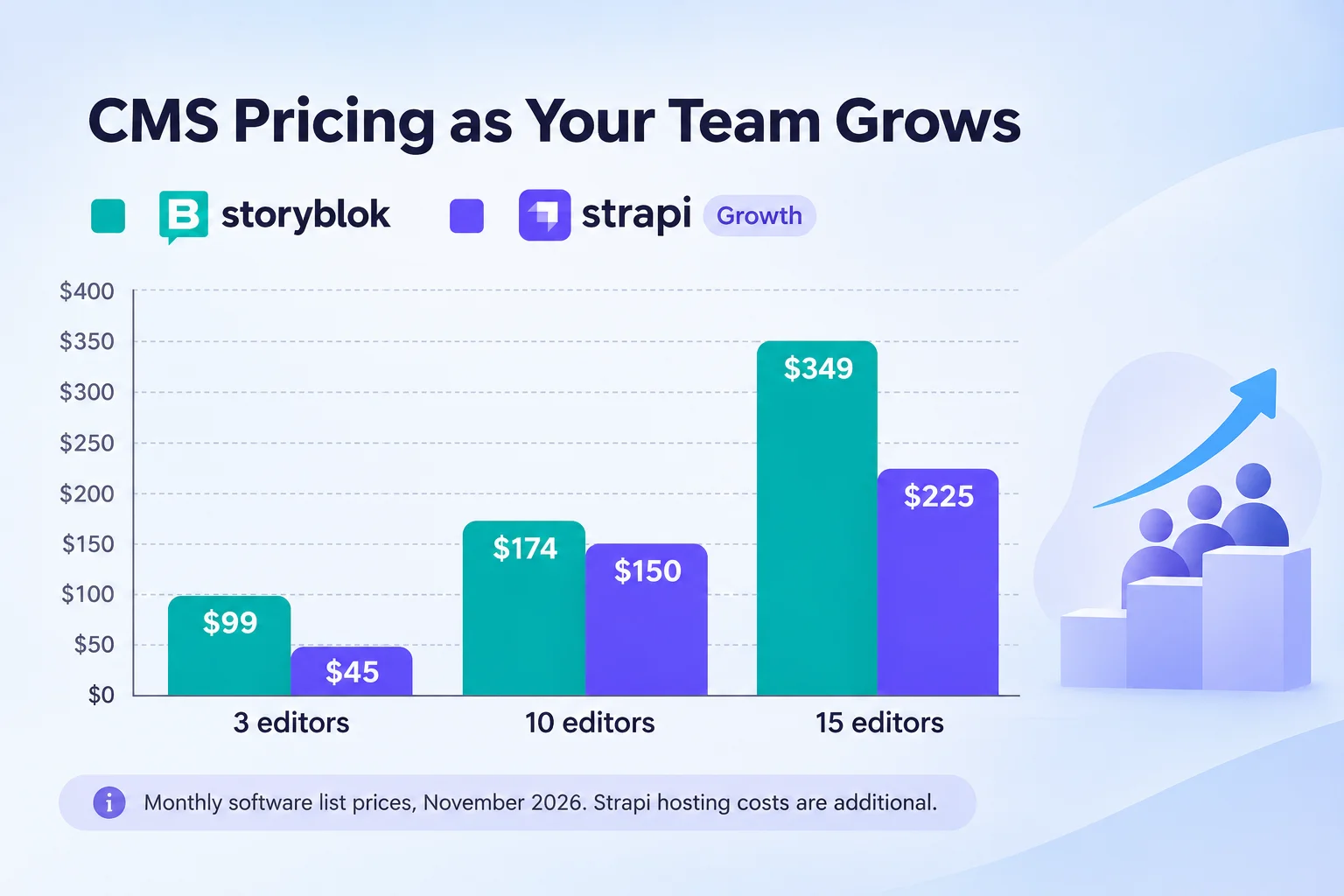
Storyblok costs more at every team size, and the gap widens as you grow. Here's how Storyblok vs Strapi pricing compares at three team sizes, using monthly list prices.
| Team size | Storyblok | Strapi |
|---|---|---|
| 3 editors | Growth: $99 (5 seats included) | Community: free, or Growth: $45 |
| 10 editors | Growth: $174 ($99 plus 5 extra seats at $15) | Growth: $150 ($45 plus 7 extra seats at $15) |
| 15 editors | Growth Plus: $349 (Growth caps at 10 seats) | Growth: $225 ($45 plus 12 extra seats at $15) |
A few things change the real bill. Storyblok charges for extra locales, traffic and API requests on Growth, and features like releases and custom roles need its custom-priced Premium plan. Strapi's licence doesn't include hosting, so you pay for that separately. Strapi Cloud starts at $35 a month per project on its Starter plan, with Pro at $90 and Business at $450, and each tier raises the API request and storage limits.
The licence is only one part of the cost. Most projects have three:
| Cost | Paid to | What it covers |
|---|---|---|
| Software licence | Storyblok or Strapi | The CMS plan, from free to Enterprise |
| Hosting | Your cloud provider, or included with Storyblok | Servers, database, storage and bandwidth |
| Build and support | Your development partner | Content model, page blocks, front end, training and support |
"Don't compare licence prices alone. Compare what your team will pay in year two, when you have twice the editors, three more languages and a campaign calendar that never stops." Niket Shah, Founder, OpenSpace Services
Who Owns Your Content if You Switch Later?
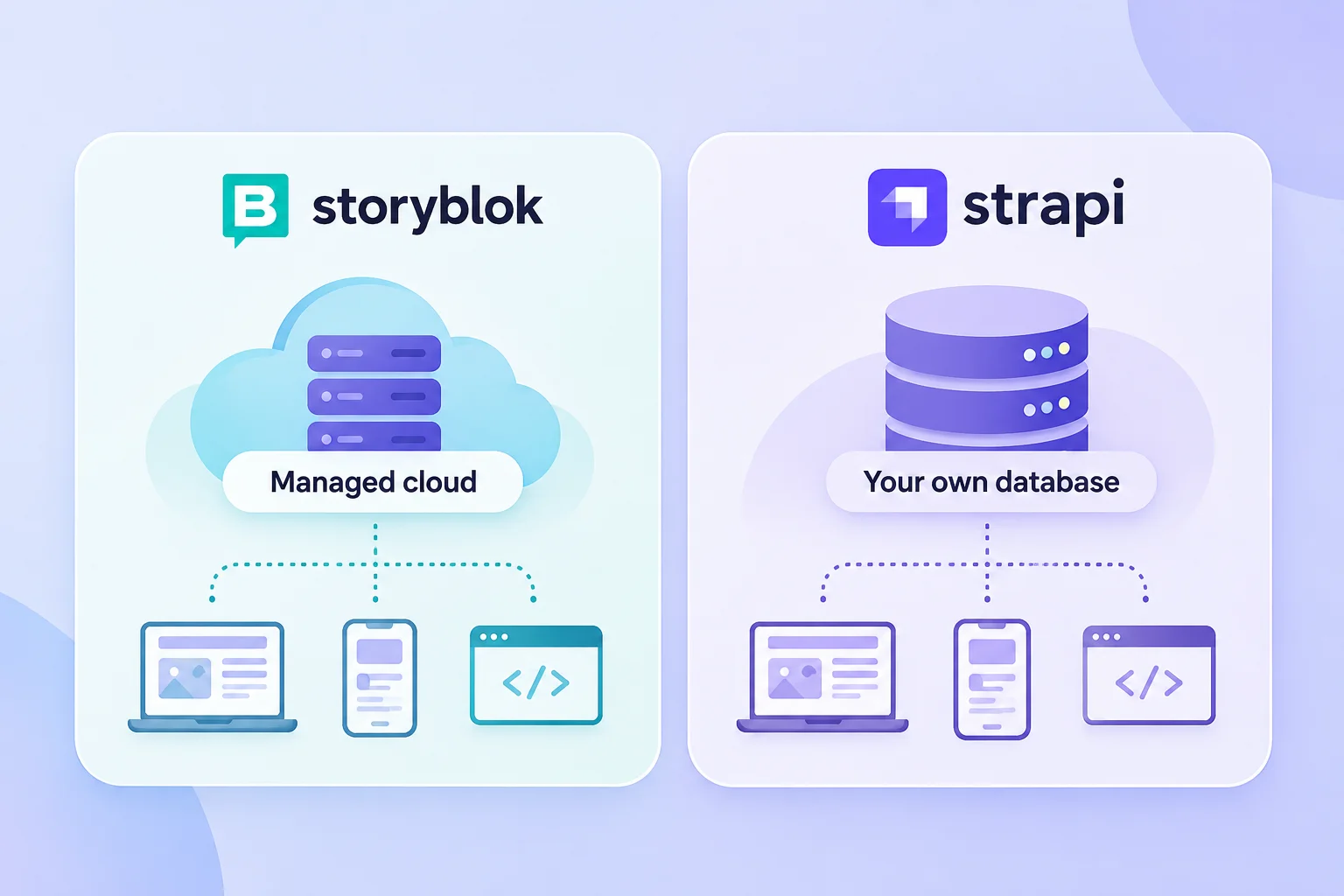
With Strapi, you do, fully. Your content sits in your own database, and you can move it with Strapi's export and transfer tools.
With Storyblok, your content lives on Storyblok's platform. You can export it through its Management API, but page structures and rich text are stored in Storyblok's own format, so moving to another CMS takes mapping work.
Neither is a deal-breaker. It's worth knowing before you build hundreds of pages, not after.
Security is the other half of this. Storyblok is ISO 27001 and TISAX certified, GDPR compliant and hosted on AWS, so most of the security work is done for you. Strapi lists GDPR and SOC 2 compliance, with a SOC 2 report available as an Enterprise add-on. If you self-host Strapi, though, securing the servers and keeping Strapi updated is your team's job, or your partner's.
When is Storyblok the Better Choice for Marketing Teams?
When visual editing and zero hosting matter most. Here's the Storyblok vs Strapi pros and cons picture from the Storyblok side.
- Your editors want drag-and-drop page building from day one
- You don't want to manage hosting or updates at all
- You need built-in A/B testing and can budget for Premium
- Your team is small and stable, within Growth's seat limits
It's a strong product, and for some teams it's the right call.
When Should Marketing Teams Choose Strapi Over Storyblok?
When you want control, flexibility and costs that grow gently with your team.
- You want to own your content and data
- Your team is growing and seat caps would get expensive
- You need campaign releases without an enterprise contract
- You publish in many languages
- You need custom integrations with your customer relationship management (CRM) system, product data or internal tools
- You want the freedom to change front ends or hosting later
For many growing businesses, Strapi is the best headless CMS for marketing teams that also want long-term control. Our guide to the benefits of a headless CMS for marketing teams covers the bigger picture.
What does a Strapi Partner Set up for Marketers?
A good partner makes Strapi feel simple for marketers, which is where most of the editing gap disappears.
- A library of brand-approved page blocks
- Clear roles, so writers draft and managers publish
- Preview connected to your real website
- Releases set up for campaign launches
- SEO fields built into every page
- Short, role-based training for your team
One example is our work with Signet Excipients, an excipients distributor serving pharma companies. We built a Next.js and Strapi website with a searchable product catalogue, so their product team can update catalogue data without waiting on developers.
"Marketers don't care which CMS wins on paper. They care whether they can launch on Tuesday without filing a ticket on Monday." Niket Shah, Founder, OpenSpace Services
Which CMS Should Your Team Choose?
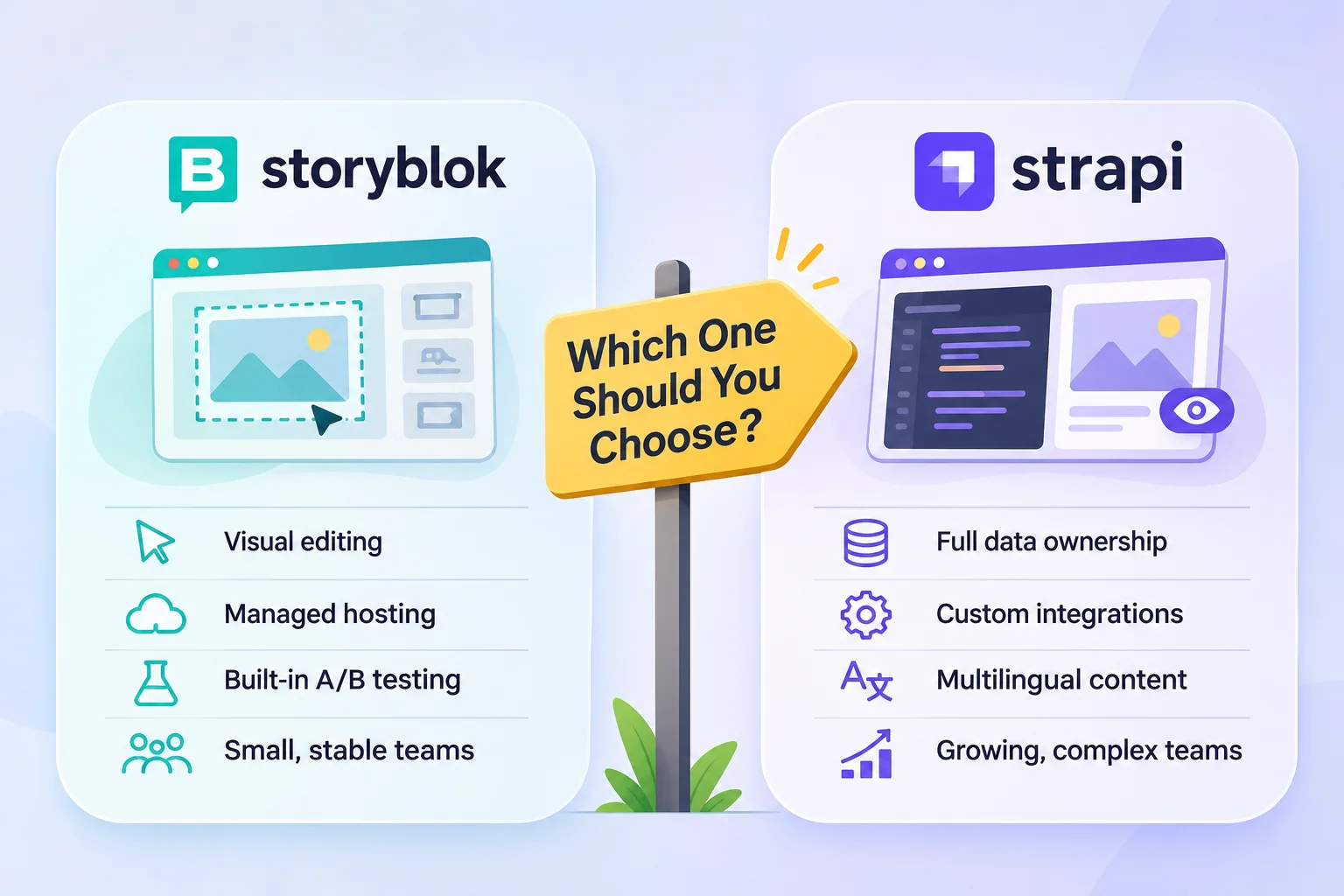
Count your editors today, then estimate how many you'll have in two years, and how many languages you'll publish in. Run those numbers through both pricing models. For most growing teams, that one exercise settles the Storyblok vs Strapi decision.
If Strapi fits, our Strapi CMS development services cover content modelling, page blocks, preview and training. Want a second opinion first? Talk to our team.