

Quick answer: Choose Directus if you already have a SQL database and want an admin panel, APIs and automation on top of it.
Choose Strapi if you're building a new content-driven website or app and want flexible page building, a large plugin ecosystem and an MIT open-source licence.
In 2026, v12, self-hosted Directus runs on a limited Core tier unless you add a licence key, so check the terms before you commit.
Two headless CMSs, both built on Node.js, both free to start. On paper, Directus and Strapi look almost interchangeable. In practice, they're built on opposite ideas, and picking the wrong one can mean months of workarounds.
The Directus vs Strapi question usually comes down to one thing: do you already have a database, or are you starting fresh? Everything else follows from that. In this guide, our team compares features, the 2026 licence changes, real costs, performance and switching, so you can choose with confidence.
How do Directus and Strapi Compare at a Glance?
Here's a quick Directus vs Strapi comparison of the points that matter most.
| Parameters | Directus | Strapi |
|---|---|---|
| Approach | Database first: wraps an existing SQL database | Content model first: creates and manages its own schema |
| Licence | Source-available (MSCL). From v12, a licence key unlocks more than the limited Core tier | MIT open source (Community edition) |
| Databases | Postgres, MySQL, MariaDB, MSSQL, SQLite, Oracle, CockroachDB | Postgres, MySQL, MariaDB, SQLite |
| Page building | Groups and many-to-any relations | Components and dynamic zones |
| Automation | Flows, a visual builder | Code-based lifecycle hooks and plugins |
| Dashboards | Insights, built in | Not built in |
| AI and MCP | AI assistant and native MCP server | Strapi AI and a native MCP server |
| Community | Smaller, active | Larger, with more plugins and tutorials |
What Changed for Directus and Strapi in 2026?
Both platforms changed in ways many comparisons haven't caught up with yet.
Directus v12:
- Self-hosted Directus without a licence key now runs on a limited Core tier: 3 seats, 25 collections, 5 Flows and no single sign-on (SSO)
- The free Open Innovation Grant unlocks the full product for organisations with under US$5 million in annual revenue and fewer than 50 employees. It covers self-hosting only, and Directus Cloud costs US$99 a month in hosting fees under the grant (Directus)
- Grant keys are renewed every year (Directus community)
- Native draft and publish arrived, along with a redesigned Studio
Strapi 5:
- A free, self-hosted Model Context Protocol (MCP) server became generally available in version 5.49, so AI agents can read and manage content (Strapi)
- The Growth plan now includes 1,000 Strapi AI credits a month (Strapi)
The old advice was that Directus is free for any company under US$5 million in revenue. That’s now incomplete. Under v12, an install without a key is capped at the Core tier, and the free grant that unlocks everything also requires fewer than 50 employees. If you're reading a Directus vs Strapi 2026 guide that doesn't mention this, it was probably written before the change.
What is Directus and How does it Work?
Directus is a data platform that sits on top of a SQL database. Point it at a database, and it reads the tables and creates an admin app and APIs for them, without changing your schema.
- REST and GraphQL APIs generated from your tables
- Flows for visual, event-driven automation
- Insights for dashboards beside your content
- Realtime updates through WebSockets and GraphQL subscriptions
- Data model changes made in the live app and stored in the database
This makes Directus a strong fit when the data already exists, such as a product database or an internal system that needs a friendly interface.
What is Strapi and How does it Work?
Strapi is an open-source headless CMS built on Node.js. You design your content types, and Strapi creates the database tables, the admin panel and the APIs.
- Components and dynamic zones for flexible, reusable page blocks
- REST and GraphQL APIs, with GraphQL added as a plugin
- A large plugin marketplace and custom plugins in JavaScript or TypeScript
- Content types defined in code, so changes are tracked in Git
- Draft and publish, roles and internationalisation in the free edition
Strapi suits new websites and apps where editors need to build pages from approved blocks. Our Strapi vs Contentful vs Sanity comparison covers how it stacks up against hosted options.
What are the Key Differences between Directus and Strapi?
The biggest difference in Directus vs Strapi features is who owns the database. After that, the differences show up in editing, automation, performance and community.
How do they Handle Data and Content Modelling?
Directus follows your database. That one difference shapes editing, APIs and migration.
In Strapi, content types are changed in development and deployed as code. The Content-Type Builder is turned off in production, so every change is reviewed and versioned. In Directus, you can change the data model in the live app, which is faster but needs more care in production.
Which is Easier for Editors and Marketers?
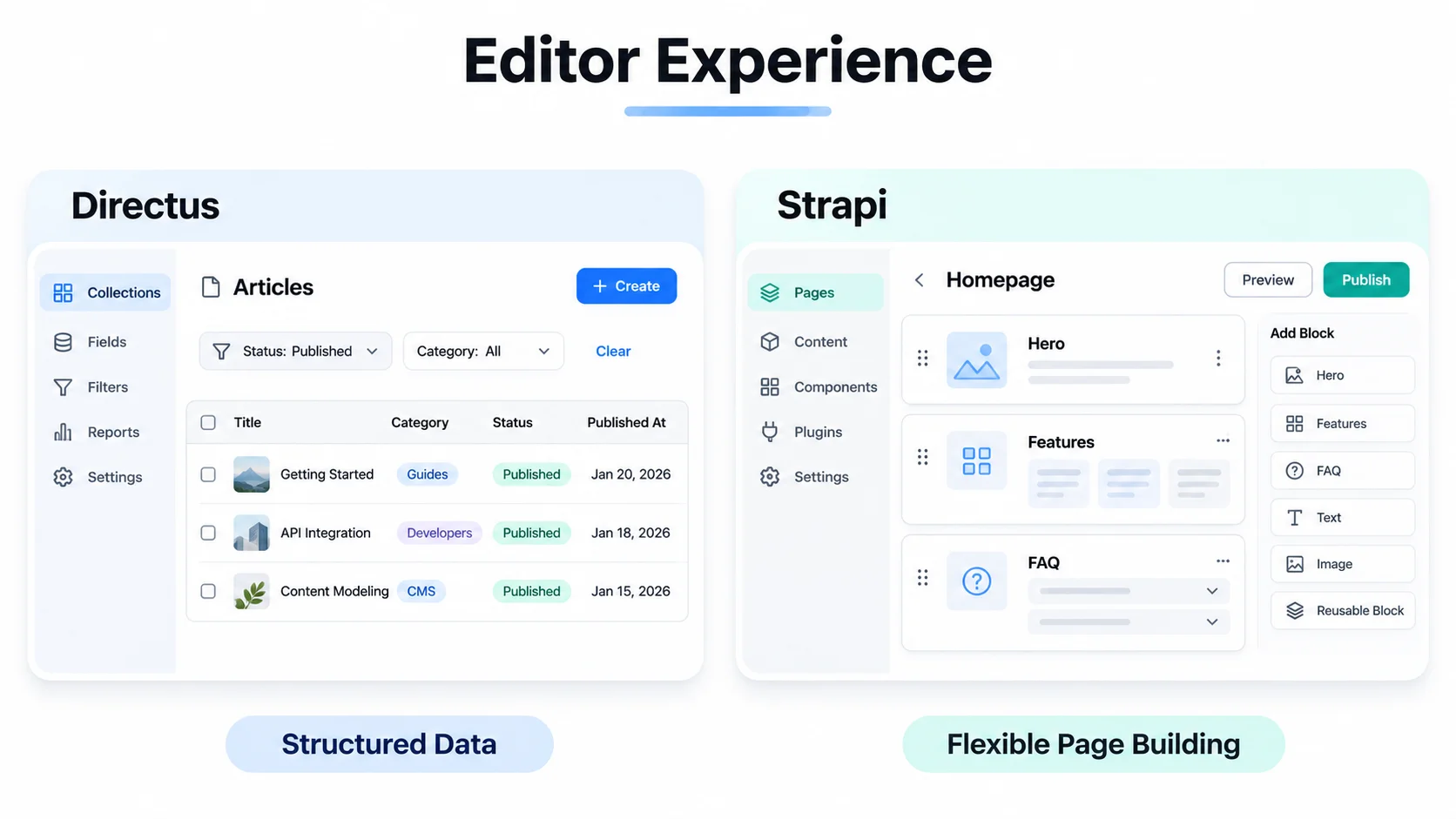
Strapi, for most marketing sites. Its dynamic zones let editors build pages from approved blocks, such as a hero, feature grid or FAQ, without a developer.
Directus is more flexible for data-heavy work. Teams that manage products, records or operations tend to prefer having dashboards and data in one place.
How do APIs, Automation and AI Compare?
Both offer REST and GraphQL. Directus generates GraphQL automatically, while Strapi adds it with a plugin.
For automation, Directus has Flows, a visual builder. Strapi uses lifecycle hooks and plugins written in code, which suits teams that want automation reviewed like any other code. Both now have native MCP servers for AI agents.
How do Performance and Scalability Compare?
There's no reliable, independent benchmark that settles Directus vs Strapi performance. Both run on Node.js, and in practice speed depends more on your database, caching, CDN and query design than on the CMS itself.
For Directus vs Strapi scalability, both can run several instances behind a load balancer. The practical difference is where complexity sits. Directus inherits the strengths and limits of your existing database. Strapi gives you a clean schema to start with, which is easier to tune for a new project.
"Most CMS speed problems aren't CMS problems. They're caching problems, image problems or a query nobody looked at. Fix those first, then compare platforms." Niket Shah, Founder, OpenSpace Services
How do Security and Permissions Compare?
Both use role-based access control. Directus offers detailed permissions down to fields and individual items. Strapi covers roles and permissions in its free edition. SSO is a Growth plan add-on or included in Enterprise, and audit logs and review workflows are Enterprise only.
How Big are the Community and Plugin Ecosystem?
Strapi's community is larger, with more plugins, tutorials and developers available to hire. Even Directus acknowledges this on its own comparison page (Directus). Directus has a smaller but active community and good documentation.
Which Costs Less in 2026: Directus or Strapi?
Both can be free to start, but the real cost depends on your team size, SSO needs and hosting. Here's how Directus vs Strapi pricing compares on published plans.
| Plan | Directus | Strapi |
|---|---|---|
| Free | Open Innovation Grant: under $5M revenue and fewer than 50 employees | Community edition: free for everyone, MIT licence |
| Entry paid plan | Cloud Core: $89 a month billed yearly, 3 seats | Growth: $45 a month, 3 seats, $15 per extra seat |
| SSO | Included in the Team plan | Growth add-on: $150 a month plus $50 per user, or included in Enterprise |
| Enterprise | Custom pricing | Custom pricing |
Sources: Directus pricing and Strapi pricing. Directus lists its Team plan price differently in two places on its pricing page, so confirm the current figure before you budget.
Don't forget the costs outside the licence: hosting, backups, monitoring and developer time. For many teams, developer time is the biggest line on the bill, which is where a large community and available developers start to matter.
Can You Switch from One to the Other?
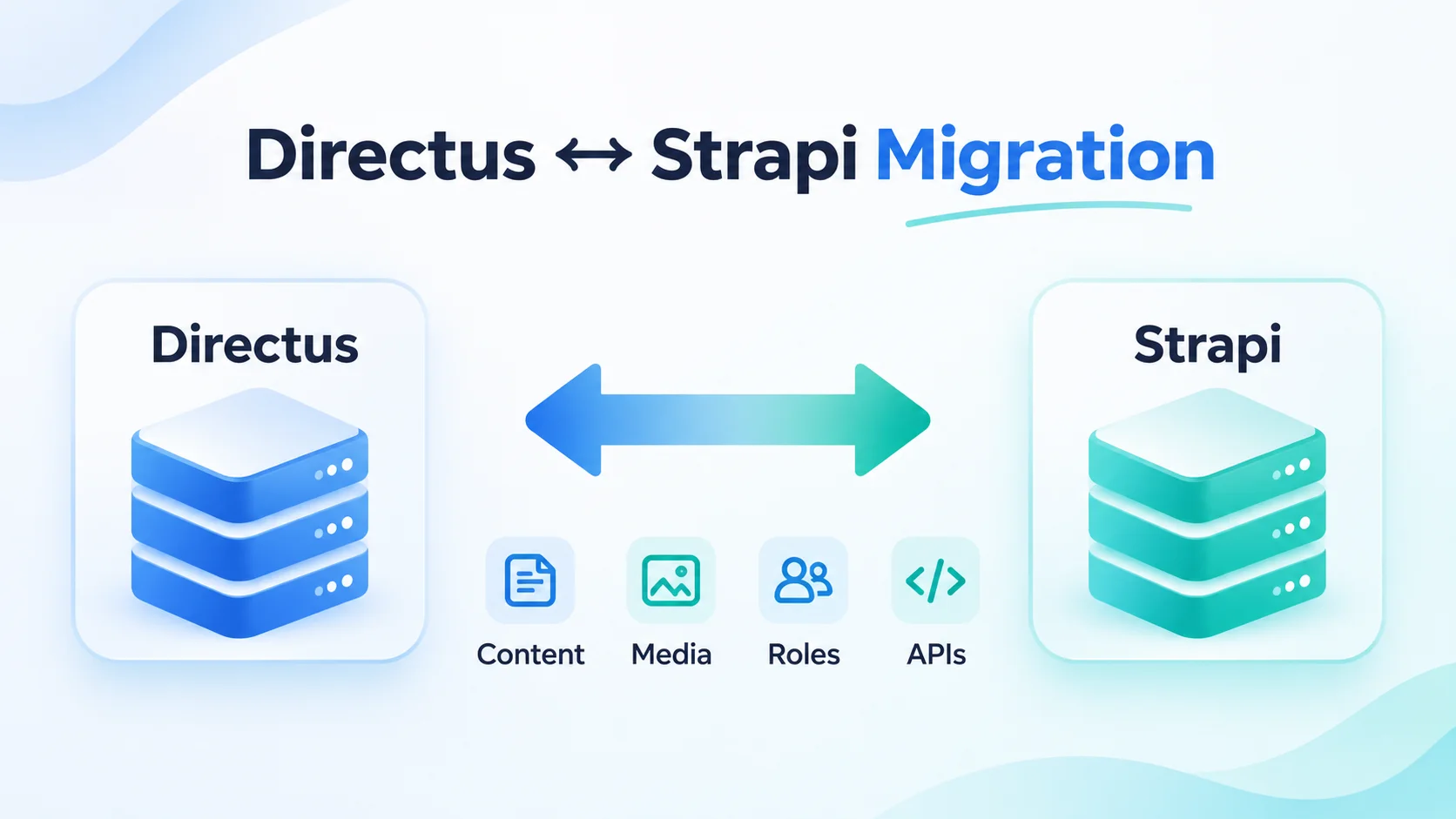
Yes, but plan it as a proper migration. The data moves fairly easily. The structure, permissions and front-end queries take more work.
- Content model: map Directus collections to Strapi content types, or the reverse
- Page blocks: Directus many-to-any relations map roughly to Strapi dynamic zones
- Media: move files and keep their links working
- Users and roles: recreate roles and permissions on the new platform
- Front end: update API calls, since endpoints and query formats differ
- Testing: run both side by side until the new setup is checked
One useful detail: Directus can connect to an existing SQL database. Some teams use that to give an admin interface to data that already sits in another system, without moving it at all.
Which Should You Choose: Directus or Strapi?
Pick the platform that matches your starting point and your team. This Strapi vs Directus headless CMS guide by scenario keeps it simple.
| Your situation | Better fit |
|---|---|
| You have an existing SQL database to expose | Directus |
| You're building a new marketing website | Strapi |
| You need internal tools and dashboards | Directus |
| Editors build pages from reusable blocks | Strapi |
| You want an OSI-approved open-source licence | Strapi |
| You're a small company under the grant limits | Either |
| You want the largest pool of plugins and developers | Strapi |
"Choose the CMS your team will still be happy with in year three, not just the one that demos best in week one." Niket Shah, Founder, OpenSpace Services
Directus or Strapi for your next project?
Start with one question: are you working with an existing database, or building new content from scratch? Write the answer down, along with who will edit content day to day. Those two answers settle most Directus vs Strapi decisions.
If Strapi fits, our Strapi CMS development services cover everything from content modelling to launch and support. Not sure yet? Talk to our team, and we'll tell you honestly which one suits your project.